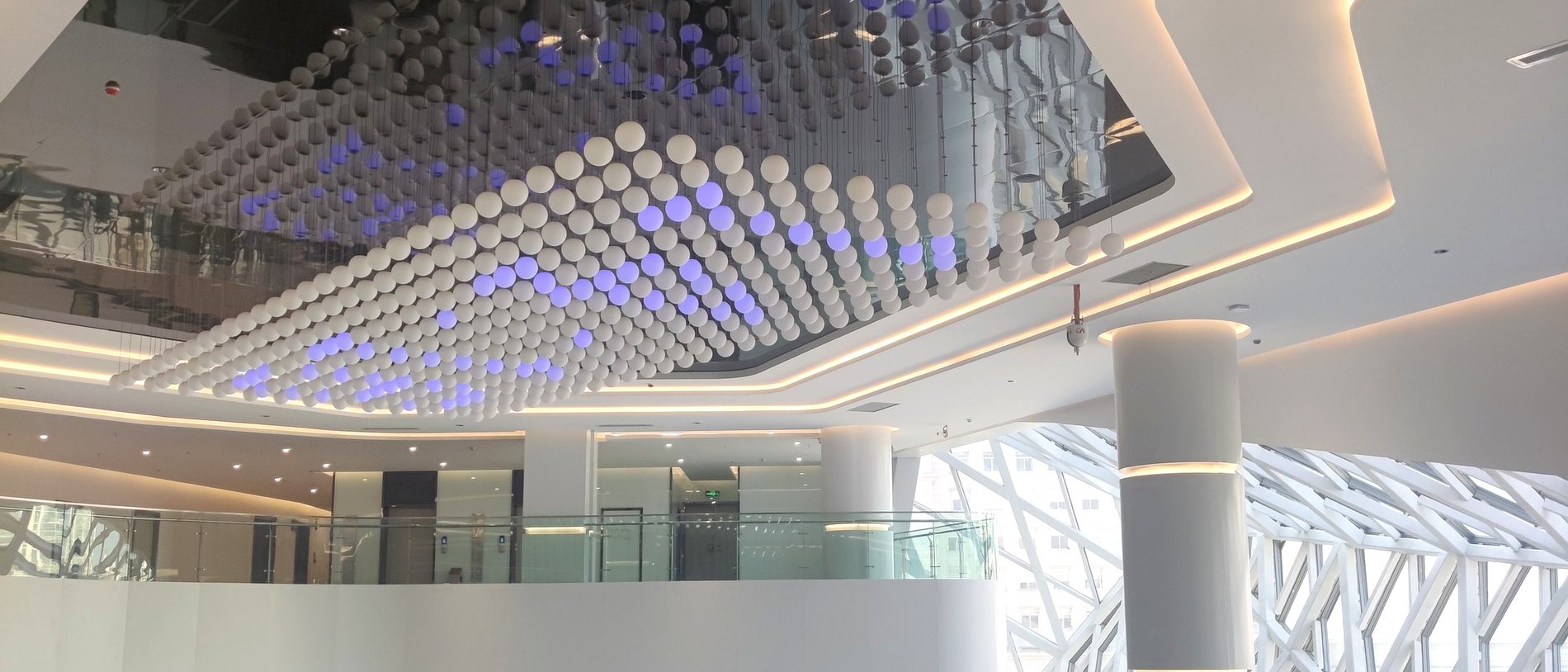
Kinetic ball matrix
Delivered installation
A frame, its cladding, its transparent parts and its control cabinet are made in the same building, by the same team, on the same schedule. Nothing sits in a queue at a third-party workshop.
Four capabilities cover almost every exhibit we build. Anything outside them — glass, castings, large-format print, specialist optics — is bought in from long-standing suppliers we have used for years, and inspected on arrival.
| 01 · Structure | Steel and aluminium frames, welded and powder-coated. Load paths designed for public use and for the exhibit's own weight. |
|---|---|
| 02 · Sheet metal | CNC cutting, bending and forming for panels, housings, brackets and mechanisms. |
| 03 · Acrylic | Cutting, edge-polishing, thermoforming and bonding for covers, tunnels, lenses and water channels. |
| 04 · Control | Cabinet assembly, wiring, PLC and microcontroller programming, sensor and drive integration. |
| Assembly | Mechanical and electrical assembly, then a full running test before crating. |
| Packing | Plywood cases, foam blocking, desiccant, packing list, loading plan. |
Four things we do on every unit, standard or custom. They are the reason a museum can run an exhibit for eight hours a day for years.
Handles, bearings, sensors and printed panels are replaceable modules with a part number on the drawing.
Full power-up and a test cycle, then a fault log that travels with the machine.
Panels open with one tool. Control cabinets are reachable without dismantling the exhibit.
Consumables and one of each critical module, so a small museum can fix a fault without waiting for a shipment.
We are certified to export and can provide test reports and material certificates on request. We do not publish certifications we do not hold; where a project requires a specific standard, tell us before quotation and we will confirm whether we can meet it.
Attach a theme outline, a floor plan, or nothing at all — a photo of the space is enough to start. Quotations are issued against real drawings, not per-square-metre guesses.