Home/Exhibits/Earth & Ecology/Volcanic eruption

Volcanic eruption

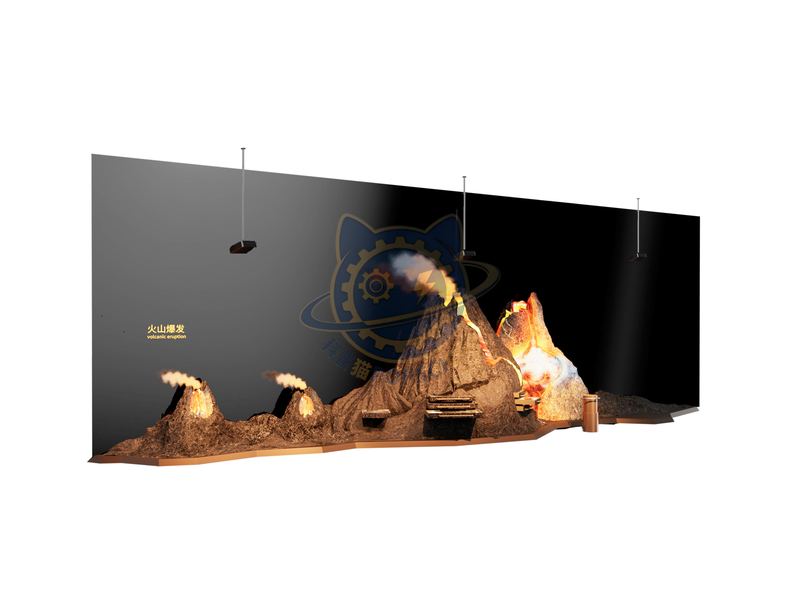
Volcanic eruption is a natural phenomenon on Earth caused by the relative movement of internal plates.

Volcanic eruption — Earth & Ecology exhibit for science museums
Studio rendering
CategoryEarth & Ecology
Standard sizeCustom size
SupplySingle unit or batch · OEM to your drawing
Lead timeStandard 4–8 weeks after deposit (confirmed per contract)
Warranty1 year, structure and control
DocumentsSpecification sheet · control diagram · spare-part list

A standard catalogue model: the dimensions, control package and finish are fixed, which is what keeps the price and the lead time predictable. Size, colour and interface language can be adapted without a new design cycle.

Ask about this model → Email us
01 / Overview

Volcanic eruption is a natural phenomenon on Earth caused by the relative movement of internal plates. The hot magma inside the Earth is active. When the earth's crust undergoes drastic changes, magma may invade rock layers and violently erupt from the ground. The places with more volcanoes on Earth are located in the contact zone of tectonic plates. In the early stages of Earth's formation, volcanic eruptions were ubiquitous.

02 / How visitors use it

The unit is designed for unsupervised public use: controls are recessed or shielded, moving parts are enclosed, and the interface is operable by a child of about six with no instruction. Where a screen is used, the language can be switched without changing the hardware, and the content can be replaced on site.

03 / The science behind it

Geologists typically classify volcanoes into three types: volcanic ash cones, shield volcanoes, and composite volcanoes. 1. Volcanic debris cone: Volcanic debris and volcanic bombs are ejected from the volcano, and fine particles of volcanic ash drift downwind. Sometimes lava also flows out from the bottom of the volcanic ash cone. Loose fire killing slag cones generally have an angle of 30-35 degrees. This type of volcano has a relatively small volume and a height of less than 600m. Most volcanic ash cones only erupt once. 2. Shield volcano: Volcanoes that erupt repeatedly form widely distributed lava flows, which are usually composed of basalt. Basalt flows out from the volcano crater, forming thin sheets. The slopes of shield volcanoes are very gentle, generally as low as 15 degrees, and the height of the volcano ranges from 300 to 1000 meters. 3. Composite volcano: formed by the alternating eruption of many lava flows and volcanic debris. Unlike lava from shield volcanoes, this type of lava is usually not easy to flow and has a shorter distance from the crater. Volcanic debris and.
04 / Built for a public floor

Every unit leaves the factory after a running test: mechanisms cycled, electronics burned in, edges dressed, fixings torqued and marked. Wear parts — bearings, sliders, lamps, belts, touch panels — are modular and listed on the spare-part sheet, so a venue technician can replace them without returning the exhibit. Crating is plywood with foam blocking; the loading plan and packing list travel with the shipment.

Same category

More in Earth & Ecology

Other models from the Earth & Ecology line, all held to the same specification and the same control package.

Start a project

Send us your exhibit list.
We will come back with a price.

Attach a theme outline, a floor plan, or nothing at all — a photo of the space is enough to start. Quotations are issued against a real exhibit list, not per-square-metre guesses.

WeChat QR code — scan to message us Scan to add us
on WeChat