Home/Exhibits/Technology & Everyday Life/Thermal insulation performance of windows

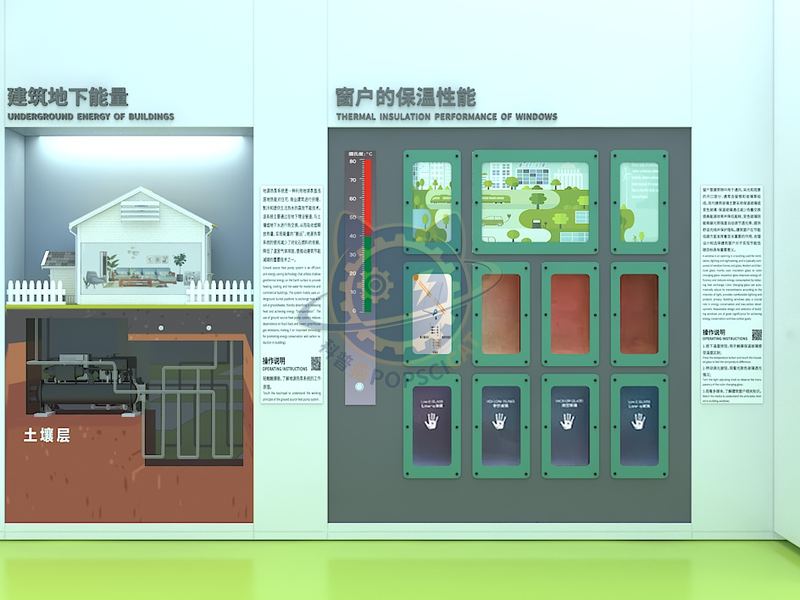
Thermal insulation performance of windows

A window is an opening in a building used for ventilation, lighting, and viewing, typically composed of window…

Thermal insulation performance of windows — Technology & Everyday Life exhibit for science museums
Reference image
CategoryTechnology & Everyday Life
Standard sizeCustom size
SupplySingle unit or batch · OEM to your drawing
Lead timeStandard 4–8 weeks after deposit (confirmed per contract)
Warranty1 year, structure and control
DocumentsSpecification sheet · control diagram · spare-part list

A standard catalogue model: the dimensions, control package and finish are fixed, which is what keeps the price and the lead time predictable. Size, colour and interface language can be adapted without a new design cycle.
Ask about this model → Email us
01 / Overview

A window is an opening in a building used for ventilation, lighting, and viewing, typically composed of window frames and glass. Modern architectural glass mainly uses insulated glass or color changing glass: insulated glass improves energy efficiency and reduces energy consumption by reducing heat exchange; Color changing glass can automatically adjust its transmittance according to the intensity of light, providing comfortable lighting and protecting privacy. Building windows play a crucial role in energy conservation and low-carbon development. Reasonable design and selection of building windows are of great significance for achieving energy-saving and low-carbon goals.

02 / How visitors use it

The unit is designed for unsupervised public use: controls are recessed or shielded, moving parts are enclosed, and the interface is operable by a child of about six with no instruction. Where a screen is used, the language can be switched without changing the hardware, and the content can be replaced on site.

03 / The science behind it

(1) Double layered skin curtain wall glass: Using the principles of air pressure difference, thermal pressure difference, and chimney effect, a relatively enclosed space is formed between the inner and outer curtain walls. It has an air inlet at the bottom and an air outlet at the top, which can control the flow of air between them. (Heat transfer coefficient KW/(m2 · K) < 1.0) (2) Low-e glass: It is a film product composed of multiple layers of metal or other compounds coated on the surface of glass. Its coating layer has the characteristics of high visible light transmission and high reflection of mid to far infrared rays, making it superior in thermal insulation and good transparency compared to ordinary glass and traditional architectural coated glass. (Heat transfer coefficient KW/(m2 · K)=1.64) (3) Hollow glass: There is a desiccant inside that can adsorb water molecules. The gas is dry, and when the temperature drops, condensation does not occur inside the hollow glass. (Heat transfer coefficient KW/(m2 · K).

04 / Built for a public floor

Every unit leaves the factory after a running test: mechanisms cycled, electronics burned in, edges dressed, fixings torqued and marked. Wear parts — bearings, sliders, lamps, belts, touch panels — are modular and listed on the spare-part sheet, so a venue technician can replace them without returning the exhibit. Crating is plywood with foam blocking; the loading plan and packing list travel with the shipment.

Same category

More in Technology & Everyday Life

Other models from the Technology & Everyday Life line, all held to the same specification and the same control package.

Start a project

Send us your exhibit list.
We will come back with a price.

Attach a theme outline, a floor plan, or nothing at all — a photo of the space is enough to start. Quotations are issued against a real exhibit list, not per-square-metre guesses.

WeChat QR code — scan to message us Scan to add us
on WeChat