Home/Exhibits/Life Science & Health/Exoskeletons and prosthetics

Exoskeletons and prosthetics

Exoskeleton robots are complex intelligent systems that integrate mechanical, electronic, computer, artificial…

Exoskeletons and prosthetics — Life Science & Health exhibit for science museums
Studio rendering
CategoryLife Science & Health
Standard sizeCustom size
SupplySingle unit or batch · OEM to your drawing
Lead timeStandard 4–8 weeks after deposit (confirmed per contract)
Warranty1 year, structure and control
DocumentsSpecification sheet · control diagram · spare-part list

A standard catalogue model: the dimensions, control package and finish are fixed, which is what keeps the price and the lead time predictable. Size, colour and interface language can be adapted without a new design cycle.

Ask about this model → Email us
01 / Overview

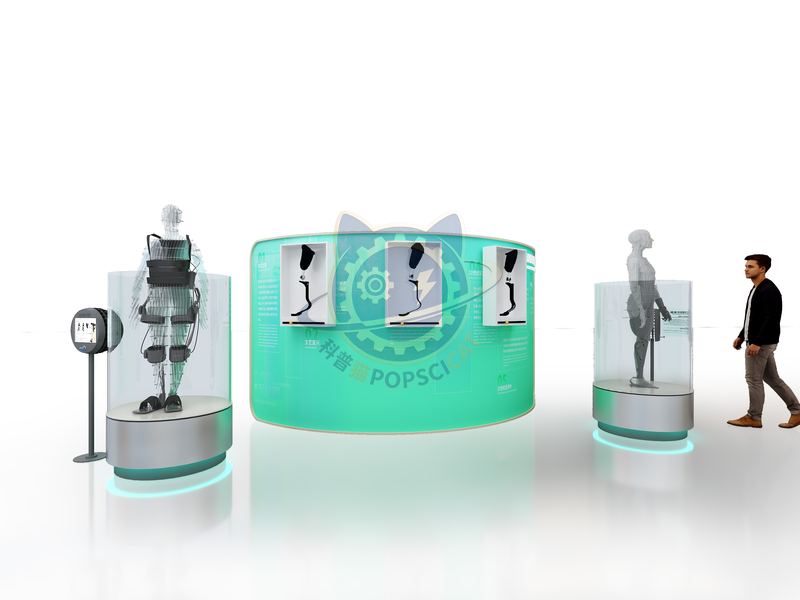
Exoskeleton robots are complex intelligent systems that integrate mechanical, electronic, computer, artificial intelligence, and other technologies. People wear specially designed "bones" on their bodies, and sensors installed at knee and hip joints can read human motion intentions and send commands to the driving system to drive leg movements, thereby achieving walking. A prosthetic is an artificial device used to replace a missing limb part. They can be upper limb prostheses (including fingers, palms, wrists, and forearms) or lower limb prostheses (including feet, ankles, calves, and thighs). Artificial limbs are designed to help patients recover lost functions and provide a natural appearance to assist individuals in reintegrating into daily life. Wooden prostheses are easy to carve and shape, making it convenient to produce prosthetic components that conform to human anatomy. Wood itself is relatively light, but in order to increase strength, additional structures need to be added, resulting in an overall increase in the weight of the prosthetic. Carbon fiber prostheses mainly consist of a carbon fiber receiving cavity, a carbon fiber energy storage footplate, and a back.
02 / How visitors use it

The unit is designed for unsupervised public use: controls are recessed or shielded, moving parts are enclosed, and the interface is operable by a child of about six with no instruction. Where a screen is used, the language can be switched without changing the hardware, and the content can be replaced on site.

03 / The science behind it

A prosthetic is a device used outside the body to replace all or part of a missing part of the human body. Used to compensate for the partial function of missing limbs, enabling amputees to restore or rebuild certain self-care, work, and social abilities. Mechanical exoskeleton equipment is a special armor made of steel frame that can be worn on the human body and provide certain assistance to humans, also known as power exoskeleton.

04 / Built for a public floor

Every unit leaves the factory after a running test: mechanisms cycled, electronics burned in, edges dressed, fixings torqued and marked. Wear parts — bearings, sliders, lamps, belts, touch panels — are modular and listed on the spare-part sheet, so a venue technician can replace them without returning the exhibit. Crating is plywood with foam blocking; the loading plan and packing list travel with the shipment.

Same category

More in Life Science & Health

Other models from the Life Science & Health line, all held to the same specification and the same control package.

Start a project

Send us your exhibit list.
We will come back with a price.

Attach a theme outline, a floor plan, or nothing at all — a photo of the space is enough to start. Quotations are issued against a real exhibit list, not per-square-metre guesses.

WeChat QR code — scan to message us Scan to add us
on WeChat