The discovery of the double helix structure of DNA was the result of the efforts of many outstanding scientists,…
| Category | Life Science & Health |
|---|---|
| Standard size | Custom size |
| Supply | Single unit or batch · OEM to your drawing |
| Lead time | Standard 4–8 weeks after deposit (confirmed per contract) |
| Warranty | 1 year, structure and control |
| Documents | Specification sheet · control diagram · spare-part list |
A standard catalogue model: the dimensions, control package and finish are fixed, which is what keeps the price and the lead time predictable. Size, colour and interface language can be adapted without a new design cycle.

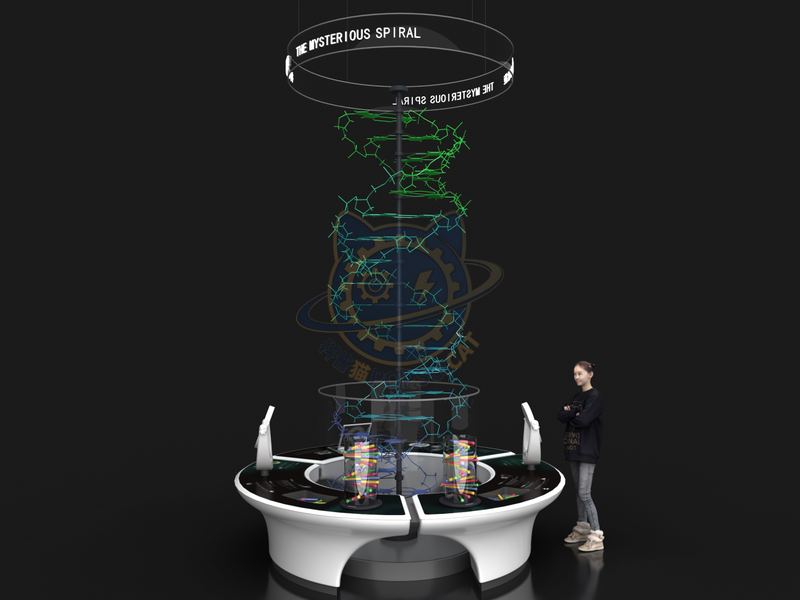
The discovery of the double helix structure of DNA was the result of the efforts of many outstanding scientists, with the most prominent being Rosalind Franklin's successful use of X-ray diffraction technology to capture images of DNA crystals. Through this image, Watson and Crick discovered the structure of the double helix. This discovery laid the foundation for the development of modern molecular biology and genetics, and became one of the greatest scientific achievements in the field of biology in the 20th century. The principle of complementary base pairing in DNA refers to the hydrogen bonding between bases A and T, G and C in the DNA molecule. James Watson and Francis Crick established this principle when constructing the DNA double helix structure model.
The unit is designed for unsupervised public use: controls are recessed or shielded, moving parts are enclosed, and the interface is operable by a child of about six with no instruction. Where a screen is used, the language can be switched without changing the hardware, and the content can be replaced on site.
In 1953, British and American molecular biologists Francis Crick and James Watson achieved one of the most profound scientific victories of the century. Using their understanding of chemical bonds and the first crystal diffraction image of DNA obtained by British chemist Rosalind Franklin using X-ray crystallography, "Photo 51," they studied the double helix structure of DNA (deoxyribonucleic acid), which is the blueprint for all living organisms.
Every unit leaves the factory after a running test: mechanisms cycled, electronics burned in, edges dressed, fixings torqued and marked. Wear parts — bearings, sliders, lamps, belts, touch panels — are modular and listed on the spare-part sheet, so a venue technician can replace them without returning the exhibit. Crating is plywood with foam blocking; the loading plan and packing list travel with the shipment.
Other models from the Life Science & Health line, all held to the same specification and the same control package.

Sound reaches two ears at different times; visitors point to the source.

An adjustable lens projects a real image onto a retina screen.

Projected anatomy on a body-sized screen layer by layer.

Contract a model biceps and watch the tendon pull the forearm.
Attach a theme outline, a floor plan, or nothing at all — a photo of the space is enough to start. Quotations are issued against a real exhibit list, not per-square-metre guesses.
Scan to add us