Home/Exhibits/Aerospace & Astronomy/Satellite experiment on cosmic microwave background radiation

Satellite experiment on cosmic microwave background radiation

In the early stages of the Big Bang, the universe was in a state of extremely high temperature and density, filled…

Satellite experiment on cosmic microwave background radiation — Aerospace & Astronomy exhibit for science museums
Reference image
CategoryAerospace & Astronomy
Standard sizeCustom size
SupplySingle unit or batch · OEM to your drawing
Lead timeStandard 4–8 weeks after deposit (confirmed per contract)
Warranty1 year, structure and control
DocumentsSpecification sheet · control diagram · spare-part list

A standard catalogue model: the dimensions, control package and finish are fixed, which is what keeps the price and the lead time predictable. Size, colour and interface language can be adapted without a new design cycle.

Ask about this model → Email us
01 / Overview

In the early stages of the Big Bang, the universe was in a state of extremely high temperature and density, filled with thermal radiation and elementary particles. As the universe continued to expand and cool, around 380000 years after the Big Bang, the temperature dropped low enough for electrons and protons to combine to form neutral hydrogen atoms. At this point, photons no longer frequently interact with charged particles and can freely propagate in the universe, forming the cosmic microwave background radiation. The cosmic microwave background radiation is a key evidence for the Big Bang theory. The uniformity of its temperature and the anisotropy of its radiation provide important information for studying the early structure formation, material distribution, and evolution of the universe.

02 / How visitors use it

The unit is designed for unsupervised public use: controls are recessed or shielded, moving parts are enclosed, and the interface is operable by a child of about six with no instruction. Where a screen is used, the language can be switched without changing the hardware, and the content can be replaced on site.

03 / The science behind it

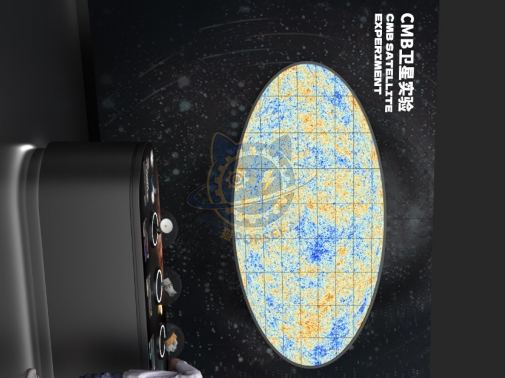
The cosmic microwave background radiation refers to a type of radiation emitted from the early universe in the radio frequency band, mainly reflecting the state of the universe's "infancy". It presents temperature fluctuations in different colors, with an average of around 2.725K, and the depth of the color represents the temperature. The cosmic microwave background radiation is the oldest light in the universe, providing important information about the early history of the universe. By studying the intensity and distribution of cosmic microwave background radiation, scientists can understand the structure, composition, and evolutionary history of the universe. Exploring the cosmic microwave background radiation has always been an important astronomical task. Currently, a total of three satellites have obtained detailed images of cosmic microwave background radiation, namely the Cosmic Background Explorer (COBE) in 1992, the Wilkinson Microwave Anisotropy Probe (WMAP) in 2003, and the Planck Survey in 2013. With the development of time and technology.
04 / Built for a public floor

Every unit leaves the factory after a running test: mechanisms cycled, electronics burned in, edges dressed, fixings torqued and marked. Wear parts — bearings, sliders, lamps, belts, touch panels — are modular and listed on the spare-part sheet, so a venue technician can replace them without returning the exhibit. Crating is plywood with foam blocking; the loading plan and packing list travel with the shipment.

Same category

More in Aerospace & Astronomy

Other models from the Aerospace & Astronomy line, all held to the same specification and the same control package.

Start a project

Send us your exhibit list.
We will come back with a price.

Attach a theme outline, a floor plan, or nothing at all — a photo of the space is enough to start. Quotations are issued against a real exhibit list, not per-square-metre guesses.

WeChat QR code — scan to message us Scan to add us
on WeChat