Cool down the city

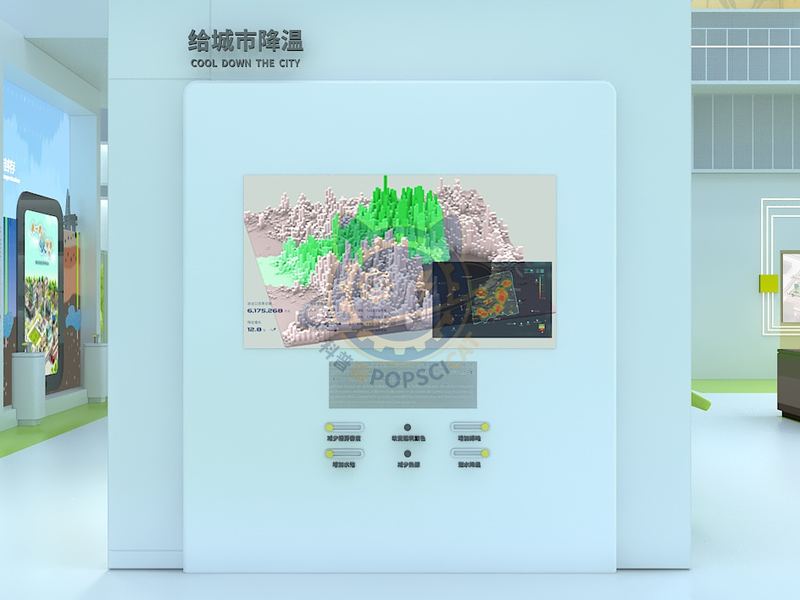
The heat island effect refers to the phenomenon where the temperature in an area is higher than in the surrounding…

Cool down the city — Technology & Everyday Life exhibit for science museums
Reference image
CategoryTechnology & Everyday Life
Standard sizeCustom size
SupplySingle unit or batch · OEM to your drawing
Lead timeStandard 4–8 weeks after deposit (confirmed per contract)
Warranty1 year, structure and control
DocumentsSpecification sheet · control diagram · spare-part list

A standard catalogue model: the dimensions, control package and finish are fixed, which is what keeps the price and the lead time predictable. Size, colour and interface language can be adapted without a new design cycle.

Ask about this model → Email us

Standard models from this range are also listed in our online store, priced in USD — see the price yourself ↗
01 / Overview

The heat island effect refers to the phenomenon where the temperature in an area is higher than in the surrounding areas due to factors such as dense buildings and lack of vegetation coverage. The heat island effect can lead to increased energy consumption, decreased air quality, and damage to residents' health. To reduce the heat island effect, we can increase the urban green area, improve the thermal insulation performance of buildings, and adopt renewable energy.

02 / How visitors use it

The unit is designed for unsupervised public use: controls are recessed or shielded, moving parts are enclosed, and the interface is operable by a child of about six with no instruction. Where a screen is used, the language can be switched without changing the hardware, and the content can be replaced on site.

03 / The science behind it

Community is the basic unit of a city and the main place for people's daily lives. However, due to its dense population, dense buildings, and scarce green spaces, it often becomes one of the most significant areas of urban heat island effect. The buildings in the community, a large amount of artificial ground (such as asphalt pavement and concrete sidewalks), and open spaces lacking vegetation cover can all lead to the accumulation of heat and an increase in temperature, resulting in a decrease in the livability and biodiversity of the community environment. Therefore, how to improve the ecological quality of communities and enhance their resilience to adapt to extreme climate change is one of the key issues in the construction of resilient cities. By changing the building materials and layout within the community, the impact of the heat island effect on the community environment can be effectively reduced. For example, using light colored or high reflectivity building materials can reflect more sunlight back into the atmosphere, thereby reducing the rise in surface temperature; The use of dark materials will absorb a large amount of light energy, causing the surface temperature of the building to rise rapidly.

04 / Built for a public floor

Every unit leaves the factory after a running test: mechanisms cycled, electronics burned in, edges dressed, fixings torqued and marked. Wear parts — bearings, sliders, lamps, belts, touch panels — are modular and listed on the spare-part sheet, so a venue technician can replace them without returning the exhibit. Crating is plywood with foam blocking; the loading plan and packing list travel with the shipment.

Same category

More in Technology & Everyday Life

Other models from the Technology & Everyday Life line, all held to the same specification and the same control package.

Start a project

Send us your exhibit list.
We will come back with a price.

Attach a theme outline, a floor plan, or nothing at all — a photo of the space is enough to start. Quotations are issued against a real exhibit list, not per-square-metre guesses.

WeChat QR code — scan to message us Scan to add us
on WeChat