Home/Exhibits/Technology & Everyday Life/Garbage disposal - incineration and flue gas treatment

Garbage disposal - incineration and flue gas treatment

Garbage incineration is the process of burning garbage at high temperatures, converting it into ash and smoke.

Garbage disposal - incineration and flue gas treatment — Technology & Everyday Life exhibit for science museums
Reference image
CategoryTechnology & Everyday Life
Standard sizeCustom size
SupplySingle unit or batch · OEM to your drawing
Lead timeStandard 4–8 weeks after deposit (confirmed per contract)
Warranty1 year, structure and control
DocumentsSpecification sheet · control diagram · spare-part list

A standard catalogue model: the dimensions, control package and finish are fixed, which is what keeps the price and the lead time predictable. Size, colour and interface language can be adapted without a new design cycle.

Ask about this model → Email us

Standard models from this range are also listed in our online store, priced in USD — see the price yourself ↗
01 / Overview

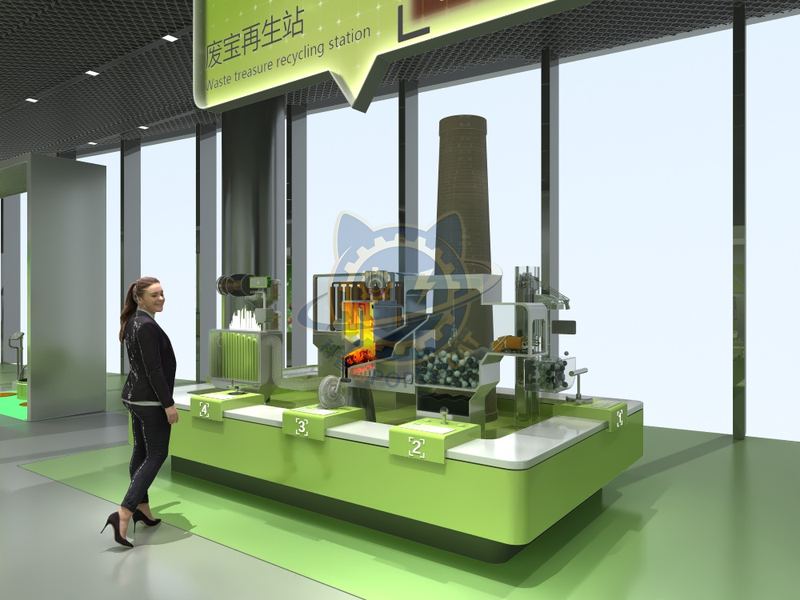
Garbage incineration is the process of burning garbage at high temperatures, converting it into ash and smoke. Due to the production of harmful gases and particulate matter such as sulfur dioxide and nitrogen oxides during the combustion process, it is necessary to treat the flue gas through physical or chemical methods (such as denitrification) to reduce pollutant emissions. Garbage incineration is widely used in the field of garbage treatment, effectively solving the problem of garbage siege.

02 / How visitors use it

The unit is designed for unsupervised public use: controls are recessed or shielded, moving parts are enclosed, and the interface is operable by a child of about six with no instruction. Where a screen is used, the language can be switched without changing the hardware, and the content can be replaced on site.

03 / The science behind it

The materials in the garbage hopper are sent to the incinerator by the furnace pushing device. Due to the staggered movement between the grate, the garbage is pushed downwards and passes through the drying section, combustion section, and burnout section of the grate in the furnace, allowing the garbage to be fully burned. At the same time, the flue gas generated in the incinerator can fully decompose the dioxins in the flue gas. The air required for the combustion of garbage in the furnace is divided into primary air and secondary air supply. The primary air is directly extracted from the garbage storage pit by the primary fan to maintain negative pressure in the garbage storage pit and unloading hall. After preheating, the primary air is introduced into the incinerator from the bottom of the furnace for combustion and decomposition, while the odorous gas carried in the primary air is burned and decomposed. The secondary air is introduced from the upper part of the furnace for combustion assistance. SNCR technology is used for preliminary denitrification in the combustion furnace. SNCR denitrification technology, also known as selective non catalytic reduction technology, is a type of technology that uses no catalyst to dissolve amino containing reducing agents (such as ammonia water and urea) in the temperature range of 850-1100 ℃.

04 / Built for a public floor

Every unit leaves the factory after a running test: mechanisms cycled, electronics burned in, edges dressed, fixings torqued and marked. Wear parts — bearings, sliders, lamps, belts, touch panels — are modular and listed on the spare-part sheet, so a venue technician can replace them without returning the exhibit. Crating is plywood with foam blocking; the loading plan and packing list travel with the shipment.

Same category

More in Technology & Everyday Life

Other models from the Technology & Everyday Life line, all held to the same specification and the same control package.

Start a project

Send us your exhibit list.
We will come back with a price.

Attach a theme outline, a floor plan, or nothing at all — a photo of the space is enough to start. Quotations are issued against a real exhibit list, not per-square-metre guesses.

WeChat QR code — scan to message us Scan to add us
on WeChat