Home/Exhibits/Frontier Technology/20 million year 1-second error - atomic clock

20 million year 1-second error - atomic clock

Cesium atomic clock: Based on the principle of electronic energy level transitions of cesium atoms, cesium atomic…

20 million year 1-second error - atomic clock — Frontier Technology exhibit for science museums
Reference image
CategoryFrontier Technology
Standard sizeCustom size
SupplySingle unit or batch · OEM to your drawing
Lead timeStandard 4–8 weeks after deposit (confirmed per contract)
Warranty1 year, structure and control
DocumentsSpecification sheet · control diagram · spare-part list

A standard catalogue model: the dimensions, control package and finish are fixed, which is what keeps the price and the lead time predictable. Size, colour and interface language can be adapted without a new design cycle.

Ask about this model → Email us
01 / Overview

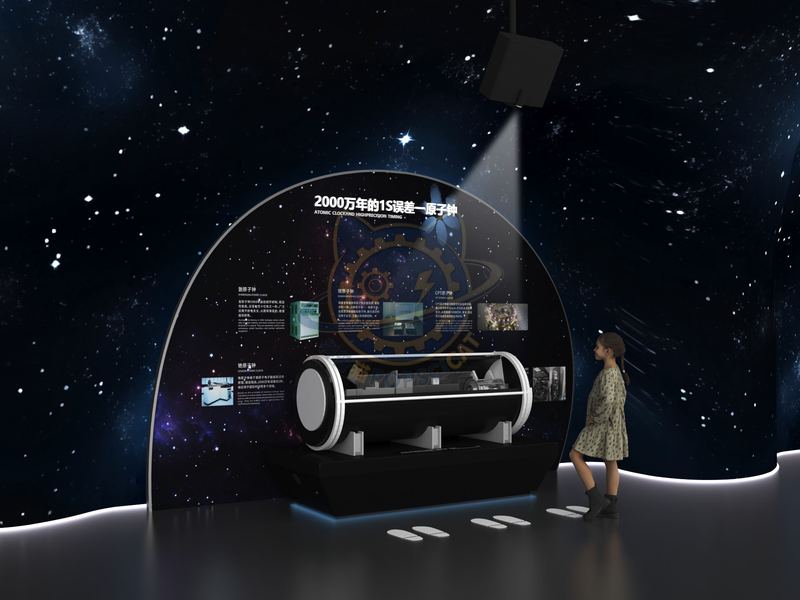
Cesium atomic clock: Based on the principle of electronic energy level transitions of cesium atoms, cesium atomic clock has extremely high accuracy, with an error of only 1 second per 20 million years, and has been applied in many fields such as international time. Hydrogen atomic clock: Developed by Ramsey in 1960, the hydrogen atomic clock has extremely high stability with a daily variation of only one billionth of a second. It is widely used in radio astronomy, rocket missile launch, nuclear submarine navigation, and more. Rubidium atomic clock: Rubidium atomic clock is the simplest and most compact among all atomic clocks. Three types of atomic clocks - cesium atomic clock, hydrogen maser, and rubidium atomic clock - have been successfully applied in space, satellite, and ground control. CPT atomic clock: CPT atomic clock is a new type of miniaturized atomic clock, with the smallest being the size of a watch. It has great application prospects in military and civilian applications such as remote communication system timing and large-scale communication network synchronization. Cold atomic clock: A cold atomic clock that cools atoms to near absolute zero and captures the pulsation of time with quantum accuracy. in.
02 / How visitors use it

The unit is designed for unsupervised public use: controls are recessed or shielded, moving parts are enclosed, and the interface is operable by a child of about six with no instruction. Where a screen is used, the language can be switched without changing the hardware, and the content can be replaced on site.

03 / The science behind it

The origin of atomic clocks: Scientists are constantly searching for more stable timing materials. Through experiments, it has been found that the operating period of electrons in certain atoms is very stable, making it particularly suitable as a standard for timing. Atoms absorb or release electromagnetic energy based on the energy difference between different electron layers surrounding the atomic nucleus. When an atom transitions from an "energy state" to a lower "energy state", it releases electromagnetic waves, which is known as the resonance frequency. The resonance frequency of the same atom is constant. Cesium atomic clock: It uses the electromagnetic waves emitted by the electrons inside cesium atoms when they jump between two energy levels as a standard to control and calibrate the electronic oscillator, thereby controlling the movement of the clock.

04 / Built for a public floor

Every unit leaves the factory after a running test: mechanisms cycled, electronics burned in, edges dressed, fixings torqued and marked. Wear parts — bearings, sliders, lamps, belts, touch panels — are modular and listed on the spare-part sheet, so a venue technician can replace them without returning the exhibit. Crating is plywood with foam blocking; the loading plan and packing list travel with the shipment.

Same category

More in Frontier Technology

Other models from the Frontier Technology line, all held to the same specification and the same control package.

Start a project

Send us your exhibit list.
We will come back with a price.

Attach a theme outline, a floor plan, or nothing at all — a photo of the space is enough to start. Quotations are issued against a real exhibit list, not per-square-metre guesses.

WeChat QR code — scan to message us Scan to add us
on WeChat