Home/Exhibits/Aerospace & Astronomy/Chang'e and Jade Rabbit set on the moon

Chang'e and Jade Rabbit set on the moon

Chang'e-3 is the second stage of China's three-step lunar exploration strategy of "orbiting, landing, and…

Chang'e and Jade Rabbit set on the moon — Aerospace & Astronomy exhibit for science museums
Reference image
CategoryAerospace & Astronomy
Standard sizeCustom size
SupplySingle unit or batch · OEM to your drawing
Lead timeStandard 4–8 weeks after deposit (confirmed per contract)
Warranty1 year, structure and control
DocumentsSpecification sheet · control diagram · spare-part list

A standard catalogue model: the dimensions, control package and finish are fixed, which is what keeps the price and the lead time predictable. Size, colour and interface language can be adapted without a new design cycle.

Ask about this model → Email us

Standard models from this range are also listed in our online store, priced in USD — see the price yourself ↗
01 / Overview

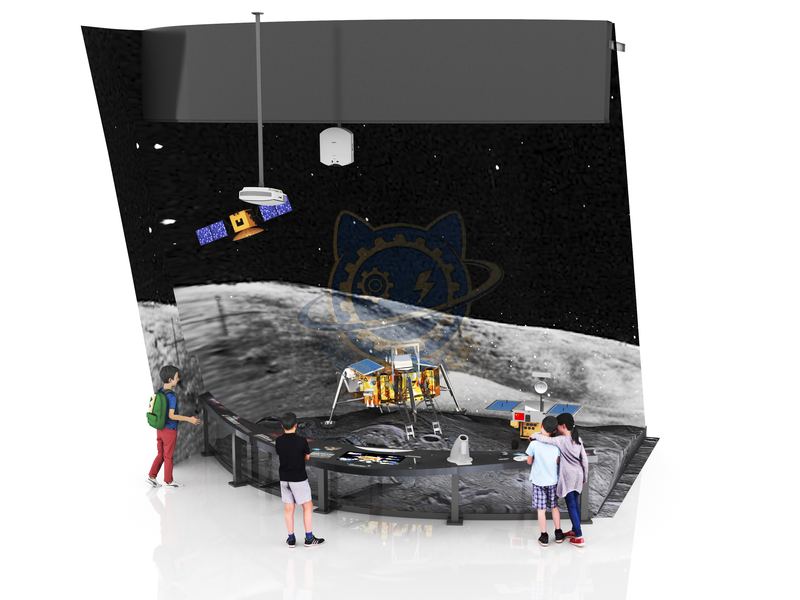
Chang'e-3 is the second stage of China's three-step lunar exploration strategy of "orbiting, landing, and returning", achieving China's first direct landing on the moon. As the leading mission of the fourth phase of the lunar exploration project, Chang'e-4 opened the curtain of the fourth phase of the lunar exploration project and achieved the world's first landing on the far side of the moon. The scientific payload on the Chang'e-4 lander can conduct low-frequency radio astronomical observations on the far side of the moon, detecting the cosmic ray radiation on the lunar surface; The scientific payload on the rover can explore and study the surface structure, topography, and mineral composition of the moon. The goal of this mission is to explore the topography, geological structure, mineral and chemical composition of the lunar surface, the internal structure of the moon, the Earth Moon space environment, and to conduct detailed research on the far side of the moon, especially the Aitken Basin. Chang'e-4 also attempted relay communication on the far side of the moon and conducted the first low-frequency radio astronomical observation. These tasks not only deepen our understanding of the geological structure and evolution of the far side of the moon, but also.

02 / How visitors use it

The unit is designed for unsupervised public use: controls are recessed or shielded, moving parts are enclosed, and the interface is operable by a child of about six with no instruction. Where a screen is used, the language can be switched without changing the hardware, and the content can be replaced on site.

03 / The science behind it

Chang'e-3 and Chang'e-4 are the second steps of the Chang'e project, achieving China's first extraterrestrial landing and the world's first lunar landing. The Chang'e-4 mission mainly includes two parts: the lunar lander and the rover on the far side of the moon. The lander is equipped with multiple scientific instruments for studying information on rocks, structures, and minerals on the surface of the moon. The rover is used to detect changes on the surface of the moon and observe cosmic rays. The main mission objectives of Chang'e-4 include carrying out exploration activities on the lunar surface topography, geological structure, mineral composition and chemical composition, internal structure of the moon, lunar space and lunar surface environment, and building a basic supporting lunar exploration engineering system; Explore the far side of the moon, especially the largest known meteorite craters in the solar system; Attempt relay communication on the far side of the moon; Conduct the world's first low-frequency radio astronomical observation. This mission is of great significance for gaining a deeper understanding of the geological structure, mineral composition, and formation and evolution of the far side of the moon.

04 / Built for a public floor

Every unit leaves the factory after a running test: mechanisms cycled, electronics burned in, edges dressed, fixings torqued and marked. Wear parts — bearings, sliders, lamps, belts, touch panels — are modular and listed on the spare-part sheet, so a venue technician can replace them without returning the exhibit. Crating is plywood with foam blocking; the loading plan and packing list travel with the shipment.

Same category

More in Aerospace & Astronomy

Other models from the Aerospace & Astronomy line, all held to the same specification and the same control package.

Start a project

Send us your exhibit list.
We will come back with a price.

Attach a theme outline, a floor plan, or nothing at all — a photo of the space is enough to start. Quotations are issued against a real exhibit list, not per-square-metre guesses.

WeChat QR code — scan to message us Scan to add us
on WeChat