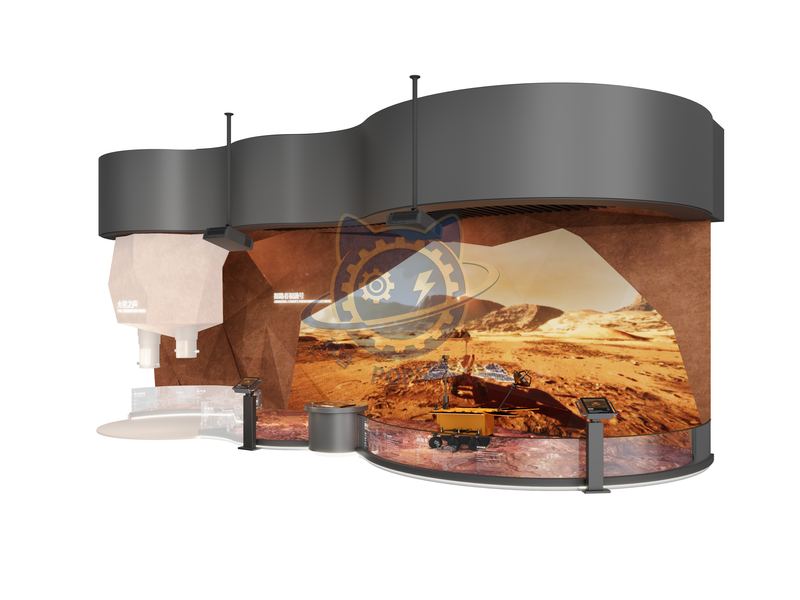
The Zhurong rover is the core probe of China's first Mars exploration mission and also the country's first Mars rover.
| Category | Aerospace & Astronomy |
|---|---|
| Standard size | Custom size |
| Supply | Single unit or batch · OEM to your drawing |
| Lead time | Standard 4–8 weeks after deposit (confirmed per contract) |
| Warranty | 1 year, structure and control |
| Documents | Specification sheet · control diagram · spare-part list |
A standard catalogue model: the dimensions, control package and finish are fixed, which is what keeps the price and the lead time predictable. Size, colour and interface language can be adapted without a new design cycle.
Standard models from this range are also listed in our online store, priced in USD — see the price yourself ↗
The Zhurong rover is the core probe of China's first Mars exploration mission and also the country's first Mars rover. The Zhurong rover adopts a biomimetic "butterfly" design, with expandable solar wings, battery arrays, and heat collection windows on the upper part of the body, and wheels arranged below. It weighs 240 kilograms, measures 3.3 meters long, 3.2 meters wide, and 1.85 meters high, and has a designed lifespan of 3 Martian months, equivalent to about 92 Earth days. On May 15, 2021, it arrived at the Utopia Planitia on Mars with Tianwen-1, marking a major breakthrough in China's deep space exploration. The Zhurong spacecraft is designed specifically for Mars exploration, aiming to explore the surface structure and composition of Mars, as well as search for water sources and signs of life. Adopting advanced mobile technology, it can autonomously navigate and avoid obstacles, and conduct terrain, geological, and meteorological exploration. The car is equipped with various scientific instruments such as panoramic cameras and spectrometers, and has traveled a total of 1921 meters, collecting 1480GB of data. These data reveal the relationship between Martian sandstorms and water activity.
The unit is designed for unsupervised public use: controls are recessed or shielded, moving parts are enclosed, and the interface is operable by a child of about six with no instruction. Where a screen is used, the language can be switched without changing the hardware, and the content can be replaced on site.
The scientific exploration mission to be completed by the Mars rover is to explore the morphology and geological structure of the Mars patrol area; Soil structure (profile) exploration and water ice exploration; Surface elements, minerals, and rocks. The Zhurong rover has explored Mars for 358 days, with a total distance of 1921 meters. The exploration of the Zhurong spacecraft on the surface of Mars is divided into three major tasks: 1 Perception: The Mars rover needs to locate and evaluate its movement safety through environmental perception before and after movement. The Zhurong rover's pair of navigation and terrain cameras are located at the top of the rover's mast, like "eyes" that can take color stereoscopic photos of the Martian surface along the way, detect the terrain undulations on Mars, and provide support for the rover's navigation. two Mobile, the Mars rover autonomously avoids obstacles and moves to a stop point, then performs environmental perception again. In response to the soft and rugged terrain on the surface of Mars, where the rover is prone to slipping, self sinking, and insufficient traction in soft sand, a joint proposal has been put forward to have the ability to crawl and detach.
Every unit leaves the factory after a running test: mechanisms cycled, electronics burned in, edges dressed, fixings torqued and marked. Wear parts — bearings, sliders, lamps, belts, touch panels — are modular and listed on the spare-part sheet, so a venue technician can replace them without returning the exhibit. Crating is plywood with foam blocking; the loading plan and packing list travel with the shipment.
Other models from the Aerospace & Astronomy line, all held to the same specification and the same control package.

A curved screen and twelve seats for a six-minute flight.

Move a planet across the band and watch liquid water survive or boil.

A comet model whose tail always points away from the light source.

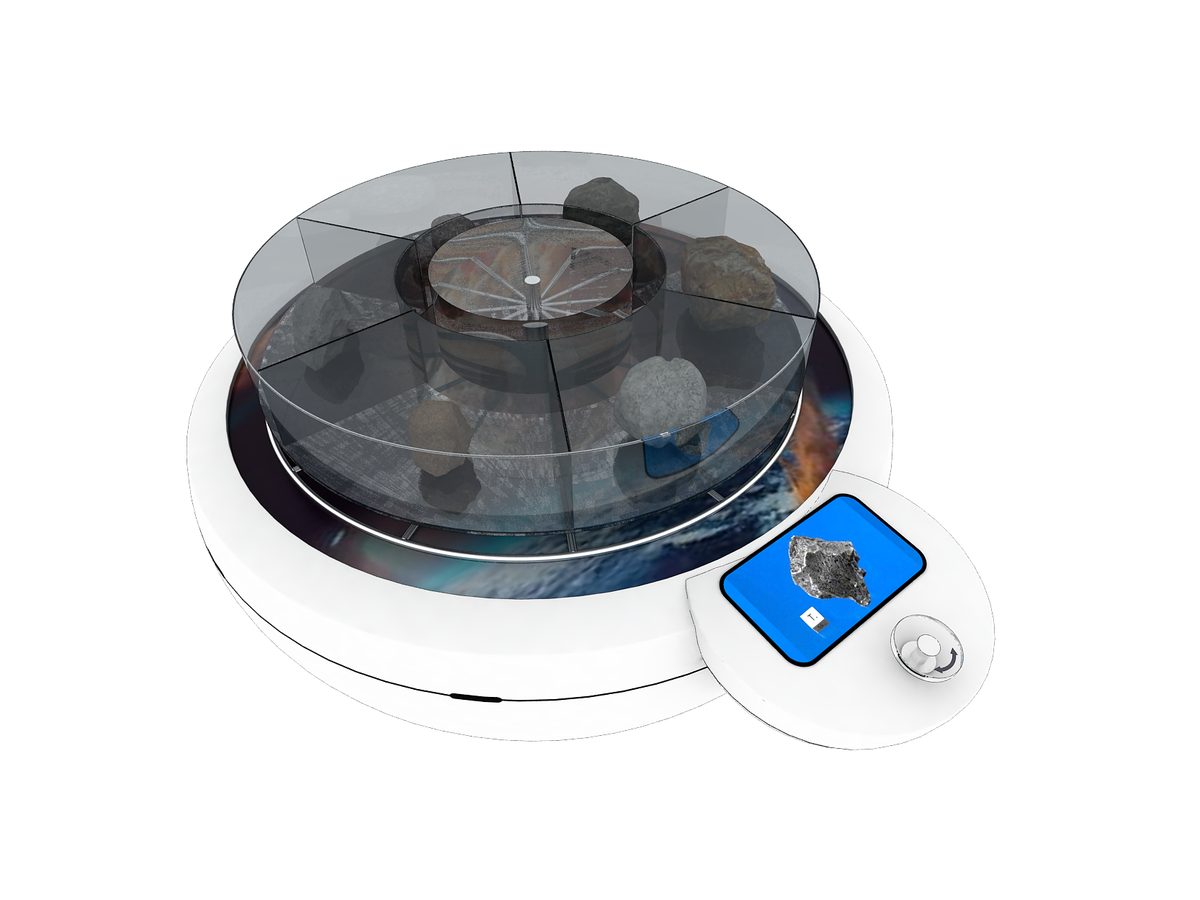
Real meteorite samples beside a simulated entry trail.
Attach a theme outline, a floor plan, or nothing at all — a photo of the space is enough to start. Quotations are issued against a real exhibit list, not per-square-metre guesses.
Scan to add us