Home/Exhibits/Aerospace & Astronomy/The Structure and Technology of China's First Star

The Structure and Technology of China's First Star

On April 24, 1970, China's first satellite, Dongfanghong-1, was successfully launched into the sky by the Long March…

The Structure and Technology of China's First Star — Aerospace & Astronomy exhibit for science museums
Reference image
CategoryAerospace & Astronomy
Standard sizeCustom size
SupplySingle unit or batch · OEM to your drawing
Lead timeStandard 4–8 weeks after deposit (confirmed per contract)
Warranty1 year, structure and control
DocumentsSpecification sheet · control diagram · spare-part list

A standard catalogue model: the dimensions, control package and finish are fixed, which is what keeps the price and the lead time predictable. Size, colour and interface language can be adapted without a new design cycle.

Ask about this model → Email us

Standard models from this range are also listed in our online store, priced in USD — see the price yourself ↗
01 / Overview

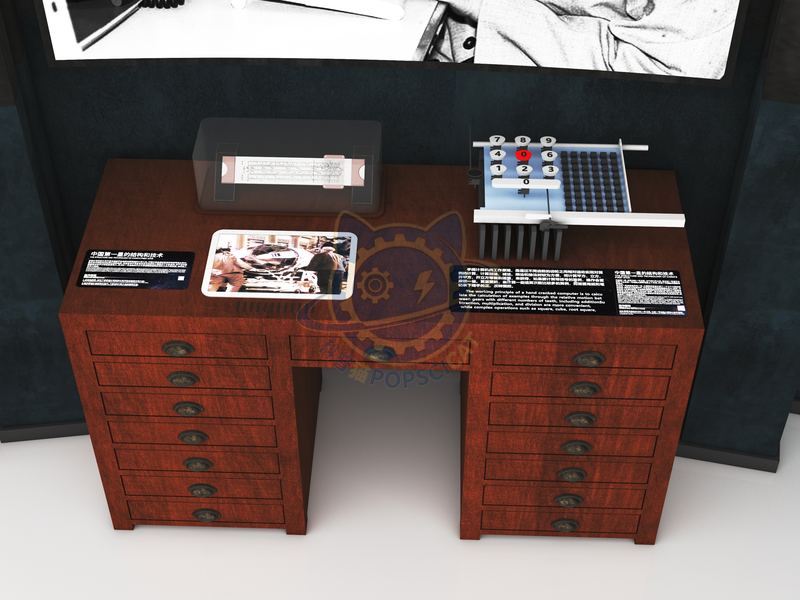
On April 24, 1970, China's first satellite, Dongfanghong-1, was successfully launched into the sky by the Long March 1 carrier rocket under the attention of the public, ushering in a new era of China's space exploration. The diameter of Dongfanghong-1 is only one meter. Engineers designed it as a quasi spherical shape with seventy-two faces, so that its trajectory cross-section changes little at any attitude during space operation. Without the need for on-board instruments, the atmospheric density and its changes in the operating area can be calculated from orbit data; It has four three meter long "antennae" on its body, which are its antennas. The music device used for singing emits radio waves through the antenna, completing communication between satellites and the ground, and can also play "Eastern Red Music" to people all over the world. Hand cranked computers and slide rules were early calculation tools based on mechanical and logarithmic principles. Hand cranked computers achieve basic arithmetic through mechanical transmission, while slide rules simplify multiplication and division operations using logarithms. Both were popular before the popularization of electronic devices.

02 / How visitors use it

The unit is designed for unsupervised public use: controls are recessed or shielded, moving parts are enclosed, and the interface is operable by a child of about six with no instruction. Where a screen is used, the language can be switched without changing the hardware, and the content can be replaced on site.

03 / The science behind it

Hand cranked computers and slide rules are tools based on mechanical principles and logarithmic concepts to perform computational tasks. Hand cranked computers convert user inputs (such as rotating handles) into numerical increases or decreases through a mechanical transmission system of gears and shafts, thereby achieving basic arithmetic operations. The slide rule utilizes the concepts of logarithms and exponents to simplify complex mathematical operations, especially multiplication and division, through a series of scales and sliders. Users can directly read the calculation results by moving the slide ruler and aligning it with the scale on the fixed ruler, without the need for tedious pen calculations. These two tools provided important computational support for scientific research and engineering calculations before the emergence of electronic calculators and computers. Hand cranked computers and slide rules have milestone significance in the history of China's technological progress, witnessing the historical process of China's transition from technological backwardness to gradually catching up and achieving significant technological breakthroughs. Through the application of these tools, China has not only become.

04 / Built for a public floor

Every unit leaves the factory after a running test: mechanisms cycled, electronics burned in, edges dressed, fixings torqued and marked. Wear parts — bearings, sliders, lamps, belts, touch panels — are modular and listed on the spare-part sheet, so a venue technician can replace them without returning the exhibit. Crating is plywood with foam blocking; the loading plan and packing list travel with the shipment.

Same category

More in Aerospace & Astronomy

Other models from the Aerospace & Astronomy line, all held to the same specification and the same control package.

Start a project

Send us your exhibit list.
We will come back with a price.

Attach a theme outline, a floor plan, or nothing at all — a photo of the space is enough to start. Quotations are issued against a real exhibit list, not per-square-metre guesses.

WeChat QR code — scan to message us Scan to add us
on WeChat