Home/Exhibits/Digital & AI/Move freely: robotic dog

Move freely: robotic dog

With the rapid development of intelligent technology and visual programming technology, imitation robot products…

Move freely: robotic dog — Digital & AI exhibit for science museums
Reference image
CategoryDigital & AI
Standard sizeCustom size
SupplySingle unit or batch · OEM to your drawing
Lead timeStandard 4–8 weeks after deposit (confirmed per contract)
Warranty1 year, structure and control
DocumentsSpecification sheet · control diagram · spare-part list

A standard catalogue model: the dimensions, control package and finish are fixed, which is what keeps the price and the lead time predictable. Size, colour and interface language can be adapted without a new design cycle.

Ask about this model → Email us
01 / Overview

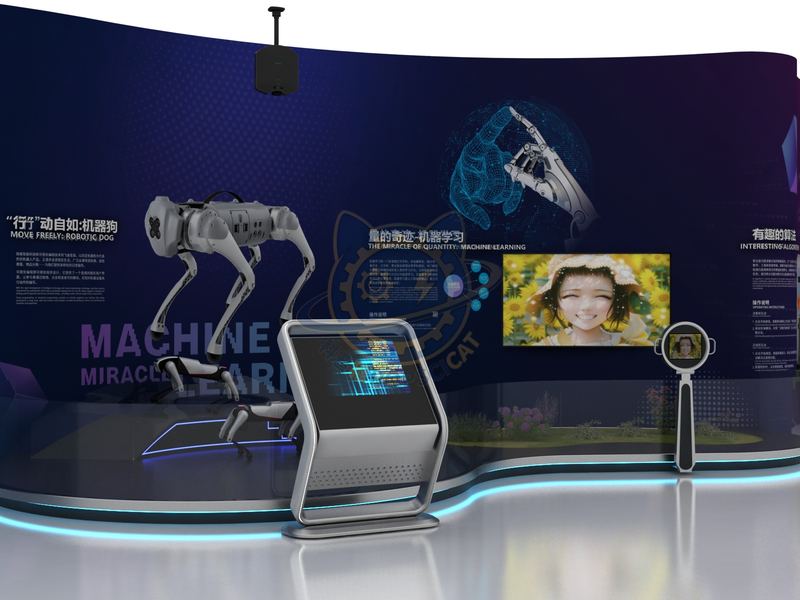
With the rapid development of intelligent technology and visual programming technology, imitation robot products represented by quadruped robot dogs are gradually entering real life, widely engaged in spraying and picking, inspection and rescue, and item sorting, providing us with diversified daily services. Visual programming can visualize program design, providing an intuitive graphical user interface that allows participants to write actions on machine devices by dragging, clicking, and connecting code modules.

02 / How visitors use it

The unit is designed for unsupervised public use: controls are recessed or shielded, moving parts are enclosed, and the interface is operable by a child of about six with no instruction. Where a screen is used, the language can be switched without changing the hardware, and the content can be replaced on site.

03 / The science behind it

Visual programming: The visual programming interface used by visitors is a tool built on programming languages. These tools provide an intuitive graphical user interface that allows users to write actions for robotic dogs by dragging, clicking, and connecting code modules. In essence, these graphical code modules will eventually be converted into instructions that the robotic dog can understand. Visual programming, also known as visual program design: based on the principle of "what you see is what you get" programming, strives to achieve visualization of programming work, that is, the results can be seen at any time, and the adjustment of the program and the results is synchronized. Visual programming is compared to traditional programming methods, where "visual" refers to the ability to design interfaces without the need for programming and through intuitive operations. The characteristics of visual programming languages are mainly manifested in two aspects: firstly, based on object-oriented thinking, introducing the concept of classes and event driven; Secondly, based on the process oriented approach, the program development process.
04 / Built for a public floor

Every unit leaves the factory after a running test: mechanisms cycled, electronics burned in, edges dressed, fixings torqued and marked. Wear parts — bearings, sliders, lamps, belts, touch panels — are modular and listed on the spare-part sheet, so a venue technician can replace them without returning the exhibit. Crating is plywood with foam blocking; the loading plan and packing list travel with the shipment.

Same category

More in Digital & AI

Other models from the Digital & AI line, all held to the same specification and the same control package.

Start a project

Send us your exhibit list.
We will come back with a price.

Attach a theme outline, a floor plan, or nothing at all — a photo of the space is enough to start. Quotations are issued against a real exhibit list, not per-square-metre guesses.

WeChat QR code — scan to message us Scan to add us
on WeChat