Understand longitudinal waves through a giant spring wave interactive device.
| Category | Basic Science |
|---|---|
| Interaction | Electromechanical interactive |
| Standard size | Custom size |
| Supply | Single unit or batch · OEM to your drawing |
| Lead time | Standard 4–8 weeks after deposit (confirmed per contract) |
| Warranty | 1 year, structure and control |
| Documents | Specification sheet · control diagram · spare-part list |
A standard catalogue model: the dimensions, control package and finish are fixed, which is what keeps the price and the lead time predictable. Size, colour and interface language can be adapted without a new design cycle.
Standard models from this range are also listed in our online store, priced in USD — see the price yourself ↗
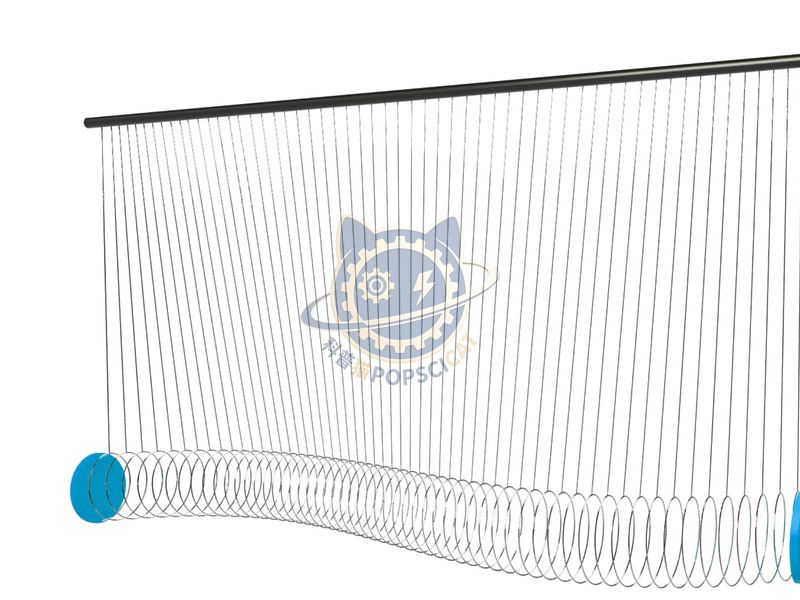
Understand longitudinal waves through a giant spring wave interactive device. The exhibit is a giant spring wave, which serves as a decoration and popular science exhibit in the venue. The propagation of longitudinal waves is achieved due to the compression and stretching deformation of various body elements in the medium, and the generation of longitudinal elastic forces that restore the body elements to their original state. The exhibit uses a huge spring to simulate the medium, and transmits waves forward by pushing and pulling the spring. The exhibit consists of a row of steel wire rings, push-pull mechanisms, etc. Push the pull rod to start and control the swing direction, causing the steel wire ring to move in a fluctuating manner from back to front. This is because the steel wire ring above undergoes compression and tension under the action of the push-pull mechanism, and then returns to its original state under the action of elastic force. The process of deformation and restoration of the steel wire ring simulates the occurrence of longitudinal waves. Longitudinal waves are waves in which the vibration direction of a particle is consistent with its propagation direction. Sound waves are a typical type of longitudinal wave. Target audience: Adolescents aged 6-15 years old, presenting in various forms.
Interaction type: Electromechanical interactive. The unit is designed for unsupervised public use: controls are recessed or shielded, moving parts are enclosed, and the interface is operable by a child of about six with no instruction. Where a screen is used, the language can be switched without changing the hardware, and the content can be replaced on site.
1. Mechanical waves are waves that propagate through a material medium (solid, liquid, or gas). There are two basic types of mechanical waves: longitudinal waves and transverse waves. 2. In longitudinal waves, particle displacement is parallel to the direction of wave propagation. The screen displays a one-dimensional longitudinal plane wave propagating along the pipe. Particles will not move forward along the tube with the wave; They just swing back and forth around their respective equilibrium positions. Select a particle and observe its motion. The screen displays the difference between the oscillatory motion of a single particle and the propagation of waves in a medium. The screen also identifies compressed and sparse areas. P-waves (primary waves) in earthquakes are examples of longitudinal waves. P-waves propagate at the fastest speed and arrive first. Longitudinal wave is a type of wave, also known as "density wave", characterized by the parallel motion direction and propagation direction of particles. Sound waves are a typical longitudinal wave. Reference materials.
Every unit leaves the factory after a running test: mechanisms cycled, electronics burned in, edges dressed, fixings torqued and marked. Wear parts — bearings, sliders, lamps, belts, touch panels — are modular and listed on the spare-part sheet, so a venue technician can replace them without returning the exhibit. Crating is plywood with foam blocking; the loading plan and packing list travel with the shipment.
Other models from the Basic Science line, all held to the same specification and the same control package.

Rotate two polarising filters and watch colours appear and vanish.

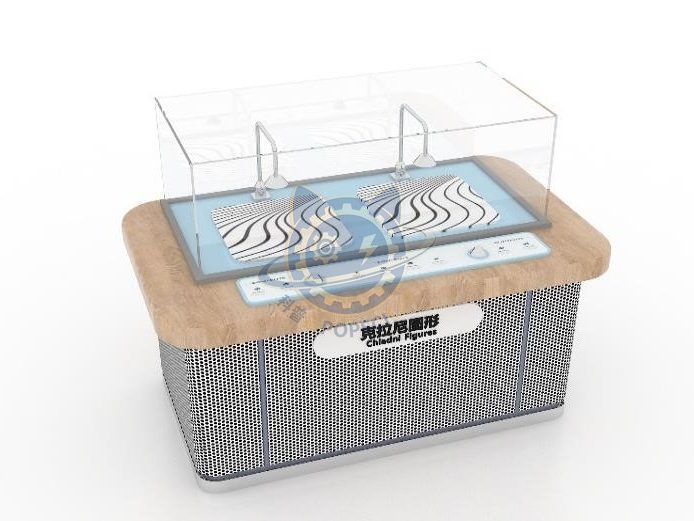
Sand on a driven plate jumps into nodal figures as the frequency changes.

Coloured discs drain to grey as the spin speed passes the eye's limit.

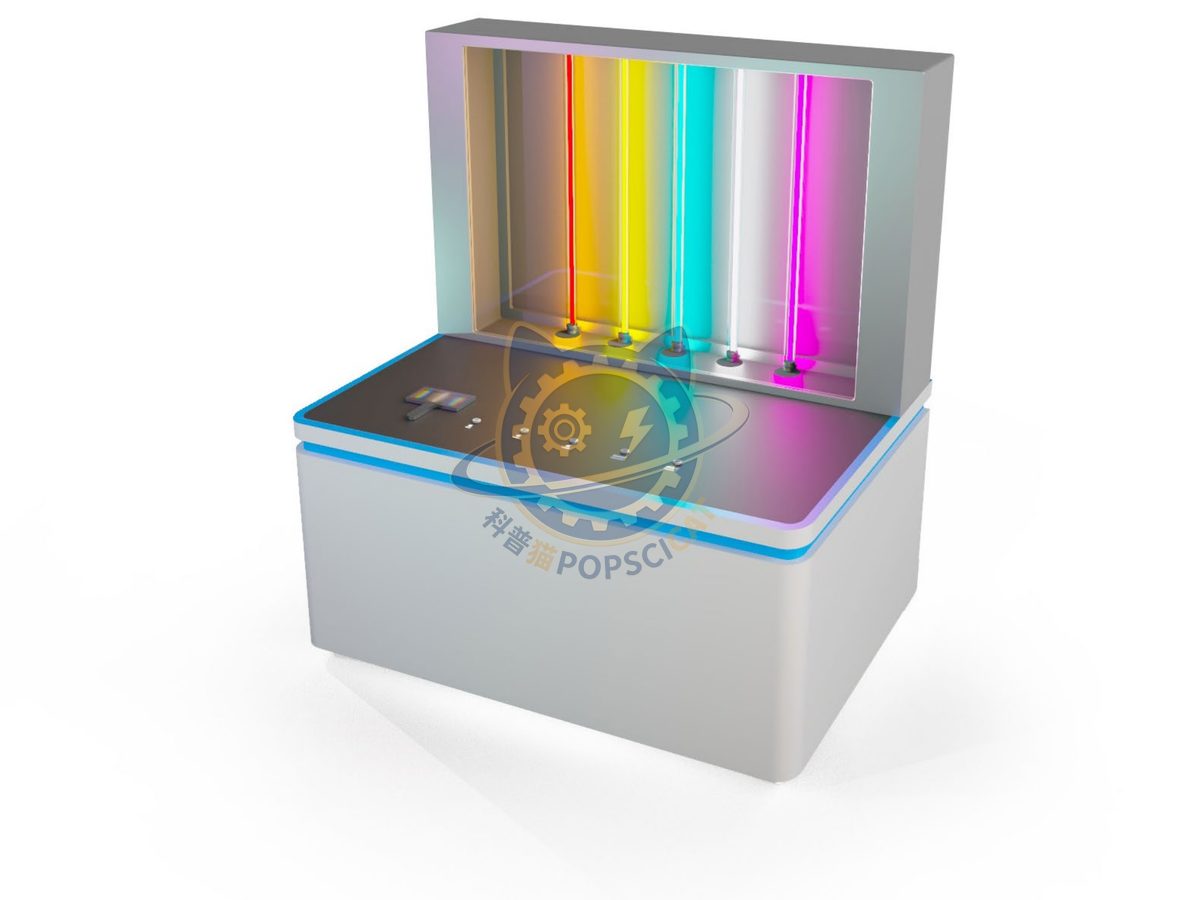
Gas discharge tubes and a slit spectroscope show emission lines directly.
Attach a theme outline, a floor plan, or nothing at all — a photo of the space is enough to start. Quotations are issued against a real exhibit list, not per-square-metre guesses.
Scan to add us