Home/Exhibits/Digital & AI/Super Storage

Super Storage

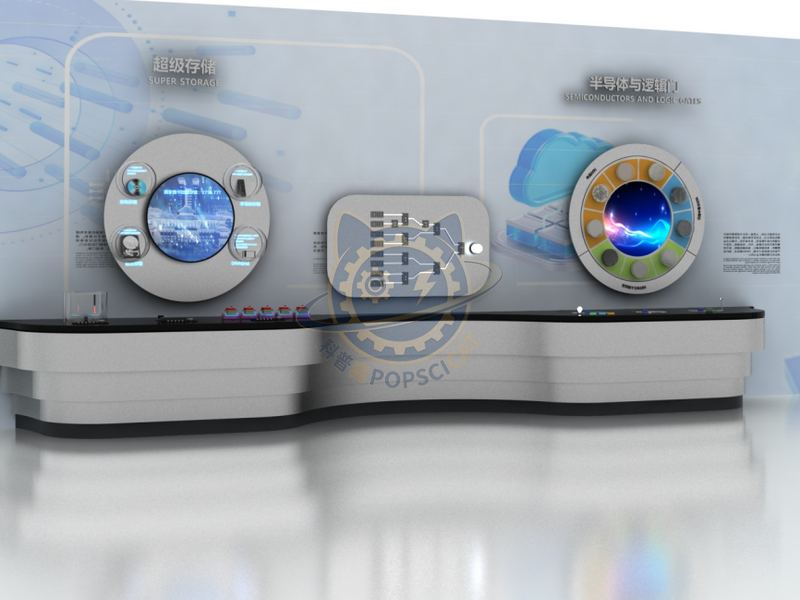
Since the birth of civilization, humans have been seeking ways to effectively store information, whether it is…

Super Storage — Digital & AI exhibit for science museums
Reference image
CategoryDigital & AI
Standard sizeCustom size
SupplySingle unit or batch · OEM to your drawing
Lead timeStandard 4–8 weeks after deposit (confirmed per contract)
Warranty1 year, structure and control
DocumentsSpecification sheet · control diagram · spare-part list

A standard catalogue model: the dimensions, control package and finish are fixed, which is what keeps the price and the lead time predictable. Size, colour and interface language can be adapted without a new design cycle.

Ask about this model → Email us

Standard models from this range are also listed in our online store, priced in USD — see the price yourself ↗
01 / Overview

Since the birth of civilization, humans have been seeking ways to effectively store information, whether it is bamboo slips, wooden slips, paper, or silk, with constantly upgrading storage media. With the continuous advancement of technology, storage methods have gradually evolved from mechanical and magnetic tapes to digital storage forms such as flash memory, hard drives, and solid-state drives, with capacity doubling, volume shrinking, and speed increasing. Scientists are still exploring quantum storage, optical storage, and DNA storage technologies, and our pursuit of information storage has never stopped.

02 / How visitors use it

The unit is designed for unsupervised public use: controls are recessed or shielded, moving parts are enclosed, and the interface is operable by a child of about six with no instruction. Where a screen is used, the language can be switched without changing the hardware, and the content can be replaced on site.

03 / The science behind it

Optical storage: The principle of optical storage mainly relies on the interaction between lasers or other optical devices and storage media to achieve information reading and writing. Information writing: When a laser beam is focused on the surface of an optical medium, its energy causes certain material structures inside the optical medium to change, such as altering its refractive index, reflectivity, or transmittance. These changes in physical or chemical properties can be used to record data. By adjusting the intensity and position of the laser beam, tiny pits, grooves, or points can be formed on the surface of the medium, representing different data bits. Information reading: When reading information, a laser beam is also used to scan the storage medium. When the laser beam is irradiated onto the surface of the medium, the changes in its reflected or transmitted light will be captured by the sensor. Sensors identify different data bits on the storage medium based on the changes in these optical signals and convert them into electrical signals for further processing. Magnetic storage: The principle of magnetic storage is mainly based on magnetic materials.

04 / Built for a public floor

Every unit leaves the factory after a running test: mechanisms cycled, electronics burned in, edges dressed, fixings torqued and marked. Wear parts — bearings, sliders, lamps, belts, touch panels — are modular and listed on the spare-part sheet, so a venue technician can replace them without returning the exhibit. Crating is plywood with foam blocking; the loading plan and packing list travel with the shipment.

Same category

More in Digital & AI

Other models from the Digital & AI line, all held to the same specification and the same control package.

Start a project

Send us your exhibit list.
We will come back with a price.

Attach a theme outline, a floor plan, or nothing at all — a photo of the space is enough to start. Quotations are issued against a real exhibit list, not per-square-metre guesses.

WeChat QR code — scan to message us Scan to add us
on WeChat