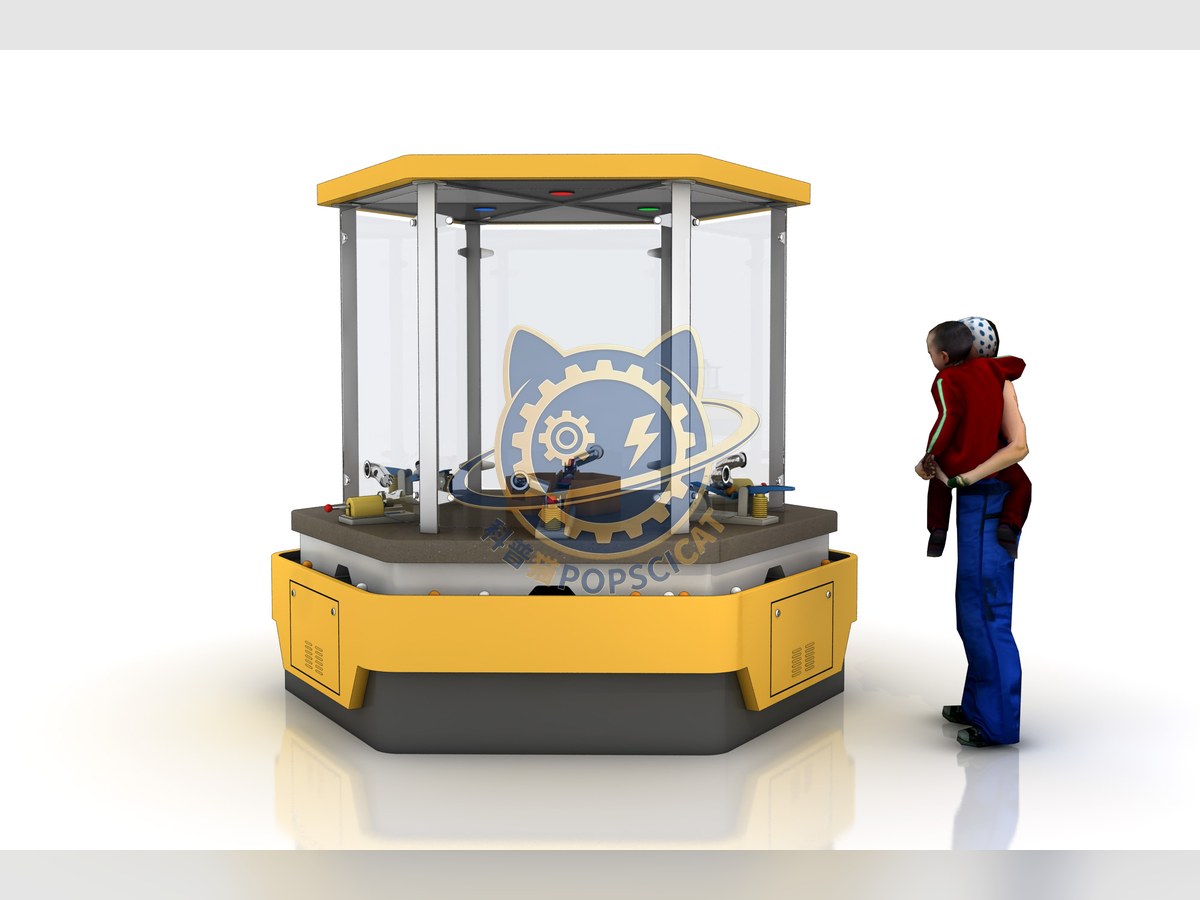
I. Purpose of the Exhibit This exhibit uses a simple and easy-to-use mechanical device to demonstrate a centralized transmission mechanism through intuitive operation. II. Scientific Principles Mechanical Transmission Mechanical transmission mechanisms can alter the mode, direction, or speed of motion provided by a power source and are purposefully utilized by people. There were many types of transmission mechanisms in ancient China, and they had a wide range of applications. In addition to those mentioned above, devices such as the seismoscope and the bellows were also products of mechanical transmission mechanisms. Ancient Chinese transmission mechanisms mainly included gear transmission, belt transmission, and chain transmission. Gear Transmission Gear transmission dates back to at least the Western Han Dynasty. The South-Pointing Chariot and the Mileage Chariot of the Western Han Dynasty, as well as the hydraulic astronomical instruments invented by Zhang Heng during the Eastern Han Dynasty, all employed fairly complex gear transmission systems. These gears were only used to transmit motion, and the strength requirements were not high. As for the gears used in production, they needed to transmit greater power, generally bore greater forces, and had higher strength requirements. In ancient times, such gears were used when employing animal power, water power, and wind power for tasks such as water lifting and grain processing. For example, in a water-wheel lift, a single-stage gear transmission mechanism must be used to change the direction and transmission of motion to meet the operational requirements of the water-wheel lift. Chain Drive Chain drives appeared very early in ancient China. Bronze chains were already used on horse harnesses during the Shang Dynasty, and chains were also used as decorations on other bronze and jade artifacts. The Qin Dynasty bronze chariot and horse unearthed in Xi'an feature exquisite metal chains. However, these cannot be considered chain drives. Chains used for power transmission first appeared during the Eastern Han Dynasty. During the Eastern Han Dynasty, Bi Lan was the first to invent the water-lifting wheel, which was used to divert water. Based on its operating principle and kinematic relationship, it can be considered a form of chain drive. The upper and lower sprockets of the waterwheel, one driving and the other driven, and the paddles wrapped around the wheels constitute the transmission chain. This transmission chain also serves as the working component for lifting water. Therefore, the waterwheel is a special case of chain transmission. Rope and belt drive Rope and belt drive is a type of transmission that utilizes frictional force. During the Western Han Dynasty, Sichuan produced well salt. When digging wells and lifting water, oxen were used to drive large rope wheels, winding the ropes around pulleys to lift well-digging tools, brine, and so on. The hand-operated spinning wheel that emerged during the Western Han Dynasty is a typical example of rope and belt transmission. On the relief sculptures of the Western Han Dynasty, there are several depictions of hand-operated spinning wheels. It is clear that the large rope wheel serves as the driving component, and it drives the spindle through a rope. By manually turning the large rope wheel one full rotation, the spindle completes dozens of rotations, demonstrating high efficiency. The three-spindle and five-spindle spinning wheels that appeared later were even more efficient. The large water-powered spinning wheel of the Yuan Dynasty also used rope-and-belt transmission. During the Eastern Han Dynasty, the metallurgical handicraft industry made an important invention called the "water-powered bellows," which was used for blowing air. III. Functional Description (Technical Solution) The exhibit allows visitors to experience different mechanical transmission structures and their principles of motion by sending small balls into the central ball collector through various interactive methods. The overall shape of the exhibit is a hexagonal prism, with three types of interactive mechanisms—launchers, tracks, and suction cups—evenly distributed throughout, totaling 6 sets. This visually demonstrates the principles of mechanical motion. When participating, visitors place the ball into the ejection device, press the handle, and eject it into the central ball collector; place the ball into the track transport device, move it to the central ball collector by operating the handle up and down; place the ball into the launching device, press the handle, and launch it into the central ball collector. The collection device features a track-based structure concealed within the exhibit stand. The small balls in the ball collector are transported via the track to the ball collection troughs located beneath the three mechanisms: the ejector, the conveyor belt, and the suction cup. 4. Operating Instructions (1) Place the ball into the ejection device, press the handle, and eject it into the central ball collector; (2) Place the ball into the track transport device, and move it to the central ball collector by operating the handle up and down; (3) Place the ball into the launching device, press the handle, and launch it into the central ball collector. It is built for unsupervised public use: surfaces are robust and wipe-clean, there are no loose parts, and the interface works without instruction, so a child of about six can operate it on a busy floor.