
01
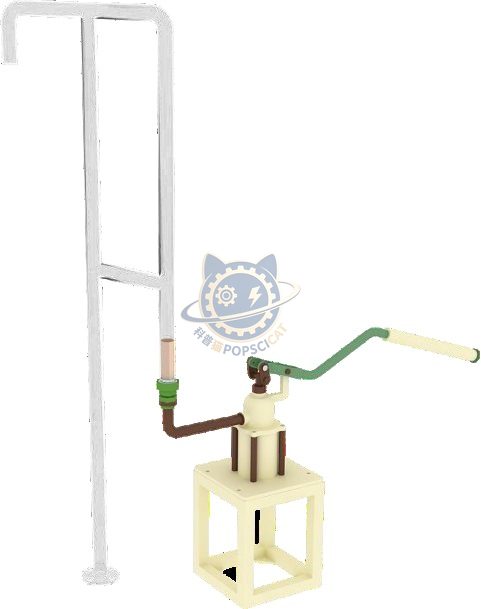
Hand Pump
A lever pulls a leather cup up a cylinder; the partial vacuum lifts water from the pool.

A water play zone is not a playground with water in it. It is the only exhibit category where children can feel buoyancy, pressure, flow and gravity at the same time, with their hands, in the same ten minutes. Every station we build is a single physics question dressed as a game.
The seven reference schemes below were all delivered for real children's halls. Each one is presented the same way: one overview of the complete water island, then the station list that makes it up. Five of the seven are working installations; one is a documentation set of 24 stations drawn for a themed water park, and the last is a bare render set — eleven stations with no written exhibit list at all, included to show how much a single shallow basin can carry.

A twin-island water table, 650 × 360 cm on the floor, carrying twelve stations around one closed loop. Water is lifted by hand, dropped by gravity, spun into a vortex and returned to the pool — the whole water cycle of a watershed, at child height.
A lever pulls a leather cup up a cylinder; the partial vacuum lifts water from the pool.

Water released at the top steps down a staircase of basins, losing height and gaining speed at every lip.

A falling sheet of water transfers momentum to angled blades — a turbine with no casing.

A header tank with a small orifice converts stored head into a narrow, fast jet aimed at a paddle wheel.
Four of the twelve sit beside the overview above; the remaining four are set out here with the mechanism behind each. Every station is fed by the same pump and drains back to the same sump, so a child can follow one cupful around the whole island.
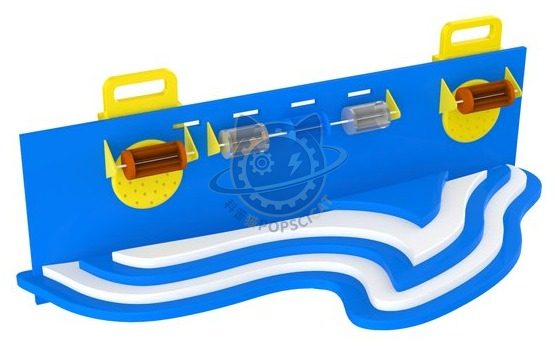
A lift gate sets the upstream level; opening it releases a surge that turns the wheel downstream.
Children raise the gate and the trough drains through the outlet, spinning the wheel and dropping the water level. Lower the gate and the level climbs again. A flood-control dam in miniature, with the consequence visible in seconds.

Density decides whether a block floats, sinks or hovers at the surface.
A shallow tray of floating foam, timber and plastic blocks. Children stack them into rafts and towers, and discover that a wide flat hull carries far more than a tall narrow one — the first lesson in naval architecture.

A paddle at the base spins the body of water; as it speeds up, the free surface forms a paraboloid.
A hand crank drives an impeller through a sealed gearbox. Children watch the flat surface dip in the middle and climb the glass wall, then keep cranking until a full air core opens down the axis.
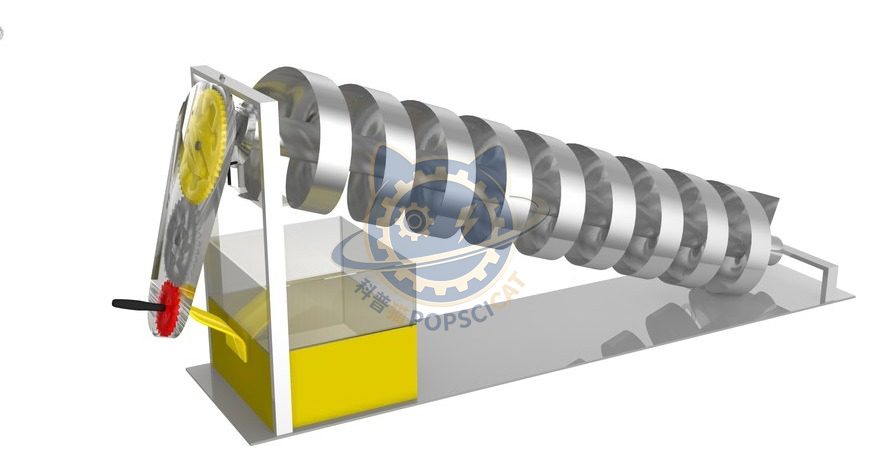
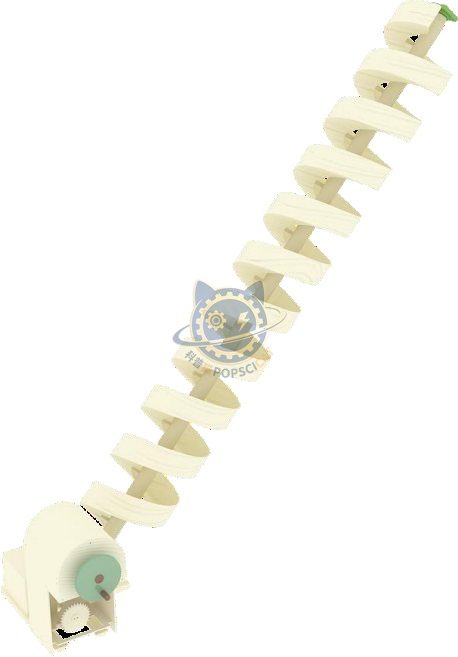
A screw rotating inside a trough traps pockets of water and walks them uphill.
Turning the crank raises water from the lower basin to the header, which then returns it to the upper pool. Children can follow one cupful all the way around the loop, and feel how much turning it takes to move it.
The same island also carries four stations that share the loop: a channel-builder wall where children slot plates into peg positions to route water, a mushroom mist dome, a spiral ball slide, and a hand-cranked water wheel. Twelve stations in total, all fed by one pump and one filtration circuit.

Nineteen stations for a children's science hall, arranged around a kidney-shaped pool with a central island. The brief was density: every square metre of pool edge had to carry a station, and every station had to be usable by a five-year-old without instruction.
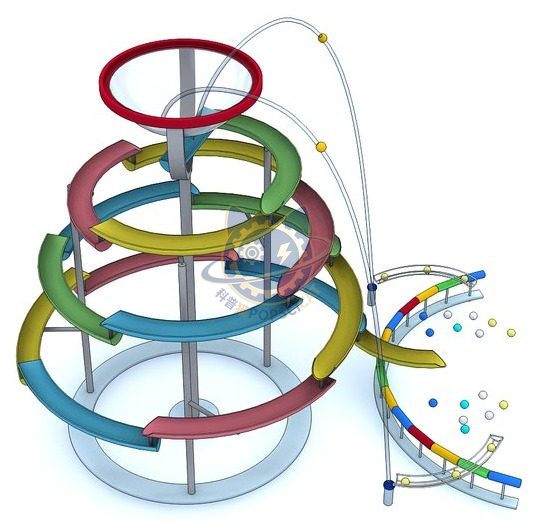
Water and balls fall through a stepped cascade; each step trades height for speed.
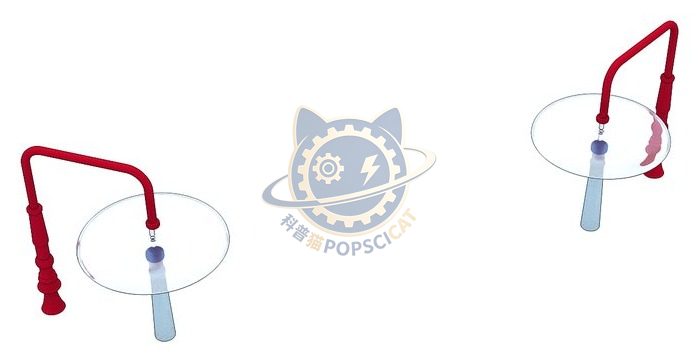
A ring of nozzles at different angles produces a family of water arcs that cross and merge.
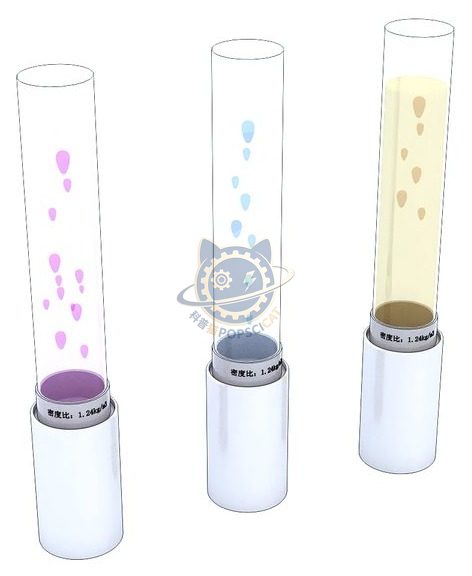
Air injected at the base of a tube rises as a chain of bubbles, dragging water with it.
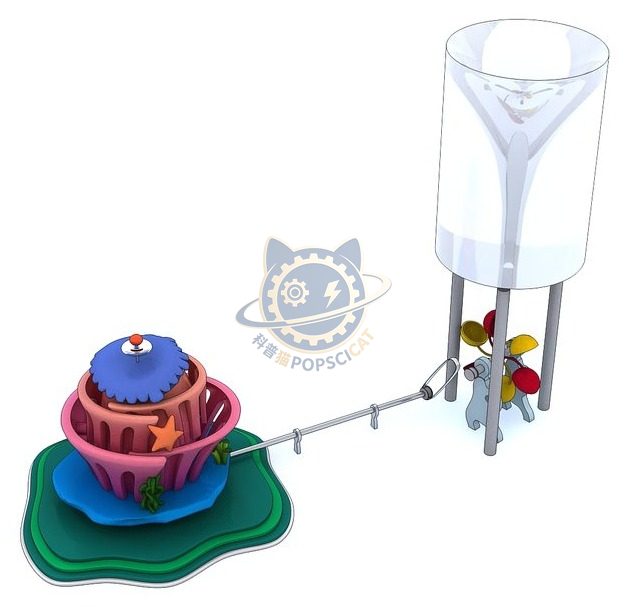
A pump stores pressure behind a nozzle; the jet carries a ball into a target.
Four stations sit beside the overview above. The rest are drawn out here, each with the mechanism that makes it work — density was the whole point of this scheme, so the list is long by design.
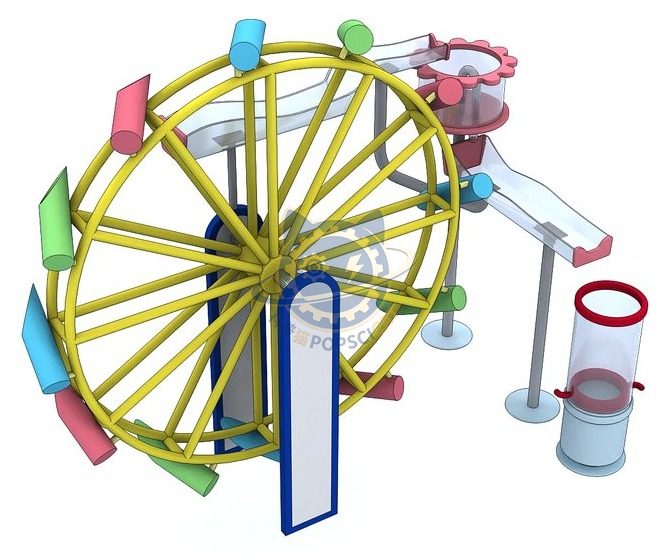
Split bamboo cups catch a falling stream and convert it into rotation.
A low wheel at child height. Children pour water by hand and watch the wheel take off.
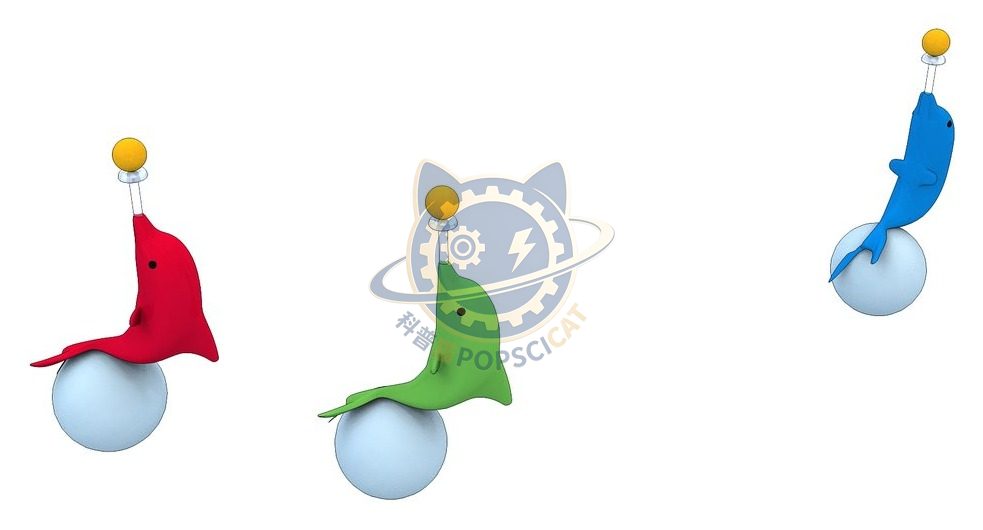
A vertical jet of water holds a ball in a stable pocket of low pressure.
Children place a ball in the jet and try to make it hover without touching it, then tilt a second jet to knock it off.
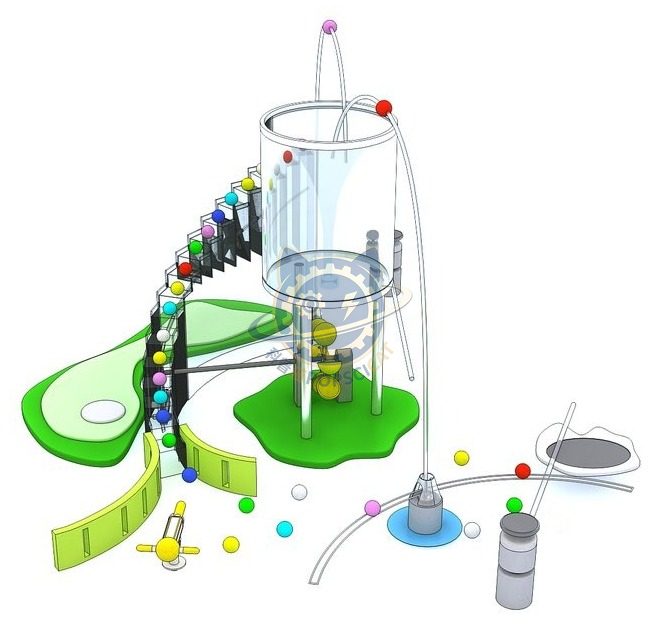
Balls are carried up a staircase channel by water, then return down a parallel run.
Children watch the same ball travel up one channel and down the other, and can stop it mid-way with a gate.
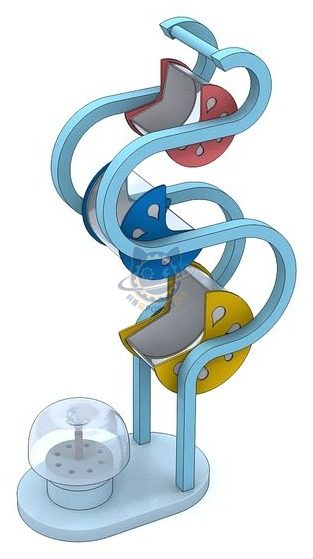
Water forced up a central riser spreads into a dome-shaped film as internal and external pressure balance.
Children stand under the dome and put a hand through the film. The water closes behind the hand.
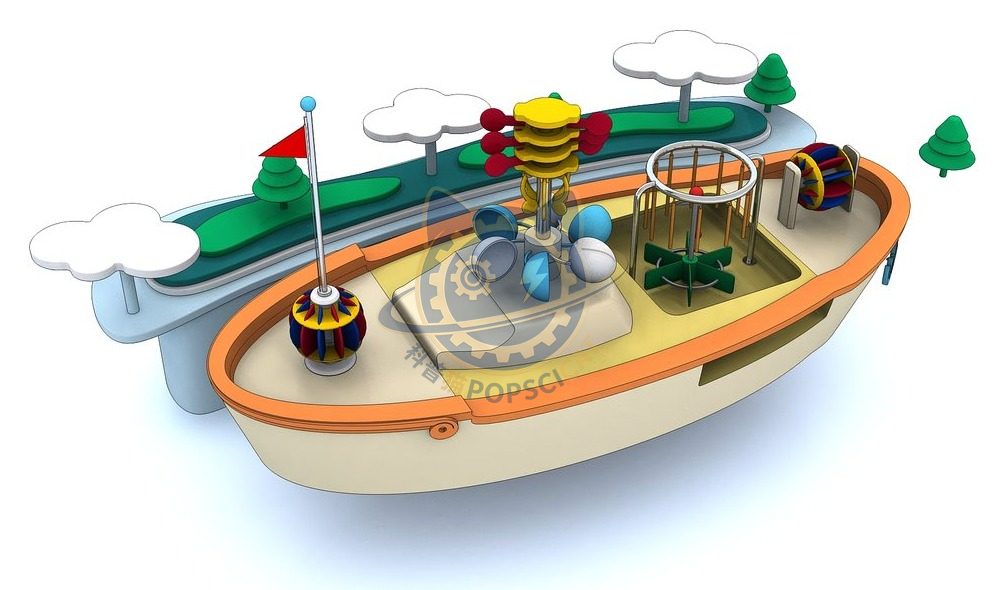
A boat-shaped platform carries eight water cannon aimed at a central target array.
Two teams fire at each other's targets. The hull collects the overshoot and returns it to the pump sump.
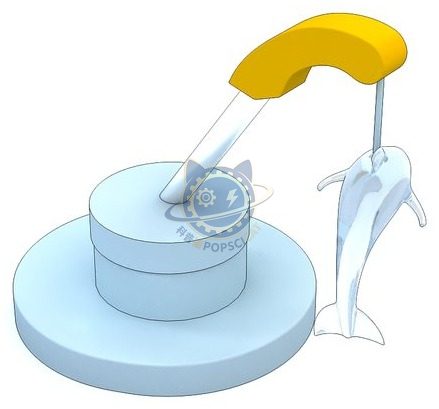
A magnet on a line lifts steel fish from a shallow pool.
The quiet station at the edge of the splash zone: children fish, count, and trade.
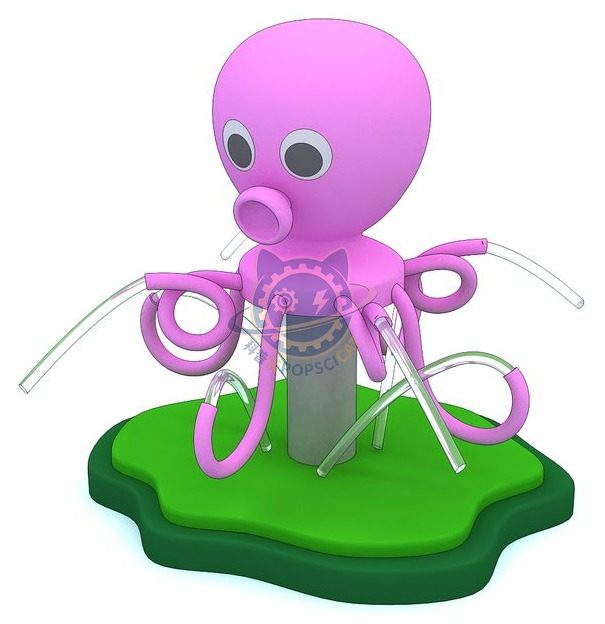
One riser feeds eight arms; each arm ends in a nozzle at a different height.
Children run between the arms and try to stay dry, learning which nozzle reaches furthest.
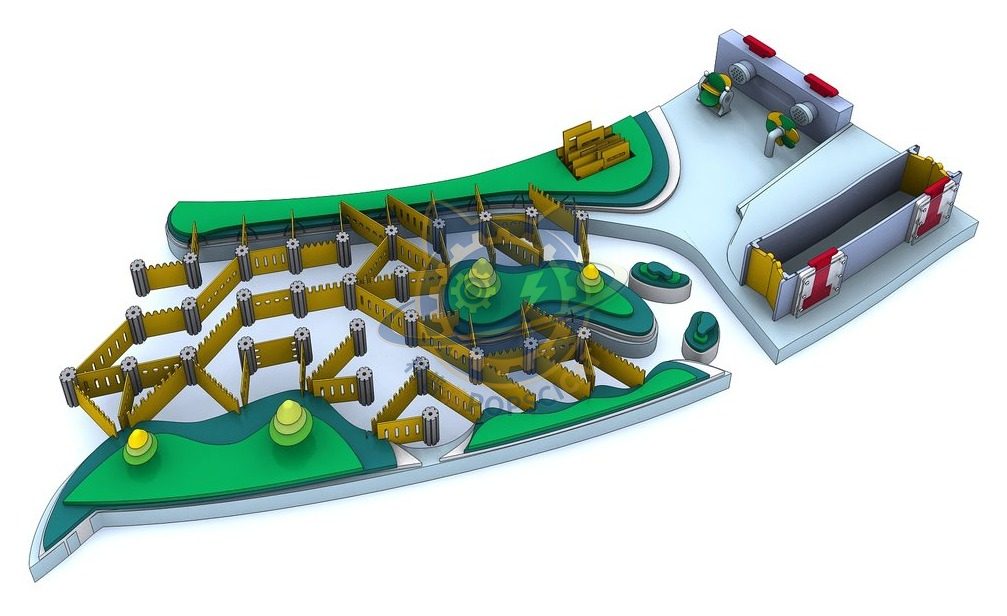
Slotted plates in a peg field let a child build the channel the water must follow.
Twenty-plus peg positions and a stack of plates. Children dam, divert and merge flows, then test whether the water reaches the target.
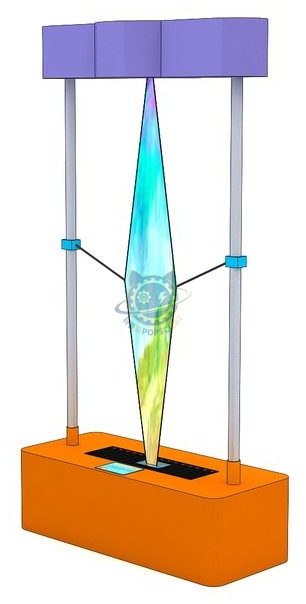
A perforated pipe releases a sheet of bubbles that rises as a translucent wall.
Children push a hand through the curtain and watch the wall close again.
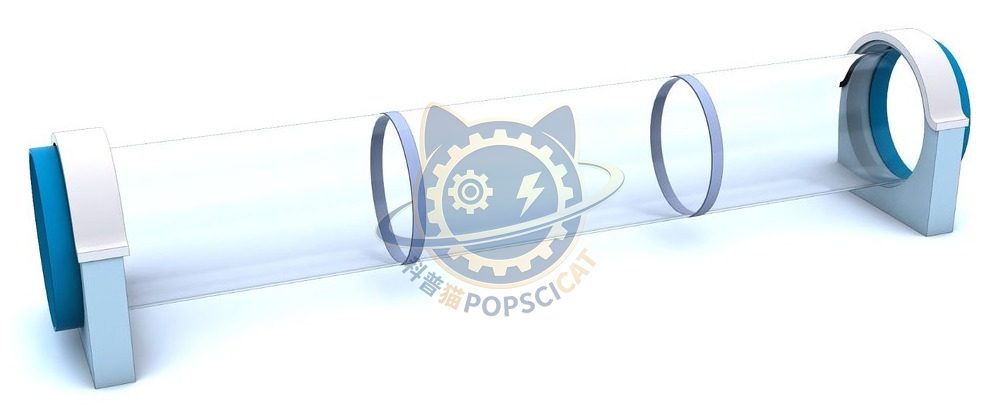
A transparent acrylic tube carries water over a walkway without spilling.
Children walk under a loaded tube and watch the water level move as the flow changes.
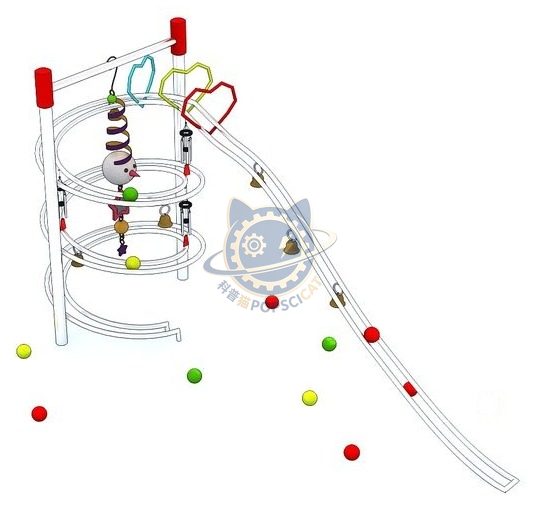
A shallow flow across a table carries balls; the child redirects them with gates.
Children build a route from the inlet to the outlet and race two balls against each other.
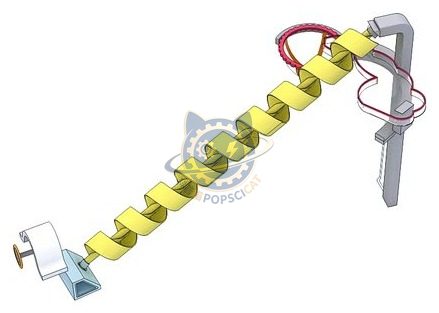
A screw in a trough lifts water in pockets as it turns.
A hand crank at child height. Children can see the pockets form and rise, one per revolution.
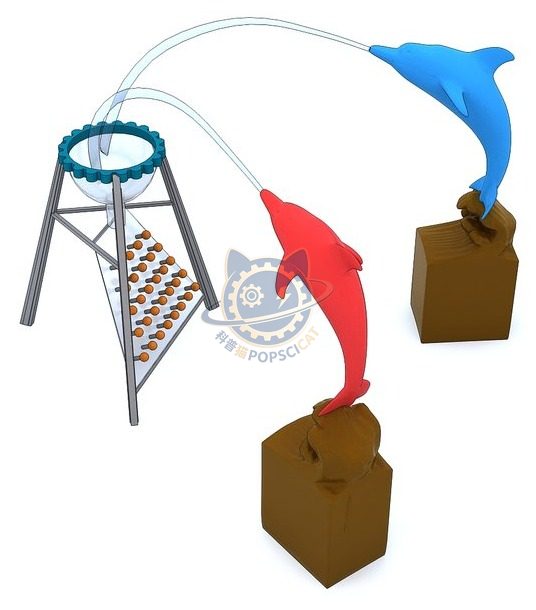
A microphone converts sound level into a pump command; louder means higher.
Children shout, clap or sing at a ring of nozzles. The fountain answers, and the whole pool edge competes.
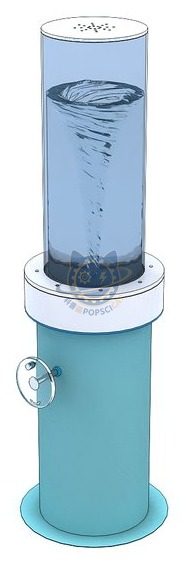
A crank-driven impeller spins the water body until a paraboloid surface forms.
Children crank and watch the surface dip, then race to open an air core before the child next to them.
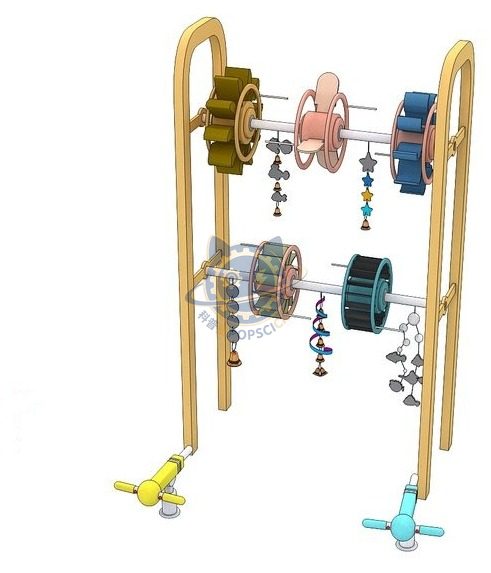
Tuned tubes struck by falling water produce distinct pitches.
Children redirect a spout across five tubes to play a scale, then add water to detune it.

A 900 × 550 cm water play zone for a children's science hall, built as one pool with thirteen stations standing in and around it. This is the most completely documented scheme we hold: every station arrives with its own size, operation note and technical parameters, not just a render.
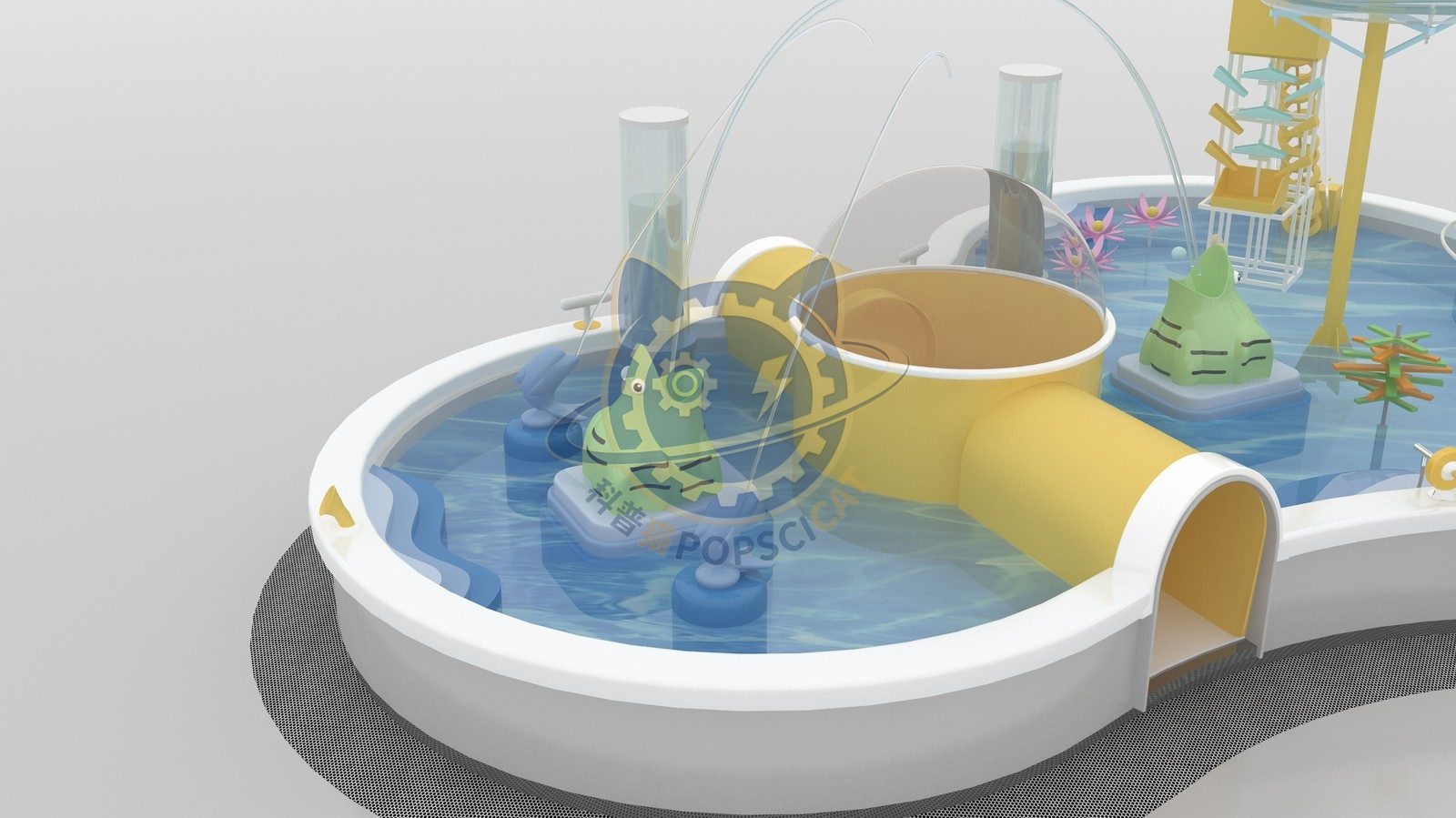
Two jets fire across the walkway the moment a child breaks the beam.
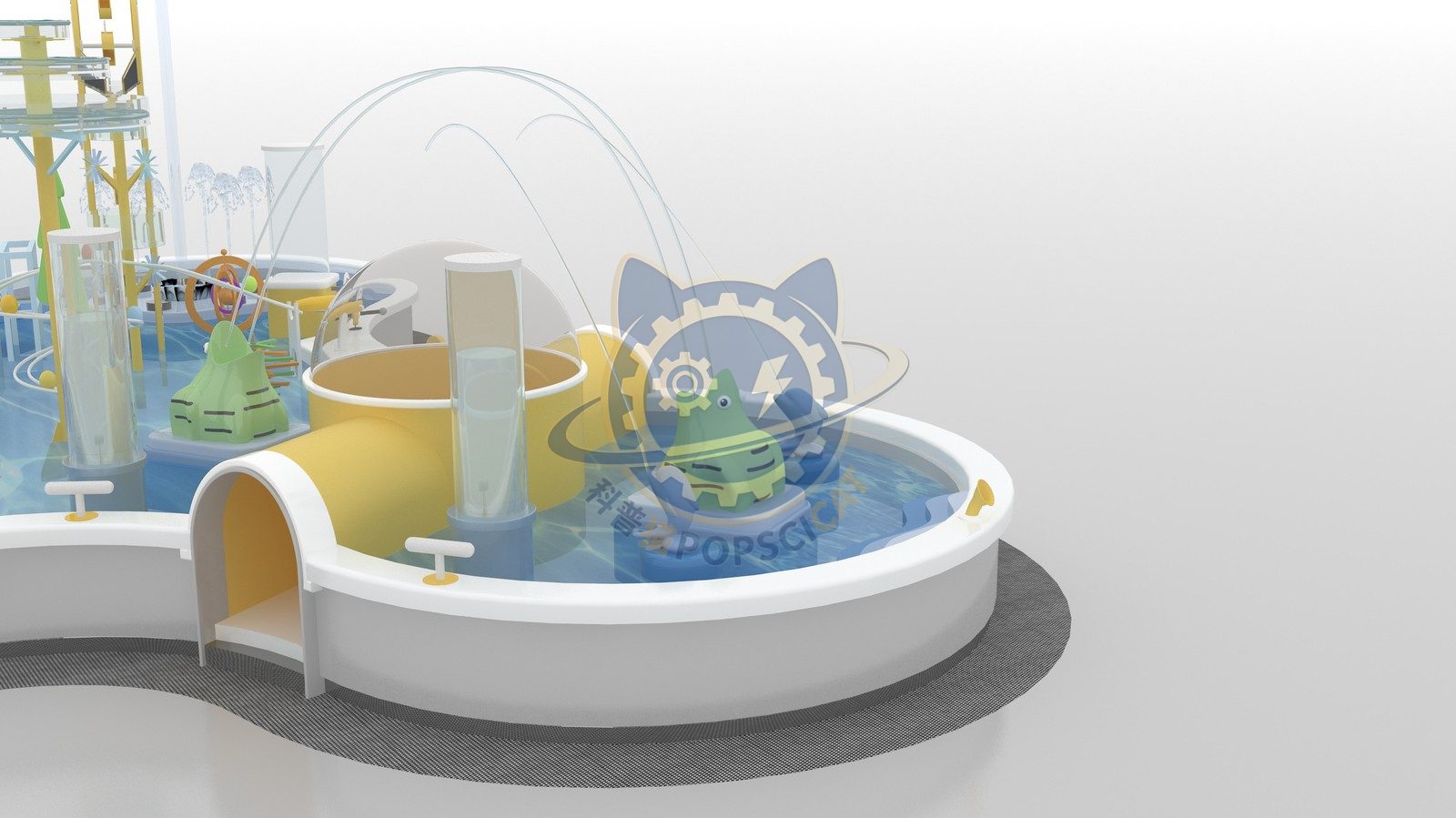
A microphone turns the volume of a shout into the height of the jet.

Air pumped into the base of a tank rises as a column of bubbles.

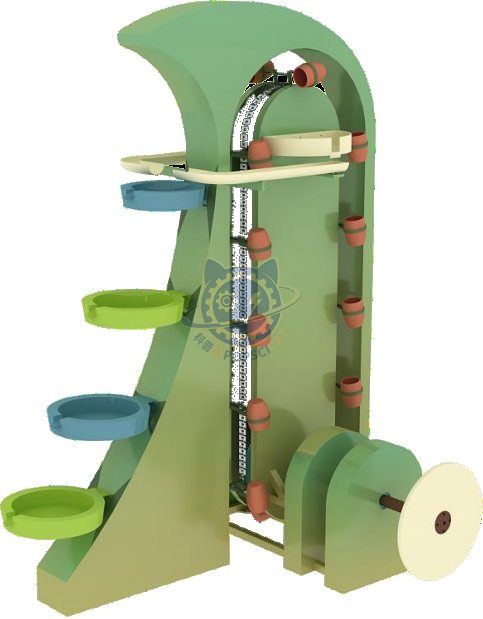
Buckets fixed to a chain scoop water at the bottom and tip it at the top.
Four stations sit beside the overview above. The remaining nine follow with their size and the mechanism behind each — this is the only scheme in the set where every station came with a full specification, not just a render.

A pump lifts water to the top dish and it walks down a stack of trays.
Water spills from dish to dish, breaking first into threads and then into drops. Children follow one thread from the top to the pool and watch height turn into speed.

Six jets on a circle are switched in time with the music.
A button starts the sequence. The controller opens each solenoid valve on the beat, and lights under the nozzles colour the six columns as they rise and fall.

A tap hangs in mid-air with no visible pipe, and the water never stops.
The supply pipe runs up inside the falling stream, hidden by the water itself. Children walk right round it looking for the connection and there is nothing to find.
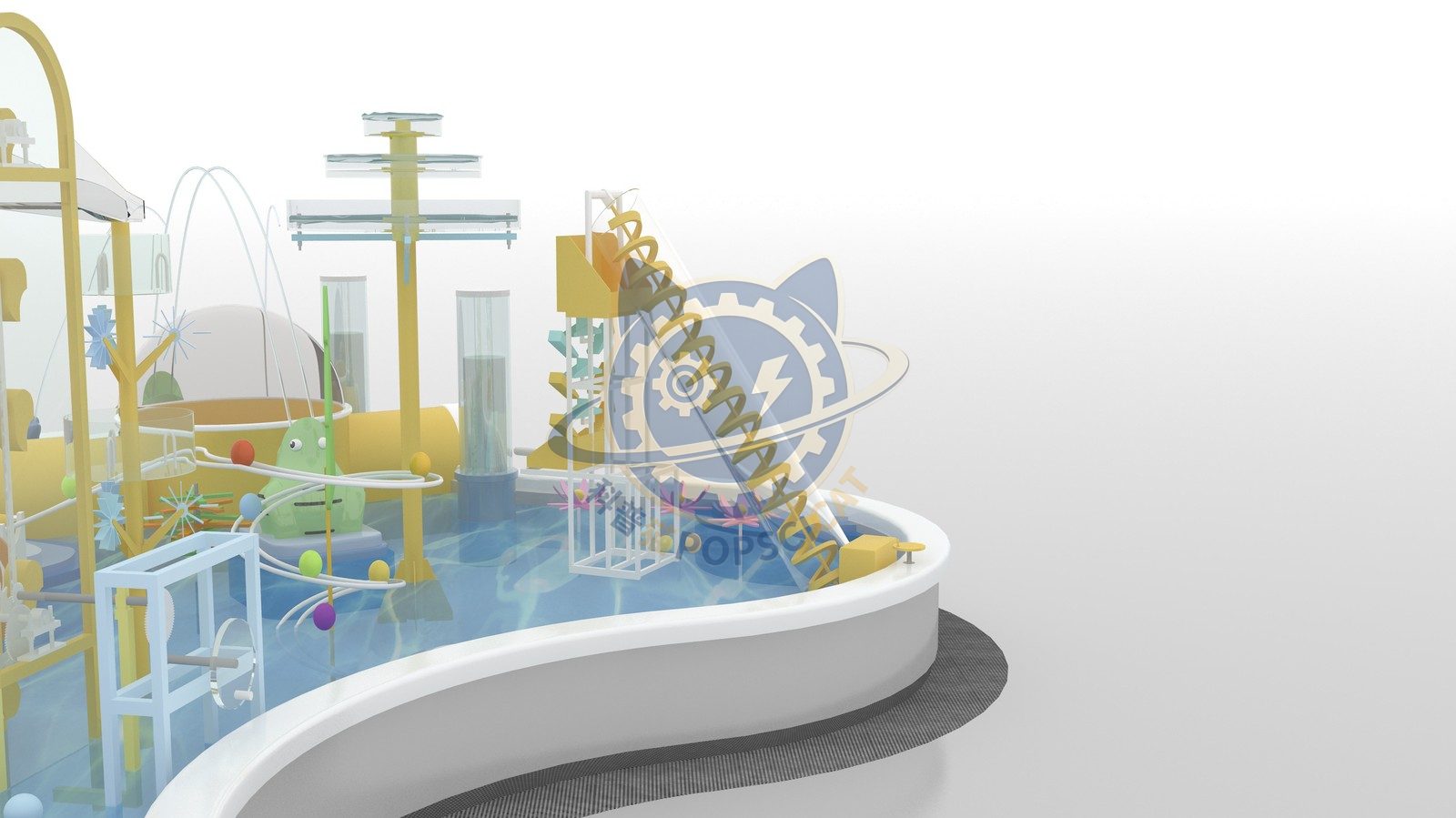
A spiral inside a clear tube walks water uphill as the tube turns.
A handwheel turns the screw. Every turn of the helix traps a pocket of water at the bottom and carries it to the top, where it spills back into the pool — a lift with no bucket and no rope.
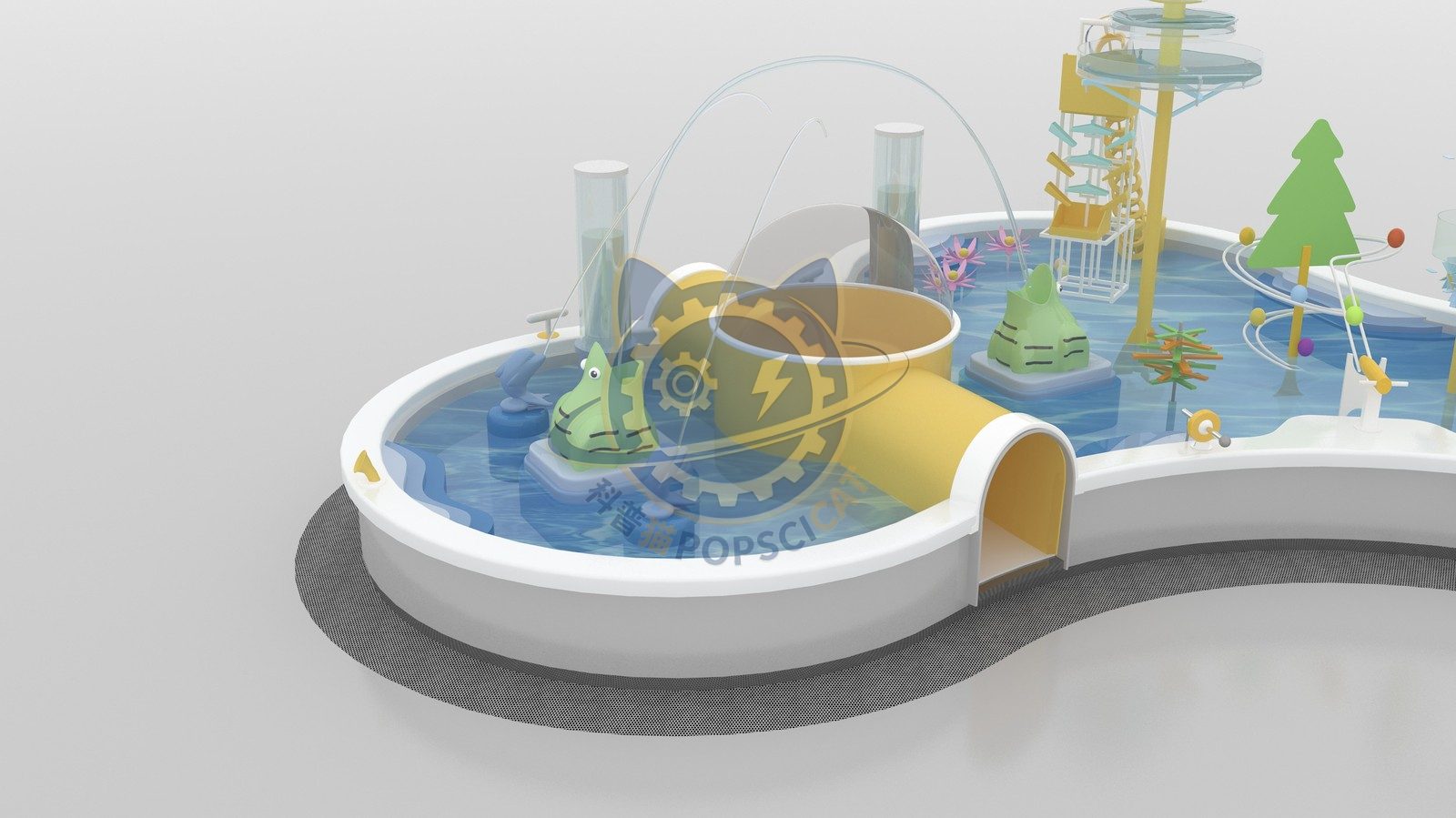
A clear crawl tunnel crosses the pool at water level.
Children enter at one end and crawl through with the pool on both sides. It has an entrance and an exit, so the crossing works in either direction, and the water outside is the exhibit.

A siphon bucket fills until its centre of gravity passes the pivot, then tips.
The bucket hangs on an off-centre axle below the chain lift. Water rises until the load overbalances it, and the release snaps open a flower of panels before the bucket swings back and resets.

A paddle spun by hand sets the whole tank turning into a funnel.
Children turn a crank driving a paddle at the bottom of a clear cylinder. Once the water is spinning fast enough the surface drops in the middle and the vortex reaches down towards the blade.

A jet of water pushes a ball up a spiral track to the top.
The ball is set at the start of the track and a water gun is aimed at it. The jet carries it round the spiral and drops it into the slide, so aim and force both have to be right.

A ball hovers in a jet because fast-moving water means low pressure.
Children float a light ball on a fountain jet. It stays in the stream instead of being thrown clear, and drifts back when pushed sideways — the counter-intuitive part is the whole point.

A themed indoor water world for a science museum. The pool is dressed as a landscape — rock, timber, lily pads — and the stations are built into the scenery rather than bolted onto a wall. Six station types, one continuous water loop.
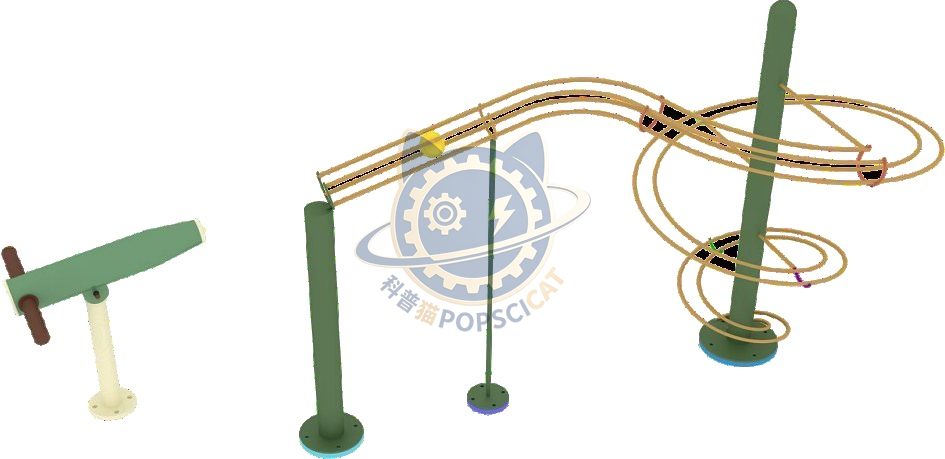
A banked timber track carries balls from a high funnel to the pool, with two alternative lines.
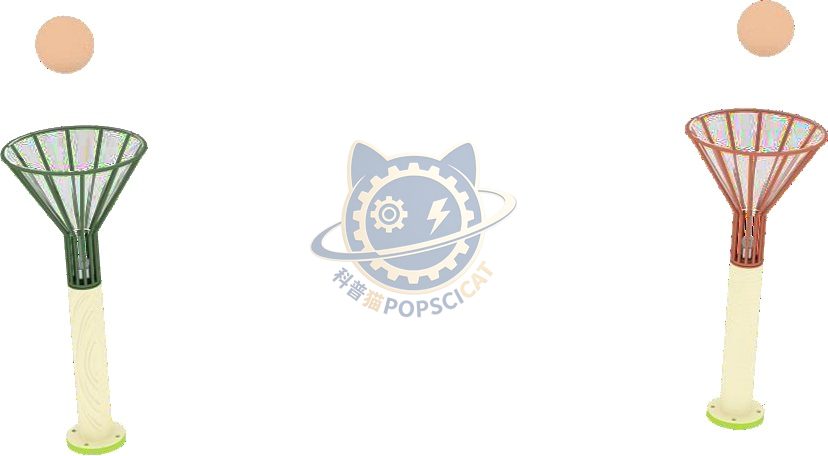
Water pushed through a fine rose forms a conical mist that falls slowly.
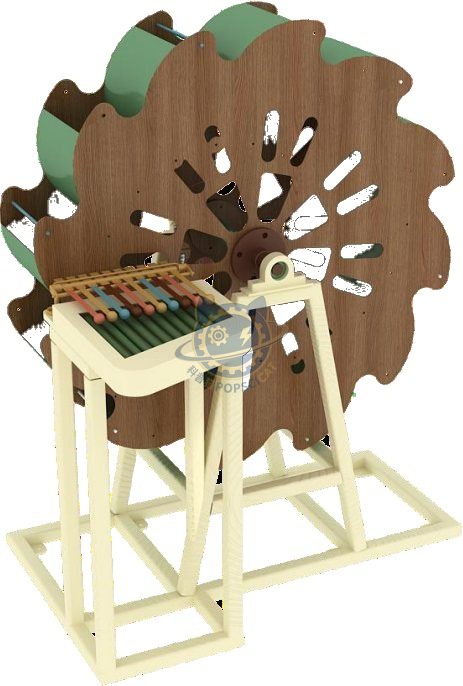
A paddle wheel drives a train of gears that turns a second, larger wheel.
A chain of cups lifts water vertically, then tips it into a header.
Rising steps carry water up a slope in a continuous staircase.
Transparent pipes and elbows let a child re-route a flow around obstacles.

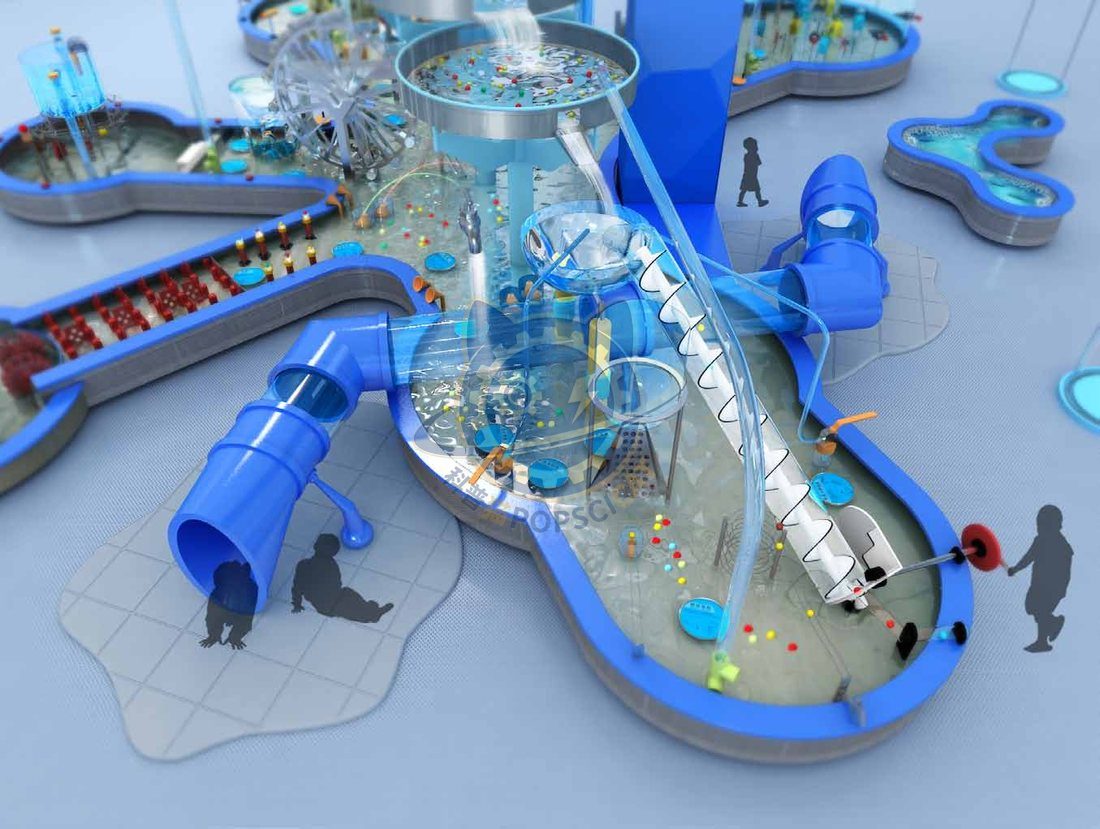
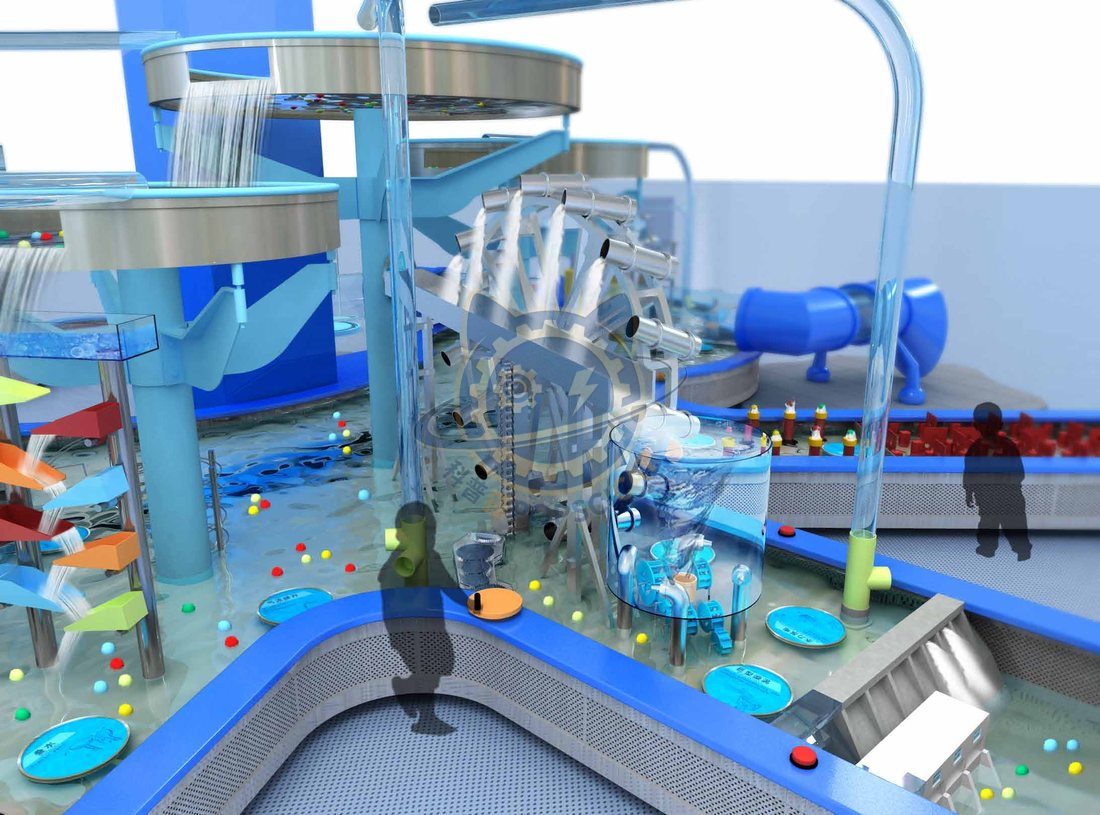
A 12 × 8 m water play zone for a children's science hall, delivered as fourteen numbered exhibits. The scheme is a single shallow basin with a raised landscape in the middle, so children wade around an island rather than standing at a table.
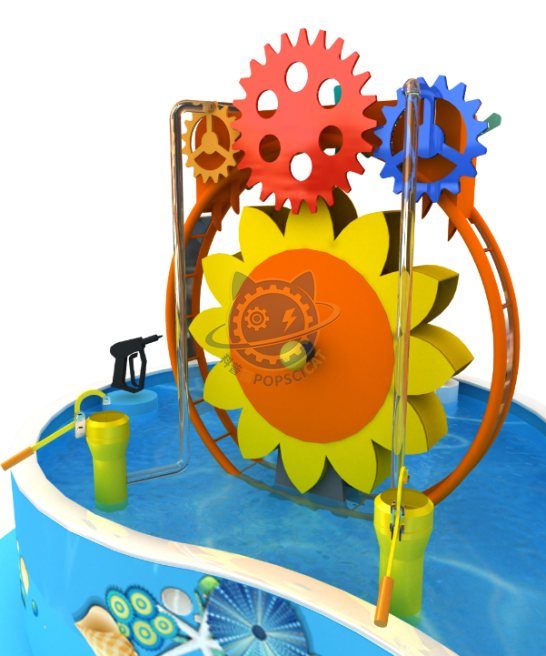
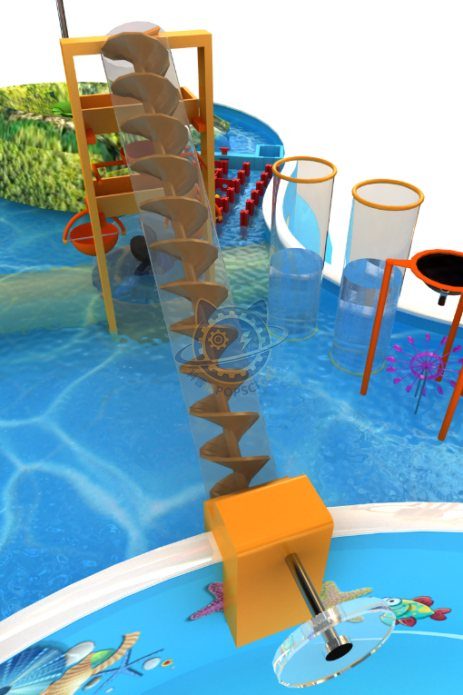
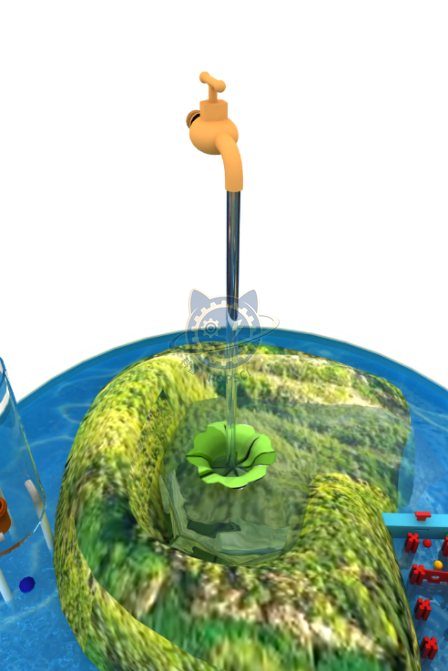
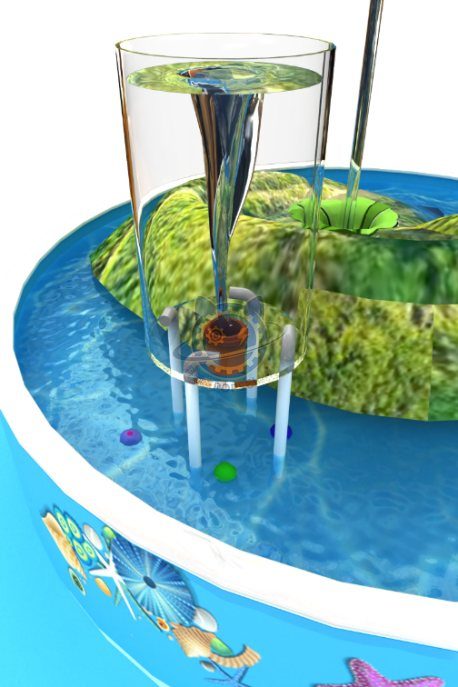
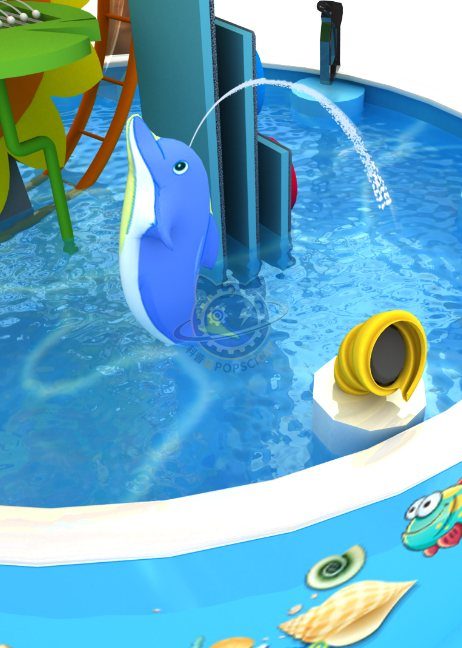

Six of them stand beside the overview as delivered. No captions came with those renders, so they are not keyed to the list; all fourteen are named below, with what each one does in the basin.
A crank-driven screw lifts water from the basin to a header trough, then returns it.
A bucket on an offset pivot fills until its centre of gravity passes the axis, then tips.
A transparent tunnel through the pool wall, so children can watch the water from inside.
A floating teapot pours continuously; the supply pipe is hidden inside the falling stream.
A spring launcher fires a ball at a target; the ball floats back to the start.
Cups on an endless chain carry water up and tip it into a channel.
A paddle wheel drives a tuned comb — water power becomes a melody.
Four piston pumps around a sunflower head push water to a raised outlet.
A pressure cannon fires at a wheel; the recoil and the spin are both visible.
A crank-driven impeller opens a whirlpool in a transparent cylinder.
A sound sensor turns shouting into jet height.
A gate releases stored head onto a turbine; a lamp lights up with the output.
Two gates let children compare a controlled release with a sudden one.
A column with tappings at four heights — the lower the hole, the further the jet.

A documentation set rather than a built scheme: 24 stations drawn in 3D for a themed water park, with three-view drawings and installation notes for each. We include it because it shows the density a single water environment can carry — 24 stations inside one continuous pool, sharing one plant room.
The whole pool, seen as one system: one sump, one filter, one circulation loop.
Pressure water cannon aimed at a central wheel assembly.
Balls fired into rotating cave mouths on a mountain model.
A gate, a turbine and a generator — the lamp proves the conversion.
A sluice that sets the upstream level and releases a surge.
A tilted screw lifts water to a header.
A channel-builder wall: slot plates into pegs to route the flow.
A rotating drum that fills, tips and rights itself.
Six of the twenty-four stations as built, drawn out below. Every station carries a drawing number in the original documentation; the register underneath keeps that numbering, because it is how the set is read on site.
A manifold of gate, butterfly and ball valves to compare.
A transparent tube carrying water over a walkway.
A jet suspends a ball in a stable pocket.
A transparent column showing head, level and pressure together.
A wall of tappings at different heights and diameters.
An overshot wheel driven by a controlled chute.
A perforated ring that builds a bubble dome around the child.
A pool-scale vortex with a visible air core.
A hand-cranked vortex in a glass cylinder.
The unsourced teapot: a hidden riser inside the falling stream.
A sound-controlled fountain.
A water-lifted platform that rises as the cylinder fills.
A flow table where children steer balls with gates.
A spring launcher and a floating return channel.
A rim of buckets that fills, lifts and tips.
A long relay wall where the ball only finishes if the team works.

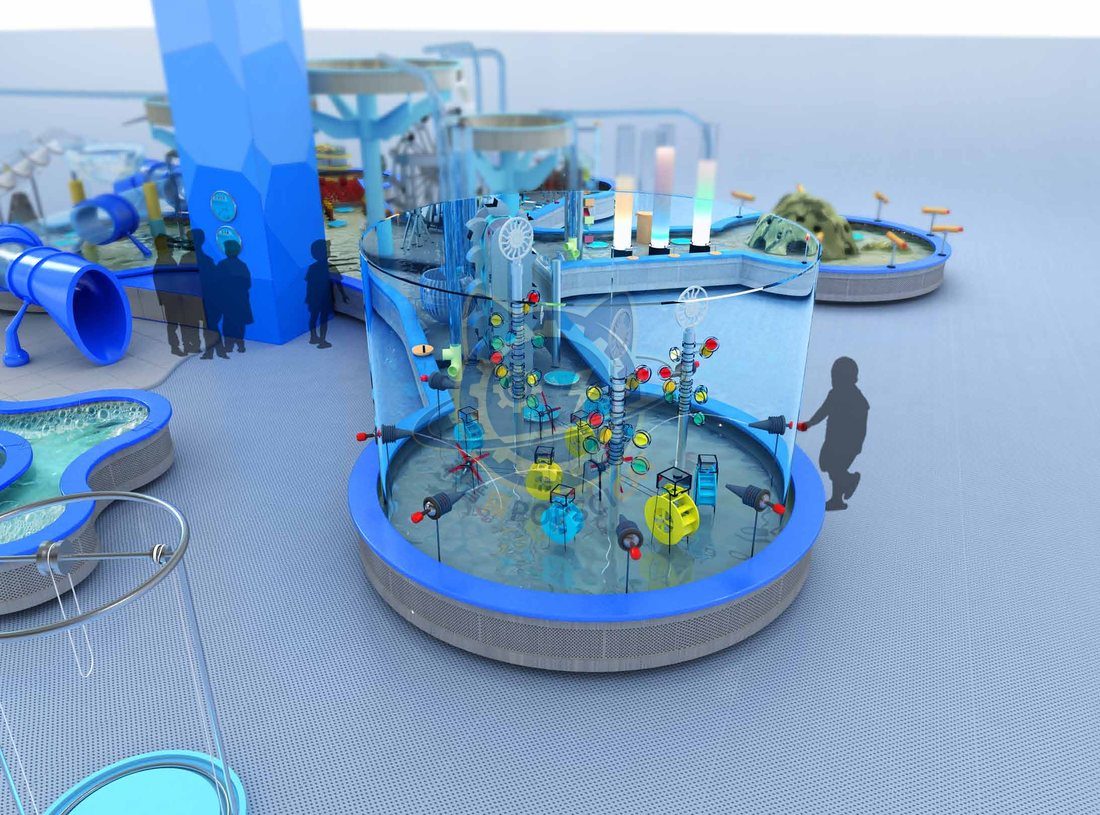
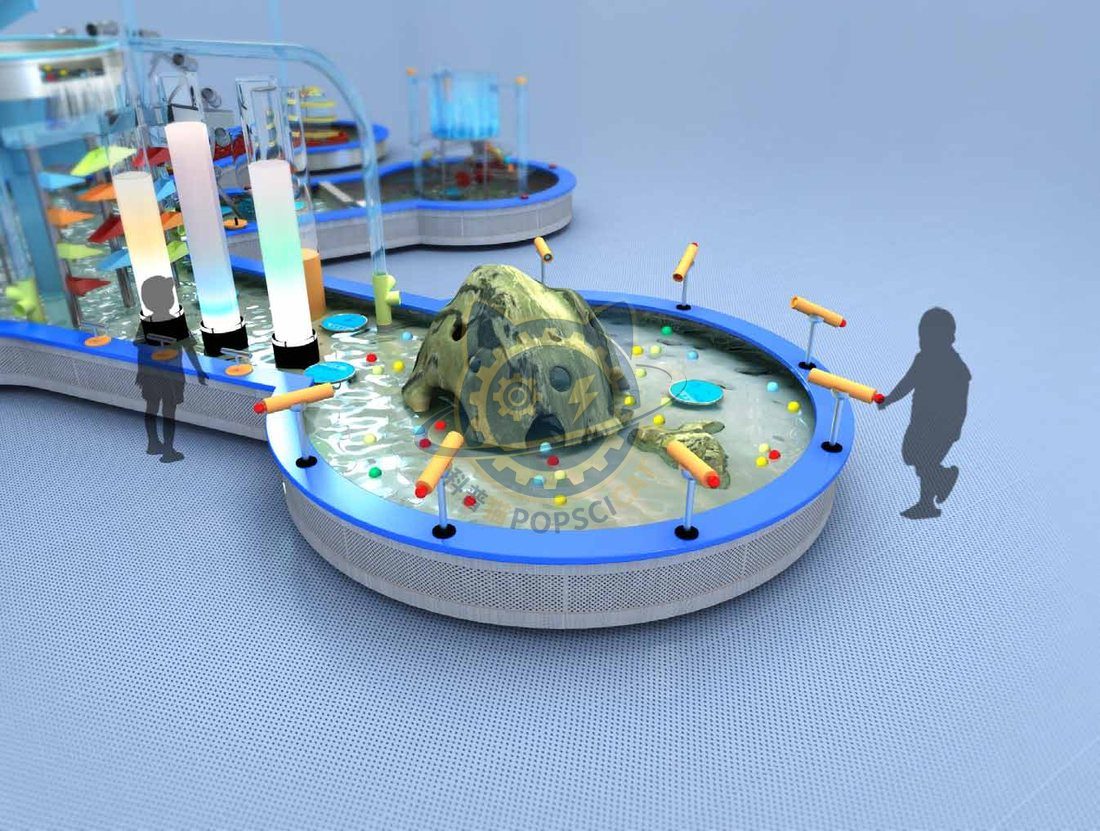
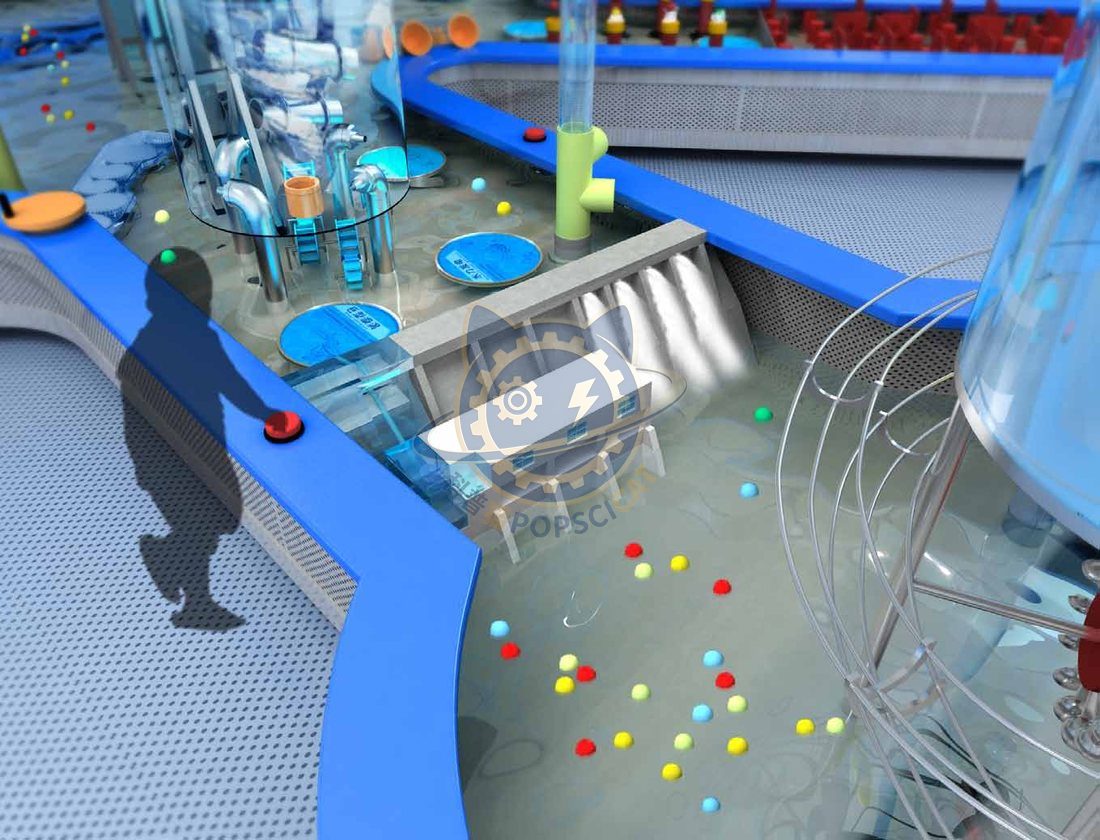
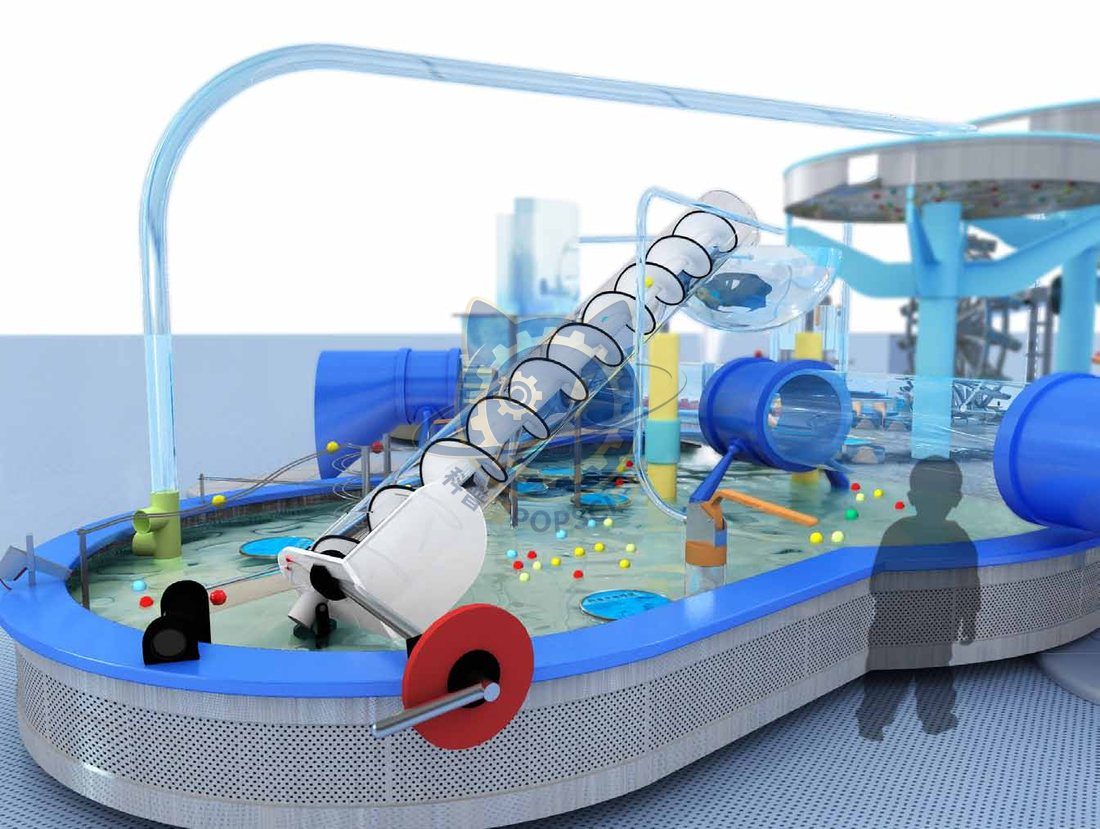
The barest set in the book. Eleven station renders from a single science-museum floor, supplied as images only — no exhibit list, no drawings, no written description of any station came with them. So we order them the way water travels: lifted at the pump, carried up by the wheels, held behind the dam, then turned, dropped, misted and finally thrown into the air on its way back to the basin.
The lifting side sits along one edge: a two-hand pump, a recoil drum, a chain of buckets and a full-height scenic wheel.
A dam wall with a working gate and a lock chamber, where the water is stopped and released on purpose.
A round basin whose inlets set the water turning, so it moves sideways instead of falling.
A stepped cascade and a spout that pours from nowhere — the two places where water goes back down.
A shout-driven fountain, a mist mushroom, and a fountain with a ball hanging in the column.
No drawing set came with this scheme, so the numbering here is ours: the pump first, then the wheels that carry water up, the gate that holds it, and the four stations that give it back — turned, dropped, misted, thrown.

A two-hand pump lifts water into a hanging bucket; the bucket fills, tips on its own and empties.

Water pushed into a drum leaves through a side nozzle, and the reaction spins the drum.

One wheel raises water in a chain of buckets; the second drives a row of tuned bars.

A full-height wheel on the pool edge — built to be watched as much as turned.

A dam wall with a working gate, and a lock chamber beside it for stepping water between two levels.

A round basin whose angled inlets set the whole body of water turning into a funnel.

Water walks down a set of shallow terraces, each one spilling over into the next.

A spout that pours with no pipe above it and nothing behind it — the feed is hidden in the rim.

A fountain that follows the noise at the rim: shout and the column climbs.

A mushroom head that releases cool mist rather than a jet, so children stand inside the spray.

A fountain head with a ball that hangs in the rising column instead of falling off it.
The seven schemes above are the ones with photographs. These fifteen are the reference layouts behind them: an island basin, a long river basin, a terrain table cast as a mountain range, a ring around a dry island, a splash floor with no basin at all. Every one was built for a room that already existed, which is why no two are the same shape.
Treat them as layouts, not products. We take the closest one and re-cut it against your floor plan — the basin, the apron and the element positions all move; the units inside them do not.

14 elements · Two-lobed basin, single level

13 elements · 9000 × 5500 mm overall

15 elements · Long narrow basin

14 elements · 7400 × 4800 mm overall

6 elements · 6500 × 4000 mm overall

Single feature · Free-form, three lobes

Two linked basins on a decorated deck

15+ elements · Long mountain-shaped table

14+ elements · Full ring around a dry island

Closed ring, dry centre

14 elements · L-shaped run, wall graphic behind

Foam ring rim, planted centre

Two lobes, lily pads and drums

Multi-zone floor, no single basin

Curved wall, jet arcade
Client names are withheld at the venue's request; the layouts, dimensions and element counts are the ones we built. Where a card carries a dash instead of an element count, the render reached us without a drawing set — the shape is accurate, the count is not ours to state. Text on the basin skirts and floor graphics is replaced with your own identity: we print the deck, the apron and the signage to your artwork.
Every station in the seven schemes is built from a catalogue of twenty-six standard units, each with its size published in millimetres. That is what lets a station you liked in one scheme go into yours, and lets a scheme be re-cut around a smaller room.
Twenty-three of the twenty-six already appear somewhere above. The three that do not are outdoor units — no basin, no pump, no power. They are here because they are the ones visitors ask for after they have seen everything else: something to pour into, something to turn, something to send a ball down.
Water fills a tipper and a loader; the visitor controls the discharge. Popular with older children and with anyone who likes diggers.
A crank feeds a header; the falling water turns a paddle wheel. One moving part, nothing to clog.
Water follows a helical channel around a central column, gaining speed as it descends, and drives a gear wheel at the base.
Length × width × height in millimetres, standard build. A different size is a new drawing, not a new concept. Fourteen of them open a full page; the rest are quoted from this table.
A water island lives or dies on its plant room. Every scheme above ships with the hydraulic design, not just the scenery.
| Water treatment | Closed loop with sand filtration, UV sterilisation and a balance tank. No standing water between sessions. |
|---|---|
| Surfaces | Pool body in gel-coated FRP or stainless 304; wetted hardware in 316 where chlorine load is high. |
| Safety | Rounded edges throughout, slip-rated wet deck, depth under 250 mm in the play basin, E-stop at the plant room. |
| Power | 100–240 V AC, 50/60 Hz. Pumps and controls in a separate dry plant room. |
| Lead time | Standard 3–6 weeks for a catalogue island; 4–8 weeks for a themed scheme with custom scenery. |
| Documentation | Render, three-view drawing and installation drawing for every station, plus a plant-room schematic. |
Attach a theme outline, a floor plan, or nothing at all — a photo of the space is enough to start. Quotations are issued against a real exhibit list, not per-square-metre guesses.
Prefer to see the floor before you commit? Factory visits and third-party inspections are welcome.

