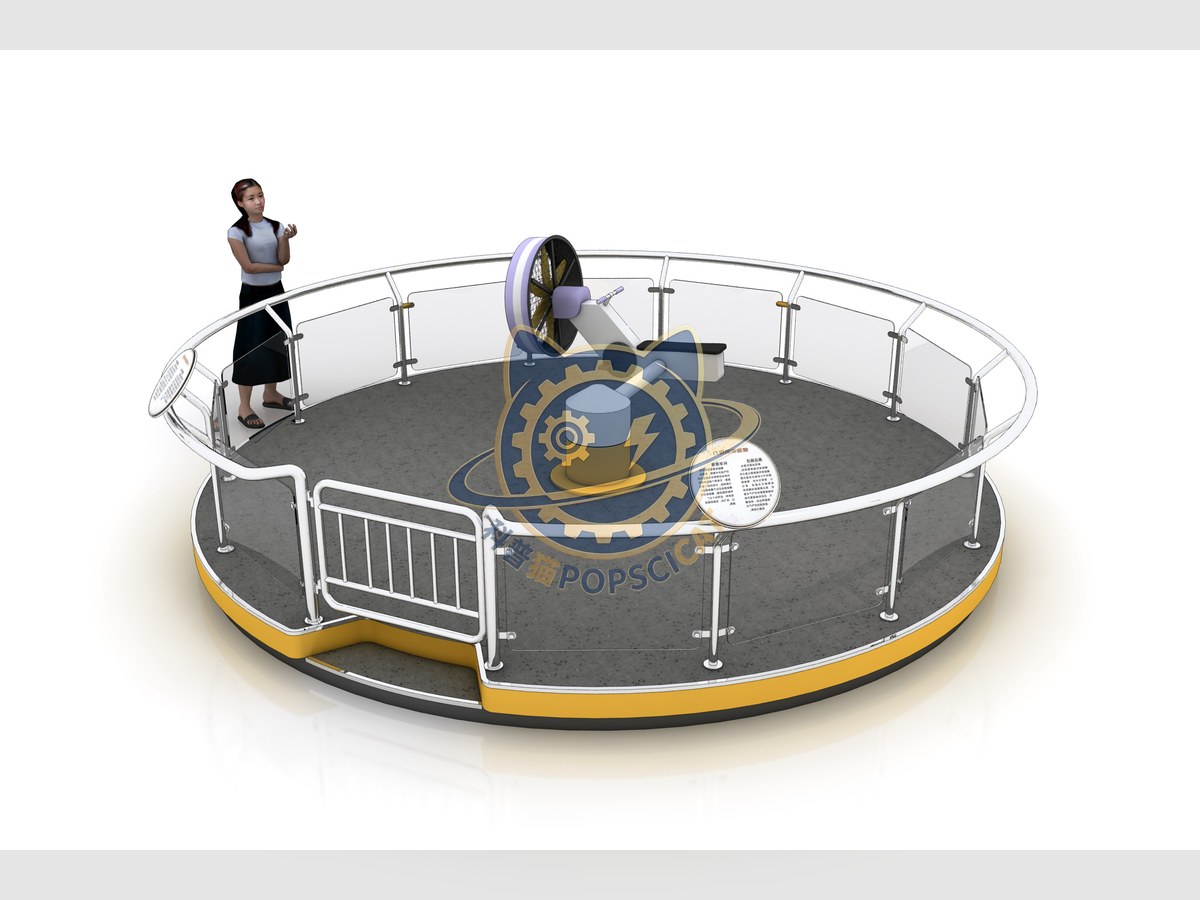
I. Purpose of the Exhibit Through interactive participation, the exhibit aims to educate visitors about Newton's Third Law (action and reaction). II. Scientific Principle The common statement of Newton's Third Law of Motion is: The action and reaction forces between two interacting objects are always equal in magnitude, opposite in direction, and act along the same straight line. This law was proposed by Isaac Newton in his 1687 book, "Philosophiæ Naturalis Principia Mathematica." When the propeller blades rotate, they draw in the air in front of them, and the resulting airflow generates a force directed backward. This is the reaction force, i.e., the thrust of the propeller. Each blade of an aircraft propeller is an elongated airfoil with a twist angle, and the twist angle of the blade is equivalent to the angle of attack of the aircraft wing. The cross-sectional shape of the propeller blade is very similar to that of the aircraft wing. The front face of the propeller blade corresponds to the upper surface of the wing, which has a greater curvature, while the rear face of the propeller blade corresponds to the lower surface of the wing, which has a nearly flat curvature. When the propeller blade rotates at high speed, the curvature of the front and rear propeller surfaces is different. The airflow exerts less pressure on the front propeller surface with a larger curvature, and more pressure on the rear propeller surface with a nearly flat curvature, thus creating a pressure difference between the front and rear propeller surfaces. Characteristics of Newton's Third Law: Newton's Third Law of Motion studies the mechanism of interaction and constraint between objects. The objects of study are at least two objects. Interactions between more than two objects can always be divided into several pairs of objects interacting with each other. Action and reaction are reciprocal and interdependent, each relying on the existence of the other as a prerequisite for its own existence. An action force without a reaction force does not exist. Force has materiality and cannot exist independently of objects (matter). Force is always generated by the interaction between two or more objects. Newton's Third Law also has an instantaneous nature, i.e., the simultaneity of action and reaction forces. They are generated, cease, and change simultaneously. The positions of the action and reaction forces are equivalent, and it is immaterial which one is called the action force and which one is called the reaction force. III. Functional Description (Technical Solution) The exhibit consists of a guardrail, a propeller assembly, a platform, etc. When participating, visitors enter the exhibit, sit in the seat under the guidance of the attendant, fasten their seat belts, grip the handlebars with both hands, and press the foot pedals. The propeller is driven to rotate slowly, generating an airflow that exerts a backward reaction force (i.e., the propeller's thrust). The propeller assembly then rotates under the influence of this force. Speed up the pedaling to experience the thrill of the exhibit moving in a circular motion! This exhibit primarily demonstrates the principles and knowledge related to Newton's Third Law (action and reaction). 4. Operating Instructions Sit on the seat, hold the handrails firmly with both hands, and pedal to experience the sensation of a rotating "merry-go-round.". It is built for unsupervised public use: surfaces are robust and wipe-clean, there are no loose parts, and the interface works without instruction, so a child of about six can operate it on a busy floor.