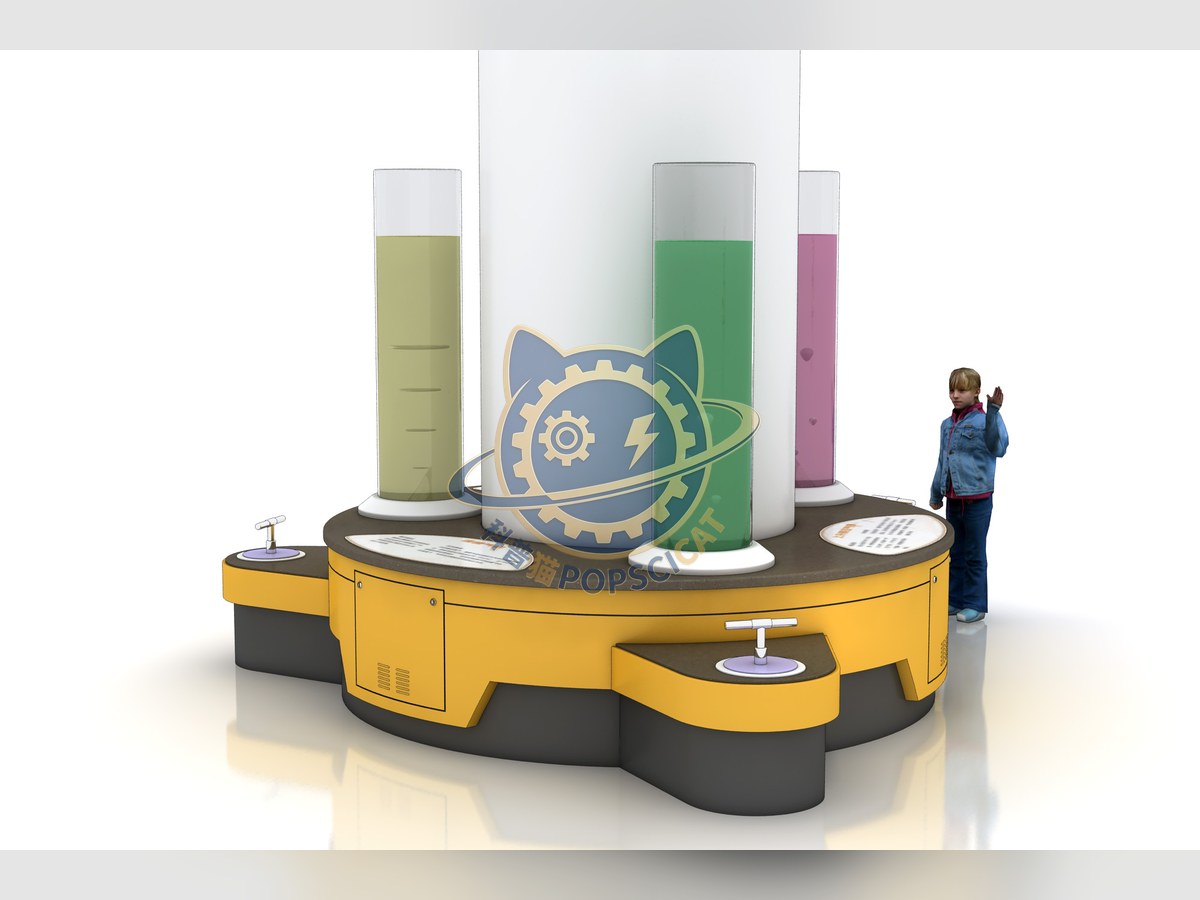
These "large cylinders" in front of us are new exhibits on the third floor.
| Category | Children's Discovery |
|---|---|
| Interaction | Open-ended, hands-on play |
| Standard size | Built to your floor plan |
| Power | 100–240 V AC, 50/60 Hz, single phase — universal input; no step-down transformer or motor re-tap |
| Supply | Single unit or batch · OEM to your drawing |
| Lead time | Standard 3–6 weeks after deposit (confirmed per contract) |
| Warranty | 1 year, structure and control |
| Documents | Specification sheet · control diagram · spare-part list |
A standard catalogue model: the dimensions, control package and finish are fixed, which is what keeps the price and the lead time predictable. Size, colour and interface language can be adapted without a new design cycle.
Standard models from this range are also listed in our online store, priced in USD — see the price yourself ↗
These "large cylinders" in front of us are new exhibits on the third floor. By operating the air pump in front, we can inject air into the cylinders and then observe what happens. We can see that the air injected into one of the cylinders rises slowly in the form of bubbles, and as it gets closer to the top, its volume increases. On the other side, a vortex forms, rising in a circular pattern and increasing in volume. Why is this? Actually, the two cylinders contain different liquids. The cylinder on the side with the bubbles contains silicone oil, while the one on the side with the vortex contains ordinary water. So why do two liquids, both injected with air, produce such different results? The answer lies in the phenomena we observe. In 1662, the British chemist Robert Boyle proposed, based on his experimental results, that for a fixed amount of gas in a sealed container, at a constant temperature, the pressure of the gas is inversely proportional to its volume. This is the first law in human history to describe the motion of gases, and also the first law to be discovered in human history. The discovery of Boyle's Law laid the foundation for later quantitative studies and chemical analyses of gases. It was not until a century later that the Frenchmen Charles and Gay-Lussac built upon this foundation to establish more comprehensive quantitative laws. The water level switch we usually use in washing machines operates based on Boyle's Law. The other is Bernoulli's principle, which was proposed by Daniel Bernoulli in 1726. Simply put, the higher the velocity of a fluid, the lower the pressure it generates. Fluids can be either gases or liquids, such as air, water, oil, etc. The essence of this principle is the conservation of mechanical energy in fluids. Our aircraft operate based on this principle. When an airplane is in flight, the distribution of air streamlines around the wings is asymmetrical in the shape of the cross-section, with dense streamlines and high flow velocity above the wings, and sparse streamlines below. It is built for unsupervised public use: surfaces are robust and wipe-clean, there are no loose parts, and the interface works without instruction, so a child of about six can operate it on a busy floor.
Interaction type: Open-ended, hands-on play. The unit is designed for unsupervised public use: controls are recessed or shielded, moving parts are enclosed, and the interface is operable by a child of about six with no instruction. Where a screen is used, the language can be switched without changing the hardware, and the content can be replaced on site.
Every unit leaves the factory after a running test: mechanisms cycled, electronics burned in, edges dressed, fixings torqued and marked. Wear parts — bearings, sliders, lamps, belts, touch panels — are modular and listed on the spare-part sheet, so a venue technician can replace them without returning the exhibit. Crating is plywood with foam blocking; the loading plan and packing list travel with the shipment.
Other models from the Children's Discovery line, all held to the same specification and the same control package.

A wheel that lifts balls and returns them by gravity.

A steel track for steel balls with a hand-cranked lift hill.

A padded tunnel with peepholes and a sound at the far end.

A soft-edged climbing frame with a slide and a lookout deck.
Attach a theme outline, a floor plan, or nothing at all — a photo of the space is enough to start. Quotations are issued against a real exhibit list, not per-square-metre guesses.
Prefer to see the floor before you commit? Factory visits and third-party inspections are welcome.