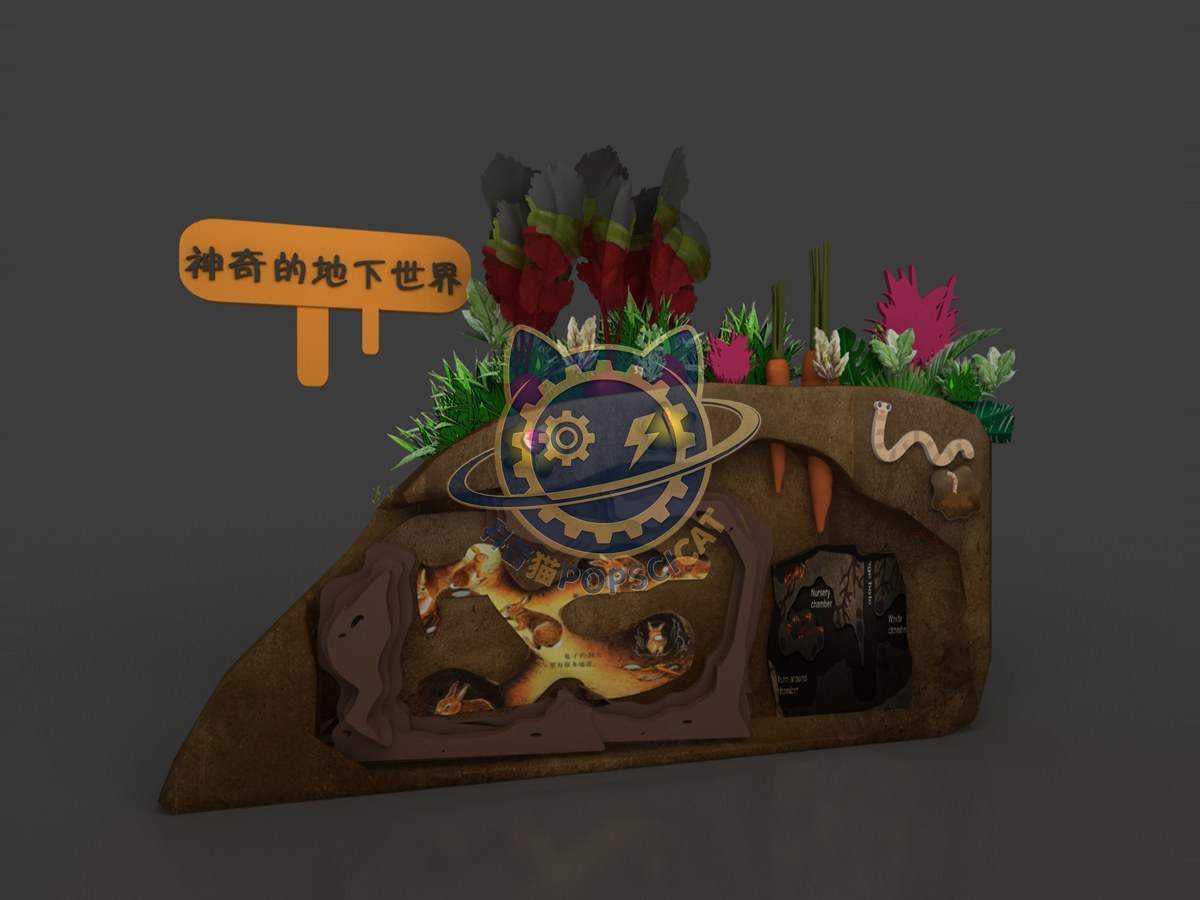
Within 20 meters below the ground surface, there are mainly habitats for animals and plants.
| Category | Children's Discovery |
|---|---|
| Interaction | Open-ended, hands-on play |
| Standard size | Built to your floor plan |
| Power | 100–240 V AC, 50/60 Hz, single phase — universal input; no step-down transformer or motor re-tap |
| Supply | Single unit or batch · OEM to your drawing |
| Lead time | Standard 3–6 weeks after deposit (confirmed per contract) |
| Warranty | 1 year, structure and control |
| Documents | Specification sheet · control diagram · spare-part list |
A standard catalogue model: the dimensions, control package and finish are fixed, which is what keeps the price and the lead time predictable. Size, colour and interface language can be adapted without a new design cycle.
Standard models from this range are also listed in our online store, priced in USD — see the price yourself ↗
Within 20 meters below the ground surface, there are mainly habitats for animals and plants. This exhibit shows us how rabbits, ants, and earthworms live underground, as well as models of plant root systems. Wild rabbits dig numerous burrows underground to hide from predators and protect their young. In order to protect their young, who have not yet opened their eyes, mother rabbits, who are not very strong attackers, have to rely on an intricate network of burrows. Such a network of burrows is like a "large communal courtyard," and its coverage can be as large as several football fields. Clever rabbits are adept at using the advantages of tunnels to evade their predators, which is what we often refer to as "a fox with many holes." Ants' underground nests are enormous, with an incredibly complex internal structure that is practically a maze. It has good drainage and ventilation systems, and most of its entrances and exits are small, arched mounds of earth, with a hole in the middle like a volcano. Earthworms live and spend their entire lives in the soil. They have the ability to burrow through the soil and dig tunnels. The tunnels they create crisscross and connect in all directions, mostly located within the topsoil layer at a depth of 7–14 centimeters. Earthworms are consumers, decomposers, and regulators in the ecosystem, and play an important role in changing soil fertility and soil texture. Plant roots are also deeply buried in the soil. Compared to the stems above ground, plant root systems are highly developed. A single wheat plant has over 70,000 fibrous roots, with a total length of about 500 meters. If you add up its roots and root hairs, the total length can reach 20 kilometers. Why do plants develop such extensive root systems? There are two main reasons. On the one hand, it is to facilitate the absorption of nutrients and moisture from the soil. On the other hand, plant roots help plants withstand various natural disasters, such as strong winds, heavy rain, and flooding. It is built for unsupervised public use: surfaces are robust and wipe-clean, there are no loose parts, and the interface works without instruction, so a child of about six can operate it on a busy floor.
Interaction type: Open-ended, hands-on play. The unit is designed for unsupervised public use: controls are recessed or shielded, moving parts are enclosed, and the interface is operable by a child of about six with no instruction. Where a screen is used, the language can be switched without changing the hardware, and the content can be replaced on site.
Every unit leaves the factory after a running test: mechanisms cycled, electronics burned in, edges dressed, fixings torqued and marked. Wear parts — bearings, sliders, lamps, belts, touch panels — are modular and listed on the spare-part sheet, so a venue technician can replace them without returning the exhibit. Crating is plywood with foam blocking; the loading plan and packing list travel with the shipment.
Other models from the Children's Discovery line, all held to the same specification and the same control package.

A wheel that lifts balls and returns them by gravity.

A steel track for steel balls with a hand-cranked lift hill.

A padded tunnel with peepholes and a sound at the far end.

A soft-edged climbing frame with a slide and a lookout deck.
Attach a theme outline, a floor plan, or nothing at all — a photo of the space is enough to start. Quotations are issued against a real exhibit list, not per-square-metre guesses.
Prefer to see the floor before you commit? Factory visits and third-party inspections are welcome.