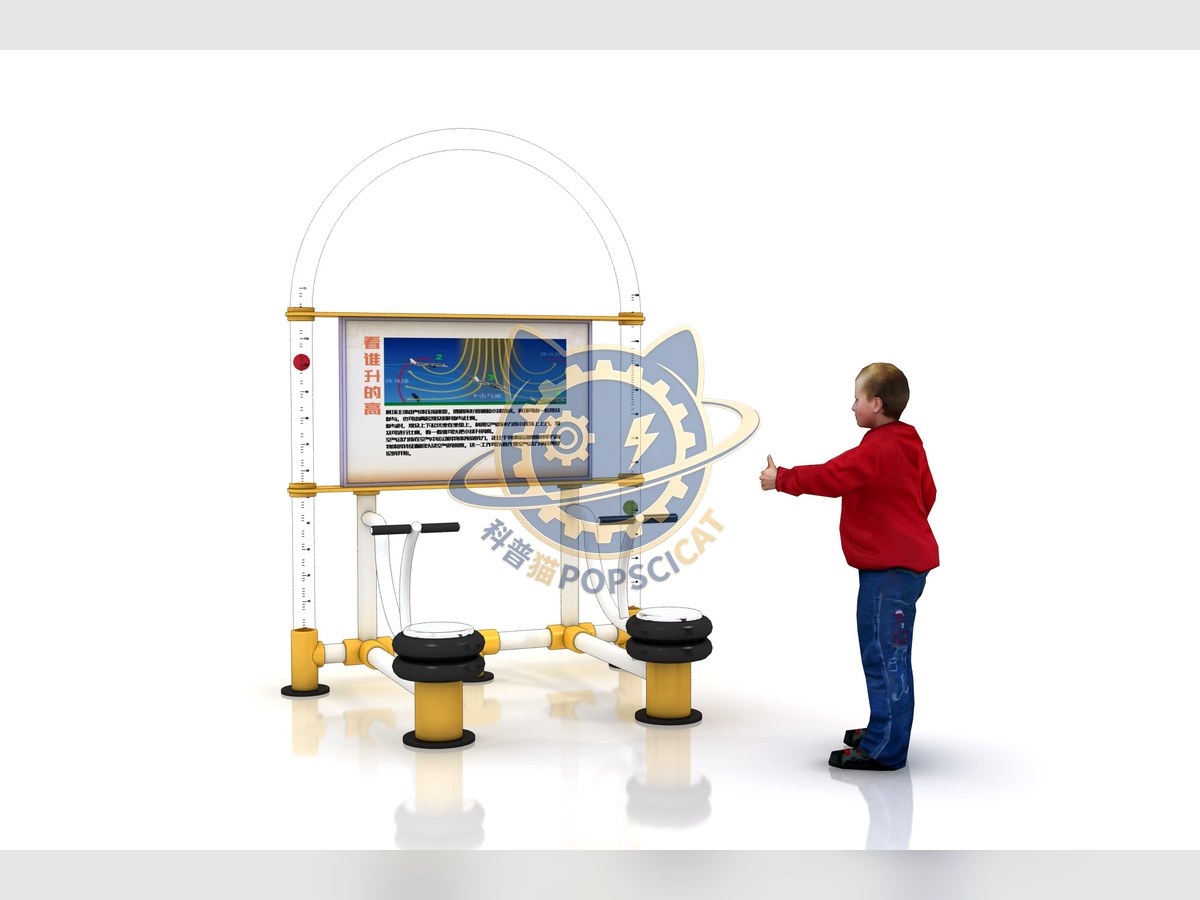
I. Purpose of the Exhibit This exhibit uses mechanical interaction to allow visitors to experience an engaging game and learn about the principles of gas pressure and energy conversion. II. Scientific Principles Gas Pressure Atmospheric pressure is the pressure exerted by the atmosphere on a unit area, i.e., it is numerically equal to the weight of a vertical column of air extending upward from a unit area to the upper limit of the atmosphere. The famous Magdeburg hemispheres experiment proved its existence. The SI unit of atmospheric pressure is the pascal, abbreviated as Pa. [1]. In meteorology, kilopascals (kPa) or hectopascals (hPa) are generally used as units. Other commonly used units are: bar (1 bar = 100,000 Pa) and centimeters of mercury (or millimeters of mercury). Atmospheric pressure varies not only with altitude but also with temperature. Changes in atmospheric pressure are closely related to changes in weather. According to the ideal gas law, pv = nRT: The gas pressure is directly proportional to the amount of gas (n) and the temperature of the gas (T), and inversely proportional to the volume of the gas (v). R is the universal gas constant. That is, when the temperature remains constant, pressure is inversely proportional to the volume of the gas; the larger the volume of the gas, the lower the pressure. When the audience squeezes the rubber tire seat, the gas inside the air cushion is compressed, its volume decreases, the pressure increases, and the small ball is ejected. Conservation of Energy Energy cannot be created or destroyed out of thin air. It can only be transferred from one object to another, and the forms of energy can also be converted into one another. This is people's summary of energy, known as the law of conservation of energy. It was discovered independently by more than 10 scientists from various professions in 5 countries, each from a different perspective. Among them, Mayer, Joule, and Helmholtz were the main contributors. It is one of the most fundamental laws in natural science, and it scientifically explains the idea that motion is indestructible. In the exhibit, visitors continuously compress the rubber tire seat, applying a force that serves as the initial energy. This energy is then converted into an impulse that propels the small ball through the compression of the gas within the seat's air cushion. III. Functional Description (Technical Solution) By squeezing the air cushion on the rubber tire, visitors propel the small ball in the front glass tube to move upward. It vividly and entertainingly demonstrates the relationship between the pressure and volume of gases, as well as the principles and knowledge related to energy conversion. IV. Operating Instructions (1) Sit on the seat, press down on the seat with force, and observe the small ball bounce up; (2) Compete with your friends to see whose ball rises the highest. It is built for unsupervised public use: surfaces are robust and wipe-clean, there are no loose parts, and the interface works without instruction, so a child of about six can operate it on a busy floor.