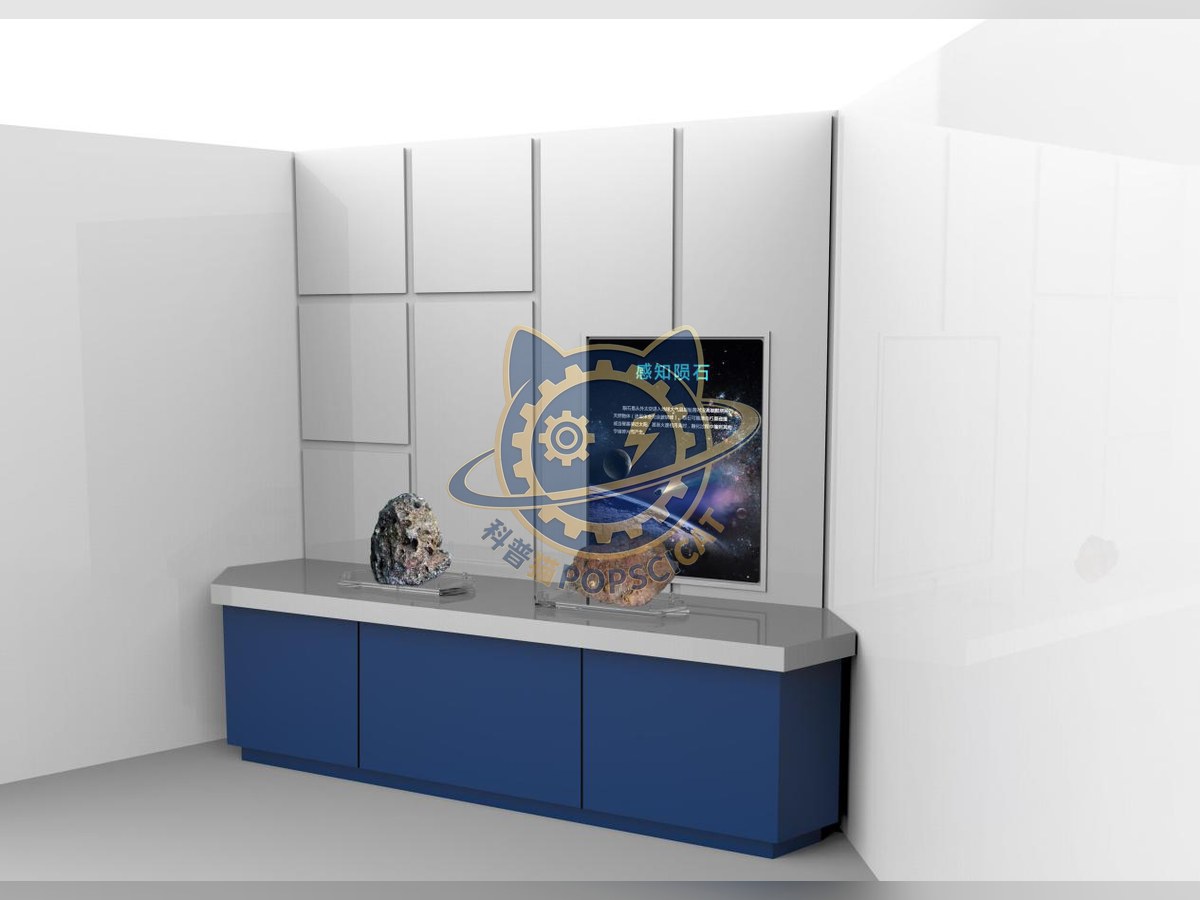
Meteorites, also known as "shooting stars," are unburned stony, iron, or stony-iron mixed materials that have deviated from their original orbits outside Earth and rapidly fall onto the surface of Earth or other planets as cosmic meteors or dust fragments. Meteorites come in various shapes and sizes. Based on the iron-nickel metal content within them, they are generally classified into four categories: stony meteorites, iron meteorites, stony-iron meteorites, and tektites. The two rocks before us are volcanic rock and meteorite, respectively. Visitors can observe and touch them to intuitively experience the characteristics of meteorites. Volcanic rocks, also known as extrusive rocks, are a type of igneous rock formed when magma erupted from a volcano rapidly cools and solidifies on the Earth's surface. Examples include basalt, andesite, rhyolite, and trachyte. So, how do we distinguish between meteorites and volcanic rocks? Characteristics of volcanic rock: Volcanic ejecta are rich in toxic gases such as sulfur vapor, sulfur dioxide, and benzene, and have a high void ratio. Most volcanic rocks have a lower density than quartz and ordinary glass, and their texture is loose and porous. Characteristics of meteorites: 1. During its descent, friction with the atmosphere generates high temperatures, causing the surface to melt and form a black fusion crust; 2. Interaction with air currents in the atmosphere leaves numerous air imprints on the surface; 3. Most meteorites contain metallic iron and are magnetic; 4. Most meteorites contain a large number of millimeter-sized silicate spherules; 5. Meteorites generally have a higher specific gravity, usually greater than that of ordinary rocks on Earth. Currently, the largest iron meteorite preserved in the world is the Hoba iron meteorite in Namibia, Africa, weighing approximately 60 tons. The second largest is the Cape York No. 1 iron meteorite in Greenland, weighing approximately 33 tons. The Xinjiang iron meteorite in China weighs about 28 tons and is the third-largest iron meteorite in the world. The largest stony meteorite in the world is the Jilin meteorite, with a total weight of 2,550 kilograms for the collected samples. The Jilin No. 1 meteorite, weighing 1,770 kilograms, is the largest stony meteorite fragment ever collected by humans. It is built for unsupervised public use: surfaces are robust and wipe-clean, there are no loose parts, and the interface works without instruction, so a child of about six can operate it on a busy floor.