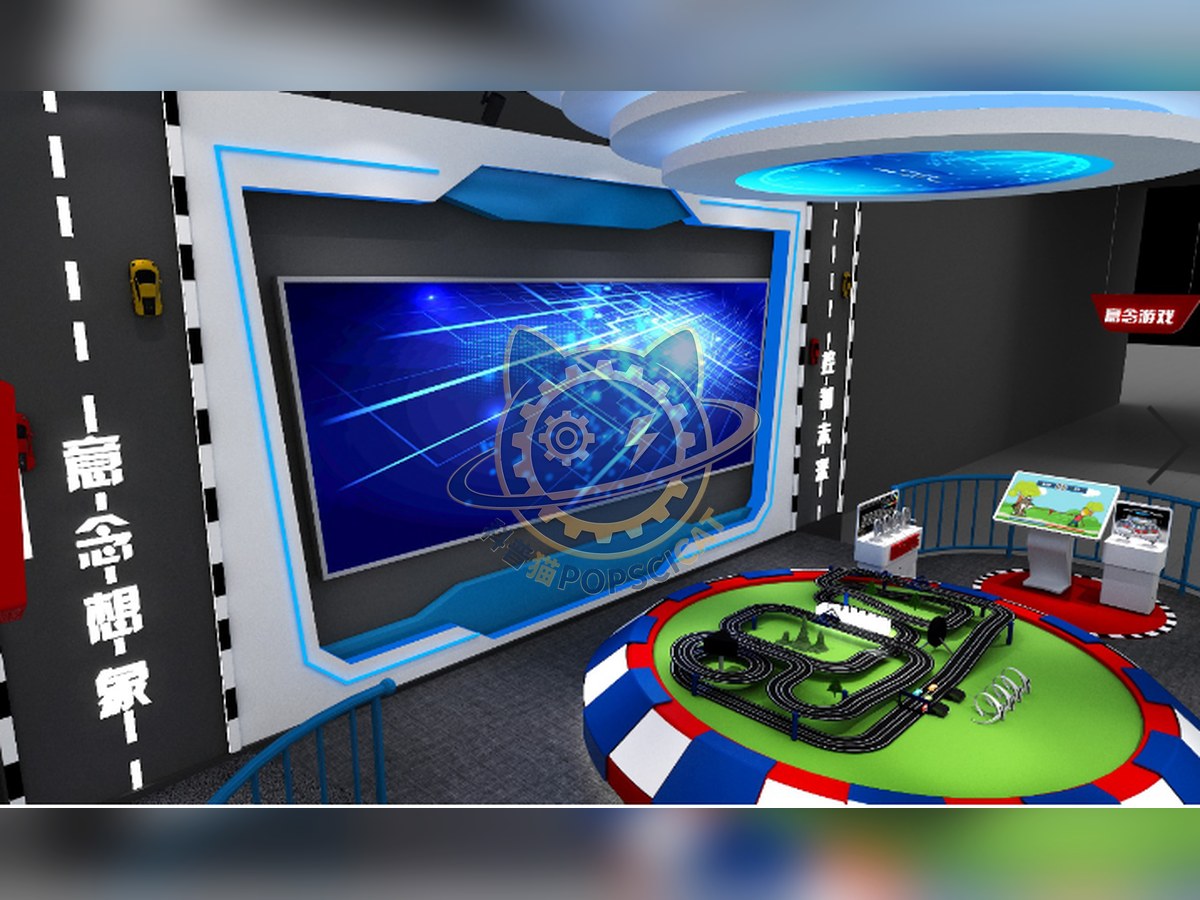
This is a slot car controlled by brainwaves. A thought-sensing headset collects brainwave signals, and the car's speed is controlled based on the level of brain focus determined by analysis. The higher the focus, the faster the speed. Extension: The brain is an organ of the human body that is more complex and mysterious than the most advanced computers in the world. The human brain weighs about 3 pounds and consists of two parts: the left hemisphere and the right hemisphere. These two hemispheres are connected by the corpus callosum. The corpus callosum is actually a bundle of nerve tissue responsible for coordinating the work of the left and right hemispheres. It connects the two hemispheres, enabling the transmission of memory and learning. Functional division of the left and right hemispheres The primary motor cortex is located at the top of the left and right hemispheres and is structurally symmetrical on both sides. Below the motor cortex is the sensory area, which also has a bilaterally symmetrical structure and is responsible for receiving and processing various types of information from the skin, bones, joints, muscles, and limb movements. This area is sometimes also called the somatosensory area. The division of labor between the motor and sensory areas of the brain is highly specialized: each specific area is responsible for controlling a specific part of the body. The left hemisphere controls the right hand and right foot, while the right hemisphere controls the left side of the body. Cerebral cortex Somatosensory and motor areas of the cerebral cortex Each part of these two areas of the cerebral cortex is connected to a specific part of the body. Most of the body's organs and tissues are represented in corresponding areas of the cerebral cortex. The size of the corresponding area of the cerebral cortex that controls a particular part of the body is not related to the actual size of that part of the body, but is proportional to the degree of precision required to control it. The areas of the human brain used to control the face and hands are relatively large, while the areas used to control the shoulders, neck, buttocks, torso, etc., are relatively small. The occipital lobe is located at the back of the brain, just above the brainstem, and is where vision is processed. Although each hemisphere receives information from both the left and right visual fields, the left eye sends more information to the right hemisphere, and the right eye sends more information to the left hemisphere. Each eye has a corresponding dominant hemisphere. The term "dominant hemisphere" refers to the hemisphere that responds more to information or dominates the response. Cerebral hemispheres Although the stimuli received by each ear are transmitted simultaneously to both hemispheres of the brain, the input to the contralateral hemisphere is usually stronger. In simple terms, the information received by the right ear is first sent to the left hemisphere, and then to the right hemisphere. As mentioned earlier, the brain is not perfectly symmetrical. Many specialized functional centers appear to be primarily located in one hemisphere of the brain or the other. The speech center and the auditory center are located on the left side of the brain, just above the ear (Broca's area). The auditory memory area is located behind the auditory center. The language area (i.e., Wernicke's area) is located in the left hemisphere for most people, but it can actually develop in either hemisphere. It is built for unsupervised public use: surfaces are robust and wipe-clean, there are no loose parts, and the interface works without instruction, so a child of about six can operate it on a busy floor.