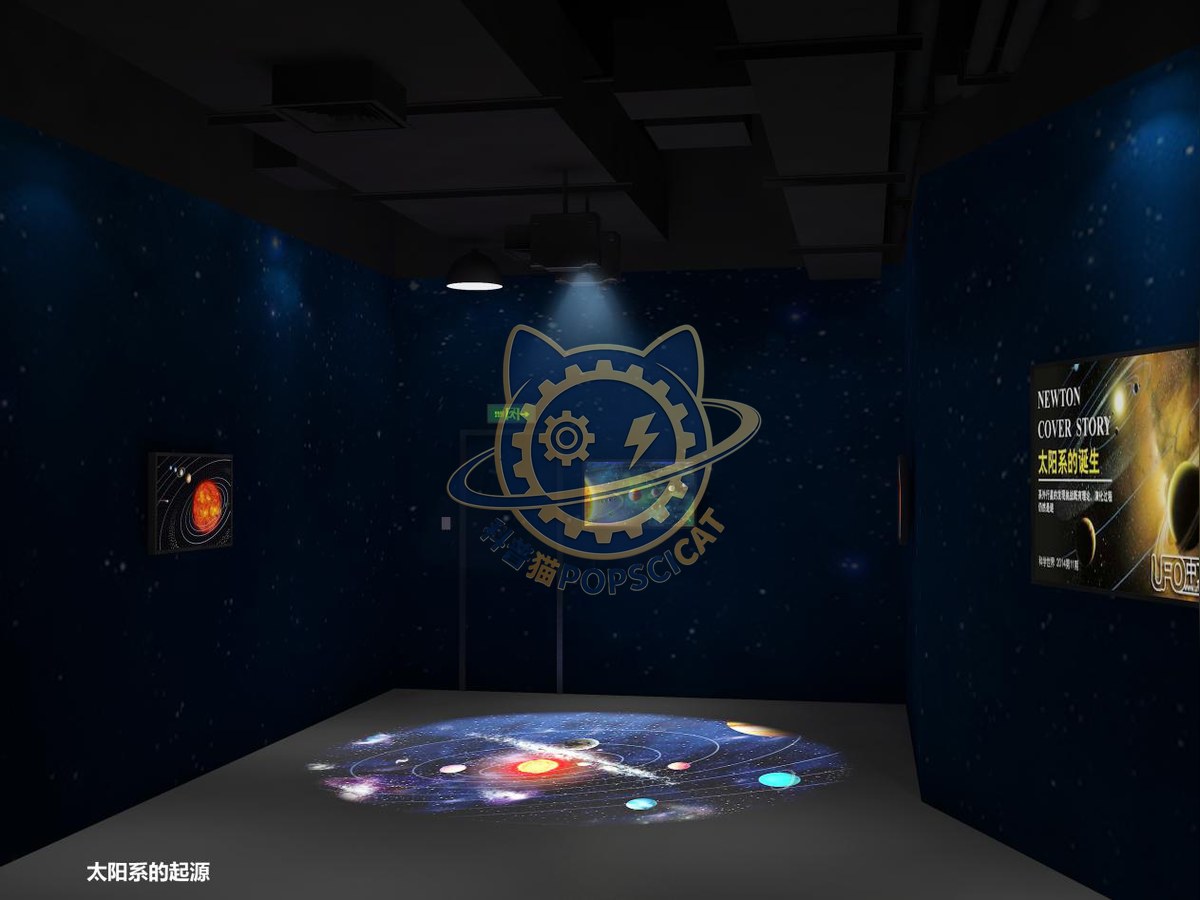
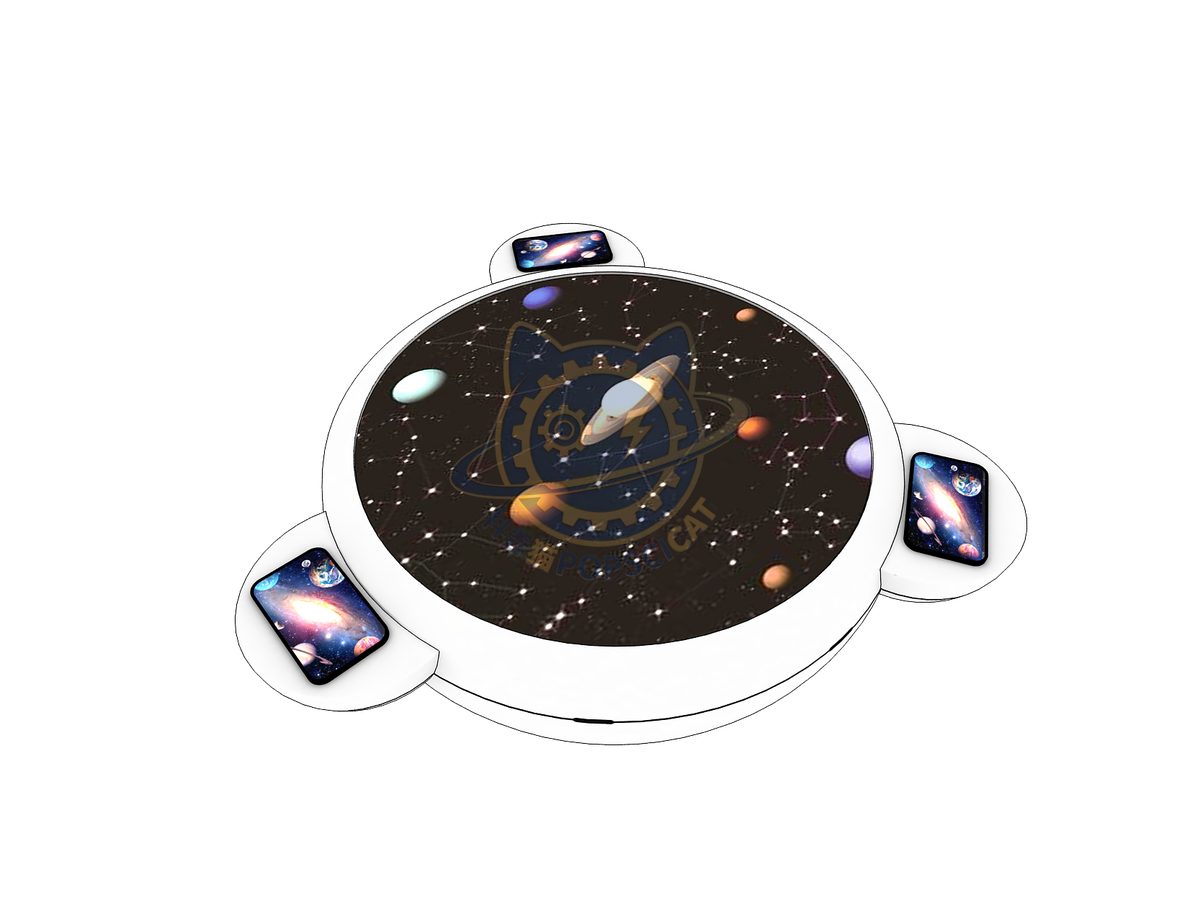
The first exhibit we came to was the Origin of the Solar System. Through animated visuals on displays and projectors, this exhibit presents the process of the formation of the solar system and the positions of the eight planets within it. The visuals are vivid, engaging, and full of depth. We know that the origin of the solar system is a major fundamental theoretical question in natural science. To date, scientists have proposed different theories about the origin of the solar system. For example, the "Nebular Hypothesis," the "Catastrophic Hypothesis," the "Capture Hypothesis," and so on. The "Nebular Hypothesis" was independently proposed by the German philosopher Immanuel Kant and the French astronomer and mathematician Pierre-Simon Laplace in 1755 and 1796, respectively. The academic community collectively refers to their theories as the "Kant–Laplace Nebular Hypothesis." They believed that approximately 5 billion years ago, the "protosolar nebula" suddenly underwent an explosion. Due to gravitational forces, the central part of the nebula formed the Sun, while the outer regions formed planets and moons. The "catastrophe theory" was proposed by the French naturalist and writer Georges-Louis Leclerc, Comte de Buffon, in 1745. He hypothesized that a large comet once collided with the Sun, and the ejected incandescent matter eventually condensed to form planets and moons. In the 1940s, Swedish physicist Hannes Alfvén, former Soviet scientist Vladimir Schmidt, and others successively proposed the "capture theory." They believed that planetary matter was formed from a nebula, and that the Sun, with its powerful gravitational force, gradually captured nebular matter from interstellar space to form a protoplanetary disk, within which planets were formed. Regardless of the theory, it is a representation of fundamental scientific principles. If you are interested, you can take a few minutes to watch the video and learn about the origin of the solar system. Our video systematically explains the entire process of the solar system's origin, as well as the various scientific principles involved in its formation. It is built for unsupervised public use: surfaces are robust and wipe-clean, there are no loose parts, and the interface works without instruction, so a child of about six can operate it on a busy floor.