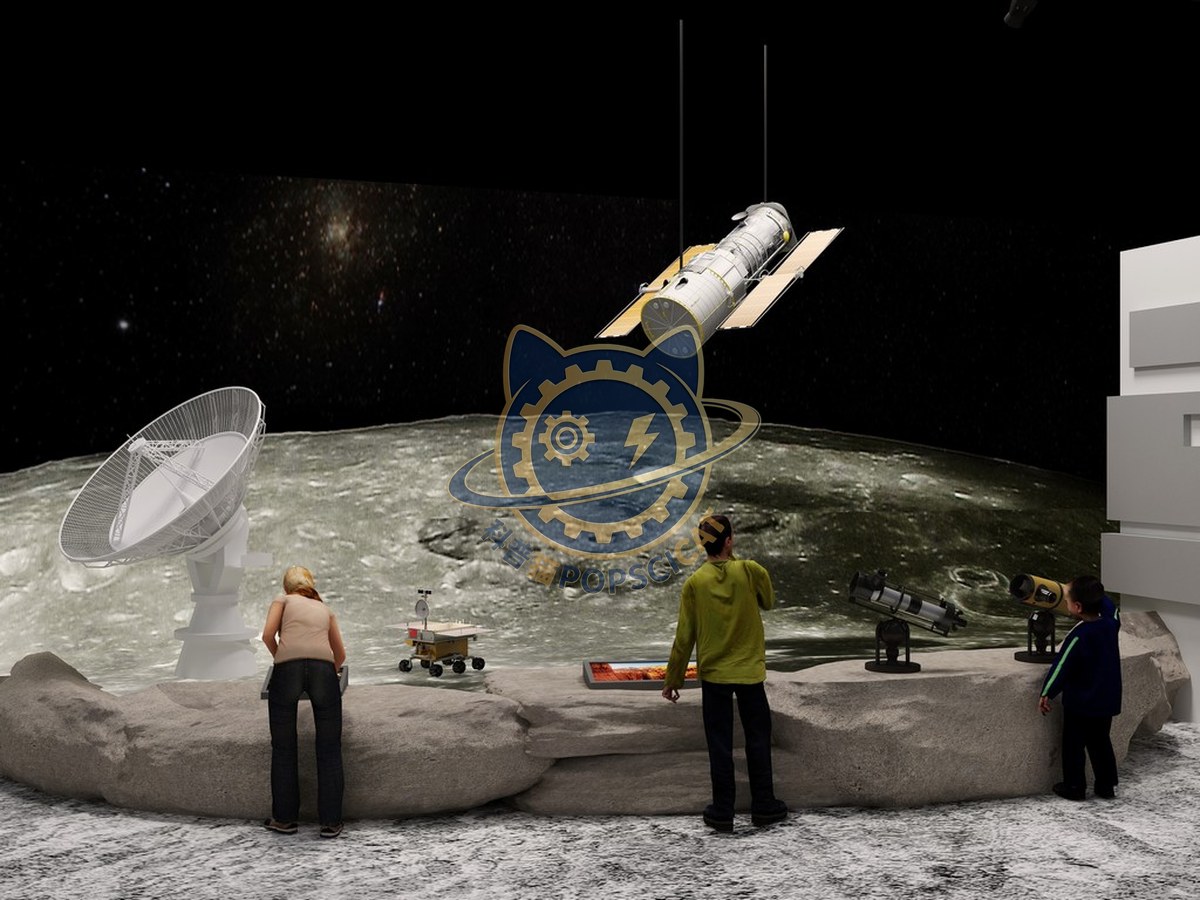
Here we can see three different telescope models: the Newtonian reflector telescope, the radio telescope, and the Hubble Space Telescope. Telescopes are an extension of human vision and an indispensable tool for astronomical and terrestrial observations. 1. The Newtonian reflector is by far the most widely used type of reflecting telescope. It is a telescope that uses a concave mirror as the primary mirror. It has a parabolic mirror as the primary mirror and a flat diagonal mirror as the secondary mirror. Light is reflected onto a focal point through the curved mirror surface, magnifying the object several times for easier observation. Reflecting telescopes are mainly used in astrophysics. They can record information emitted by celestial bodies across a wide range of visible light. At the same time, the use of mirrors effectively solves the problem of chromatic aberration. 2. A radio telescope is a telescope that primarily receives radio-frequency radiation from celestial bodies. It can measure the intensity, spectrum, and polarization of radio waves emitted by celestial bodies. The four major astronomical discoveries of the 1960s – pulsars, quasars, cosmic microwave background radiation, and interstellar organic molecules – were all related to radio telescopes. On September 25, 2016, the Five-hundred-meter Aperture Spherical Telescope (FAST), located in Guizhou Province, China, was inaugurated and put into operation. It is the world's largest single-aperture and most sensitive radio telescope. 3. The Hubble Space Telescope is a space telescope in Earth's orbit that revolves around the Earth. It is also humanity's first space telescope. It receives commands from the ground control center (located at Johns Hopkins University in Maryland, USA) and transmits various observation data back to Earth via radio. Because it operates in outer space, the images obtained by the Hubble Telescope are not affected by atmospheric turbulence and refraction, and it can obtain images of the infrared spectrum that are usually absorbed by the atmosphere. It has successfully compensated for the shortcomings of ground-based observations, helping astronomers solve many fundamental astronomical problems and enabling humans to gain a better understanding of astrophysics. The Hubble Ultra Deep Field is the deepest and most sensitive optical image of space that astronomers can currently obtain. It is built for unsupervised public use: surfaces are robust and wipe-clean, there are no loose parts, and the interface works without instruction, so a child of about six can operate it on a busy floor.