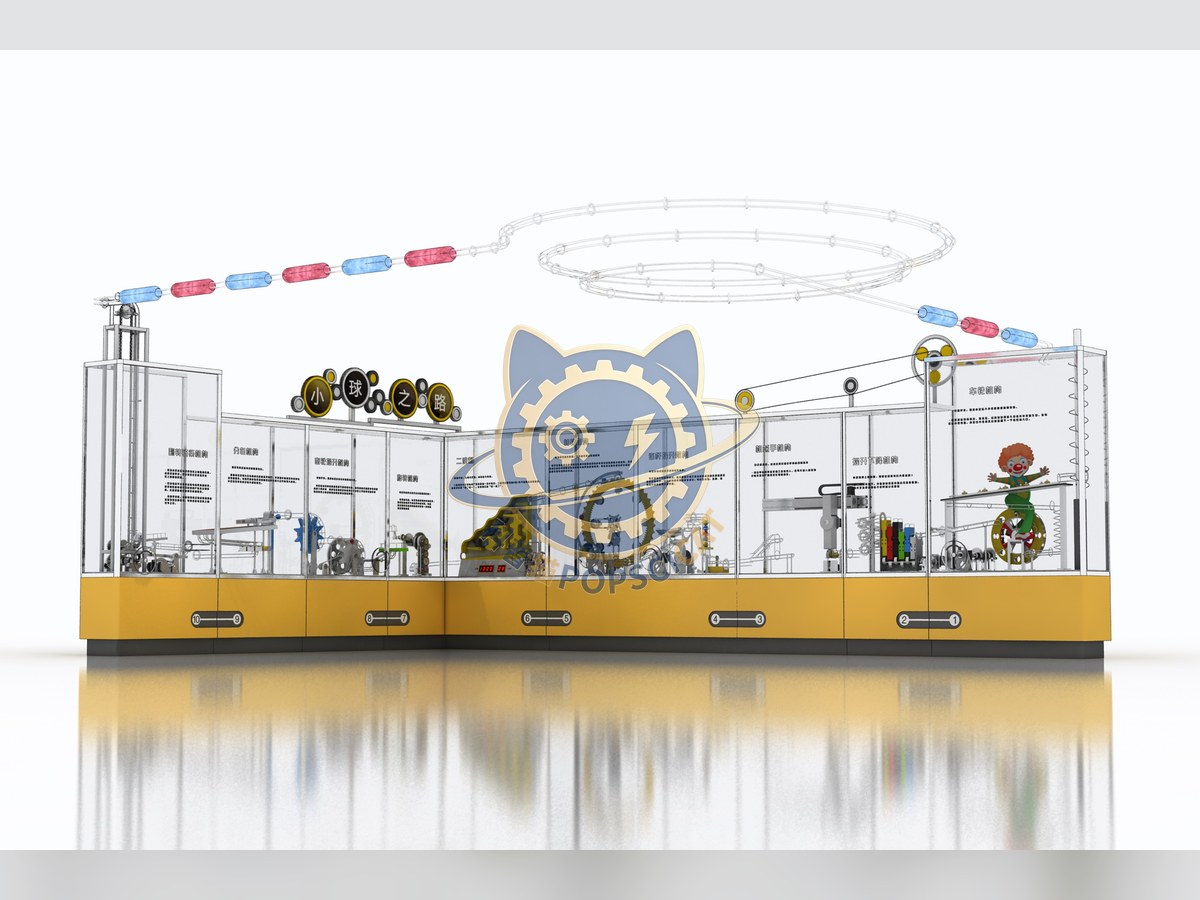
I. Purpose of the Demonstration By demonstrating the motion of a small ball, we can learn about mechanical structures and mechanical transmission. II. Scientific Principles Mechanical transmission comes in various forms, primarily categorized into two types: 1. Friction transmission, which relies on the frictional force between mechanical components to transmit power and motion, including belt transmission, rope transmission, and friction wheel transmission, among others. Friction drives can easily achieve continuously variable transmission and are generally suitable for applications with large shaft distances. Overload slippage can also act as a cushion and protect the transmission. However, this type of transmission is generally not suitable for high-power applications and cannot guarantee an accurate transmission ratio. 2. Meshing transmission, which transmits power or motion through the meshing of driving and driven parts or with the aid of intermediate parts, includes gear transmission, chain transmission, screw transmission, and harmonic transmission, among others. Meshing transmission can be used in high-power applications, and the transmission ratio is accurate, but it generally requires high manufacturing and installation precision. III. Functional Description (Technical Solution) Mechanical transmission is widely used in mechanical engineering. The term "mechanical transmission" primarily refers to transmission that uses mechanical means to transmit power and motion. Classification of mechanical transmissions: 1. Friction transmissions that rely on the frictional force between mechanical components to transmit power and motion, including belt drives, rope drives, and friction wheel drives, etc. 2 Meshing transmissions that transmit power or motion through the engagement of driving and driven elements, or through the engagement of intermediate elements, including gear transmissions, chain transmissions, screw transmissions, and harmonic transmissions, among others. Introduction to several types of transmission Belt transmission: A type of transmission that uses a belt as an intermediate flexible element to transmit motion or power. The basic principle of belt drive is to rely on the frictional force between the belt and the pulley to transmit motion and power. Gear drive: Consists of two gears, one mounted on the drive shaft and the other on the driven shaft, meshing with each other. Gear transmission is the most widely used form of transmission. Chain drive: Consists of two gears with special tooth profiles and a closed chain. During operation, the teeth of the driving sprocket mesh with the links of the chain, driving the driven sprocket that meshes with the chain. Worm gear drive: When a gear has one or more helical teeth and meshes with a worm wheel (similar to a helical gear) to form a crossed-axis drive, this type of drive is called a worm gear drive. Screw drive: A screw drive uses a screw-nut pair to achieve the required transmission. It is mainly used to convert rotational motion into linear motion while transmitting both motion and power. IV. Operating Instructions (1) Turn the handwheel and observe the trajectory of the ball after it enters the wheel. (2) Observe how the ball climbs the steps and watch its movement within the spiral track. (3) Touch the display screen and follow the prompts to make the robotic arm perform the corresponding actions. (4) Turn the handwheel to drive the multi-link mechanism to lift the ball. (5) Observe how the ball is transported from the lower end to the upper end. (6) Turn the handwheel to lift the ball and observe the transmission of the gears and pulleys. (7) Turn the handwheel to drive the cam mechanism, open the valve, and allow the ball to enter the track. (8) Turn the handwheel and observe the movement of the ball within the track. (9) Observe and analyze the trajectories of the differently colored balls. (10) Observe the movement of the ball on the track connected to the flipping mechanism. Continue to turn the handwheel and observe the movement of the small balls on the chain lifting track. It is built for unsupervised public use: surfaces are robust and wipe-clean, there are no loose parts, and the interface works without instruction, so a child of about six can operate it on a busy floor.