Two suppliers quote the same exhibit at 4,000 and 12,000 dollars. Neither is necessarily lying. What separates them is rarely margin — it is the machine underneath, the duty cycle it is designed for, and which parts of the job have been quietly left out of the price. This is what actually drives the number.
The same exhibit name can mean three different machines
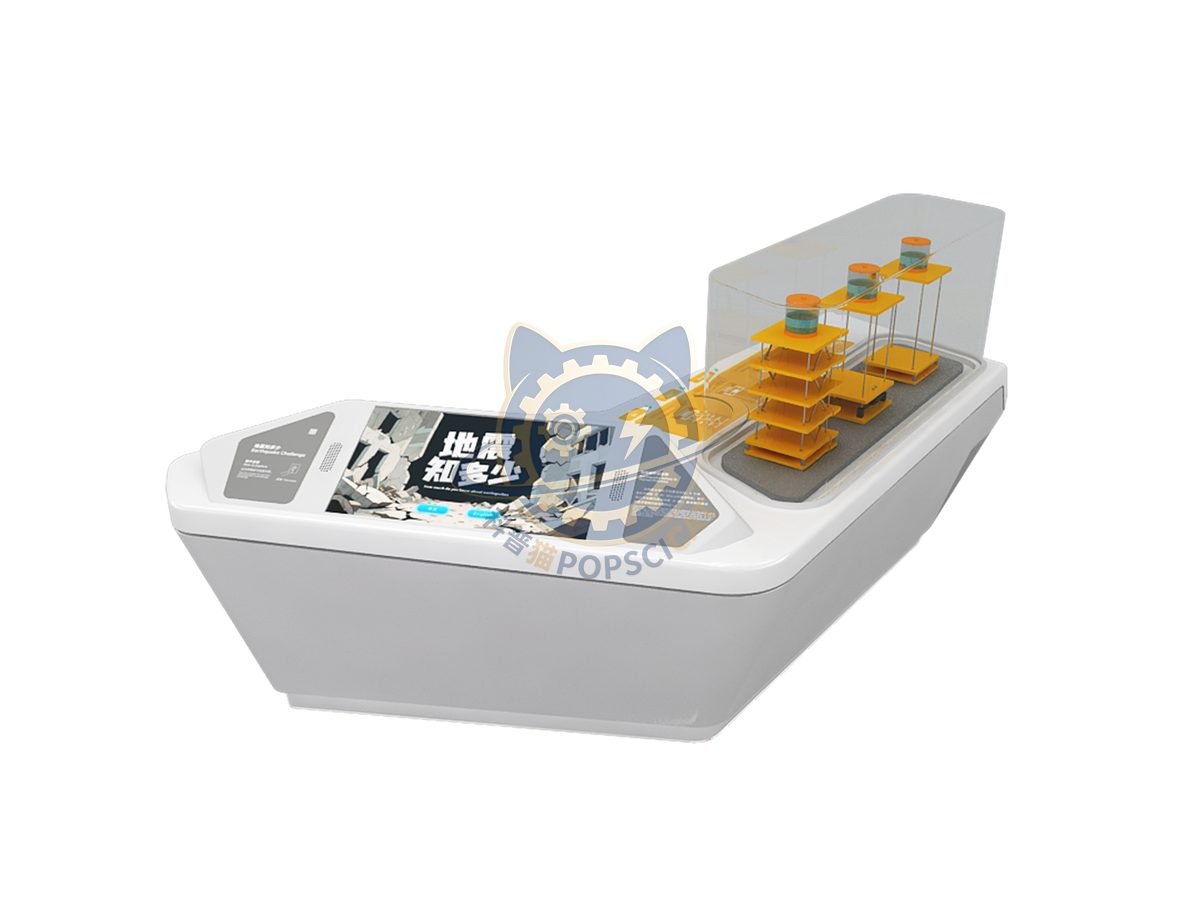
Take a unit called "earthquake simulator". It can be built as a manual crank on a sprung platform, as a motorised platform with a fixed waveform, or as a servo-driven platform with selectable frequency, amplitude and a load cell under the visitor's tower. All three are honestly described by the same name. They cost roughly 1 : 2.5 : 6.
This is the single largest source of price confusion in the industry, and it is why a quotation without a description of the mechanism is not a quotation — it is a starting position.
1. How it moves
The drive train is usually the biggest line in the cost of a moving exhibit. Manual mechanisms are cheapest and the most durable, but they only work where the visitor's effort is part of the point. Motorised units add a motor, a controller, limit switches and a safety system that stops the movement when something is in the way. Servo systems add feedback, tuning and a technician who understands them.
A useful rule: every axis of powered motion roughly doubles the engineering effort compared with a static unit of the same size, and every extra degree of freedom adds a failure mode that someone has to be able to diagnose on site.
2. How much of it is electronic
Mechanical units have no electronics at all, which is why they last and why they are cheap to own. Add a sensor and a PLC and you have added a power supply, wiring, an enclosure, a maintenance procedure and a spare-part list.
Digital interactives are a different category of purchase. A screen-based unit has a computer, a display, software and a content pipeline — and all four need a plan for year three, not just year one. When a museum compares a projected interactive with a mechanical unit at the same price, they are usually comparing a machine with a service.
Our own default is to keep a physical object inside the interaction loop wherever the exhibit can carry it. It is a cost decision as much as a design one: a unit that still does something visible when the software is being updated is a unit that does not need an emergency call-out.
3. What it is made of, and how it is finished
Steel is cheap; stainless steel is not. Standard acrylic scratches; coated acrylic costs about a third more and lasts several times longer in a public gallery. Powder coating is more expensive than wet paint and much more forgiving of a floor cleaner with a harsh cloth.
Finish is also where graphics live, and graphics are the most frequently replaced part of any exhibit. A design that lets a printed panel be swapped without touching the mechanism costs a little more at build and considerably less every three years.
4. The duty cycle you buy for
This is the line that most often explains a price gap, and the one clients least often specify.
| Setting | Approximate use | What changes |
|---|
| School lab | Hundreds of cycles a week | Standard bearings, lighter frame, occasional maintenance |
| Community centre | One to two thousand a week | Upgraded bearings, locked fasteners, accessible panels |
| Holiday science centre | Several thousand a week | Industrial drive, oversized frame, modular wear parts, spare kit |
A school unit installed in a holiday centre is not a cheap exhibit — it is a machine being used outside its design envelope, and it will fail in month eight in a way that looks like a manufacturing fault. The cost difference between the first and third rows is typically twenty to forty per cent. The difference in service life in that setting is several years.
5. Packaging and freight
Export crating is not optional for sea freight: plywood cases, foam blocking, desiccant and a loading plan add a real percentage to the unit price, and a badly crated unit arrives with a bent frame that nobody can prove was the carrier's fault. Air freight needs less crating but costs more per kilogram, which matters for heavy steel units.
Ask any supplier what the unit weighs packed, and how it is braced inside the case. If the answer is vague, the packing is a line item someone is planning to skip.
6. Installation and commissioning
Two models are common. A supplier sends a team, installs, commissions and trains the site crew — the price includes flights, visas, accommodation and days. Or the supplier ships with detailed instructions and commissions remotely with a local crew — cheaper, and it works when the museum has a competent technical team.
What must not be left out is commissioning: a full running test on site, a fault log, and a walk-through of the spare kit with the people who will use it. That is one to three days on a mid-size gallery and it is the difference between a delivery and a handover.
7. Quantity, and what repeat really buys
The first unit of a new design carries the engineering. The tenth carries materials and labour. This is why a supplier who has already built a unit can quote it far below one who is designing it for the first time — and why a catalogue of standard models is cheaper than a fully custom floor of the same size.
Where custom work earns its price is the anchor piece: the thing in the atrium that gives the building its identity. Mixing a few custom units with a backbone of standard models is almost always better value than making everything bespoke, and it is what we recommend when a budget is fixed.
What the split usually looks like
Across our own projects, the rough shape of a powered interactive exhibit price is: mechanism and structure 35–45 per cent, control and electronics 15–30 per cent, finish and graphics 10–15 per cent, packaging 5–8 per cent, and installation and commissioning 8–15 per cent. A purely mechanical unit shifts everything towards structure and finish; a screen-based unit shifts it towards control and content.
Those ranges are indicative, not a quotation. They are useful for one thing: reading someone else's quote. If a price is far below the shape above, something in the list is missing — usually duty cycle, installation or spares.
How to ask for a price that means something
Give the supplier four numbers and one sentence: the age band, the weekly opening hours, the number of units, the destination country, and what the visitor is supposed to do with the unit. With those, a manufacturer can quote a machine rather than a picture.
Then ask for the five lines: mechanism, control, finish, packaging, installation — plus spares as a sixth. A supplier who can break the price down is a supplier who knows what they are building. One who cannot is either reselling or guessing, and both are expensive in the second year.
About this article
Written by our engineering and sales team from live project work, not from a survey. Figures describe our own projects and are indicative; they are not a quotation. Sizes, ages and specifications refer to standard models and change with custom work.