Every year we get asked the same question in the first meeting: which exhibits actually work? Not which ones photograph well, not which ones win the design review — which ones a museum runs for three years and then orders again for the next floor. Below are the ten units that come back most often in our order book, what each one teaches, and the reason it survives a public floor.
How this list was put together
This is not a market survey. It is our own order book: repeat orders, re-orders for second phases, and the enquiries that arrive already naming a unit because a neighbouring museum has one. Ten units, ranked by how often they were specified again in the last twelve months.
Two things about the ranking are worth saying plainly. First, popularity is not the same as educational value — a few of the units below are on the list because they are cheap to run and impossible to break, not because they teach something profound. Second, the age ranges given are the ranges we build to, not the ages visitors actually behave like. A well-built unit for a seven-year-old gets used by adults on a Sunday afternoon, and it has to survive that too.
All ten are in production with fixed dimensions and a spare-part list, which is the real reason a museum can plan around them. Custom work is where the interesting projects are, but a floor needs a backbone of units that can be ordered, delivered and repaired without a design cycle.
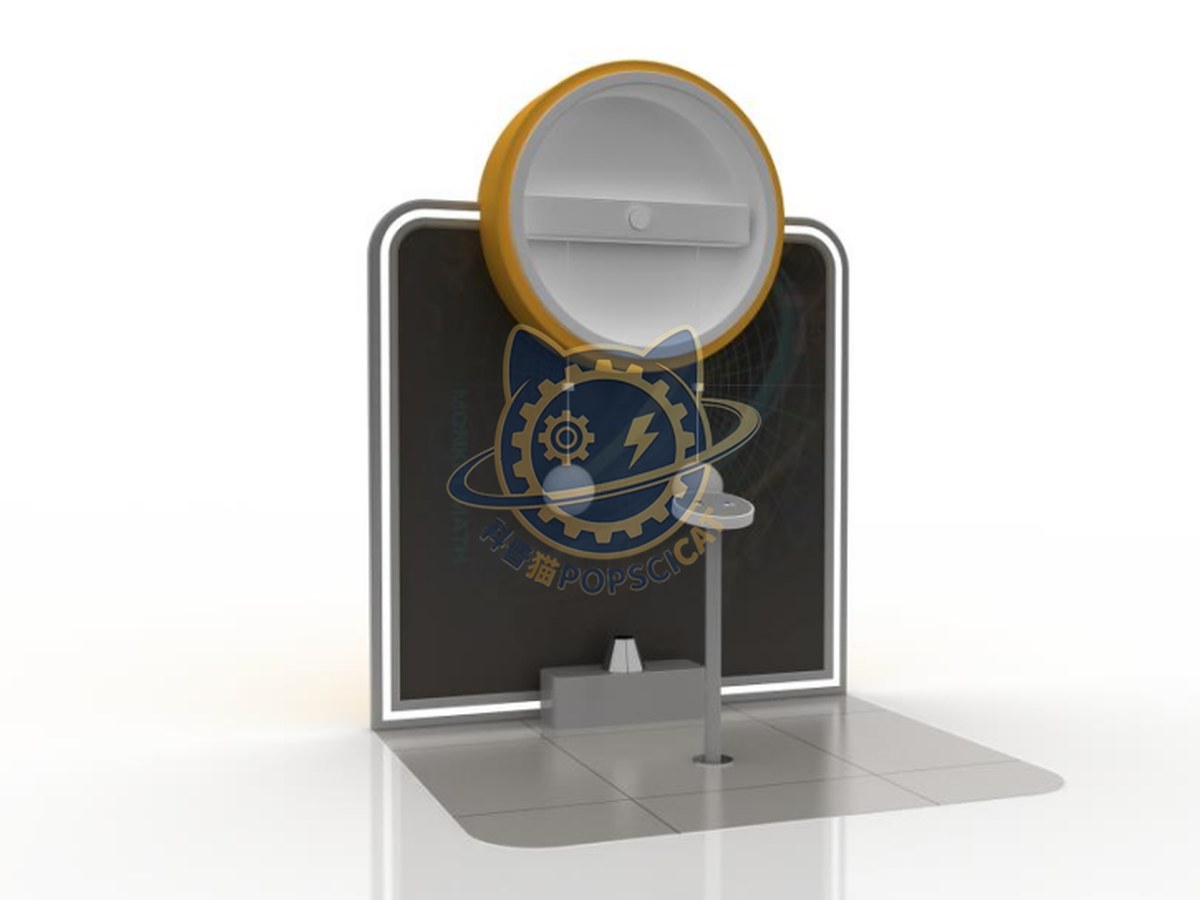
#1 Bernoulli visualization
Basic science · Ages 5+ · 1.6 × 1 × 2.1 m
What it teaches
That air is a fluid with pressure, and that fast-moving air holds less pressure than slow-moving air. The visitor sees a ball hanging in mid-air, apparently defying gravity, and the explanation is a single sentence they can carry away.
How it works
A blower pushes a column of air up through a nozzle. The ball sits in the stream, and the low-pressure region around it keeps the ball centred instead of letting it fall off the edge. Tilt the nozzle and the ball follows the new direction; add a second ball and the two dance around each other without touching.
Age and setting
Playable from about five, because the cause and the effect are both visible within a second. The physics explanation lands at ten and above. It works in a classroom, in a science centre gallery and in a shopping-centre atrium, which is unusual — most units are only good in one of those.
The reason it stays on a floor: there is exactly one moving part, the ball is the only consumable, and the mechanism is behind a panel. A unit that needs no adjustment for a year is worth more to a small museum than a cleverer unit that needs a technician every month.
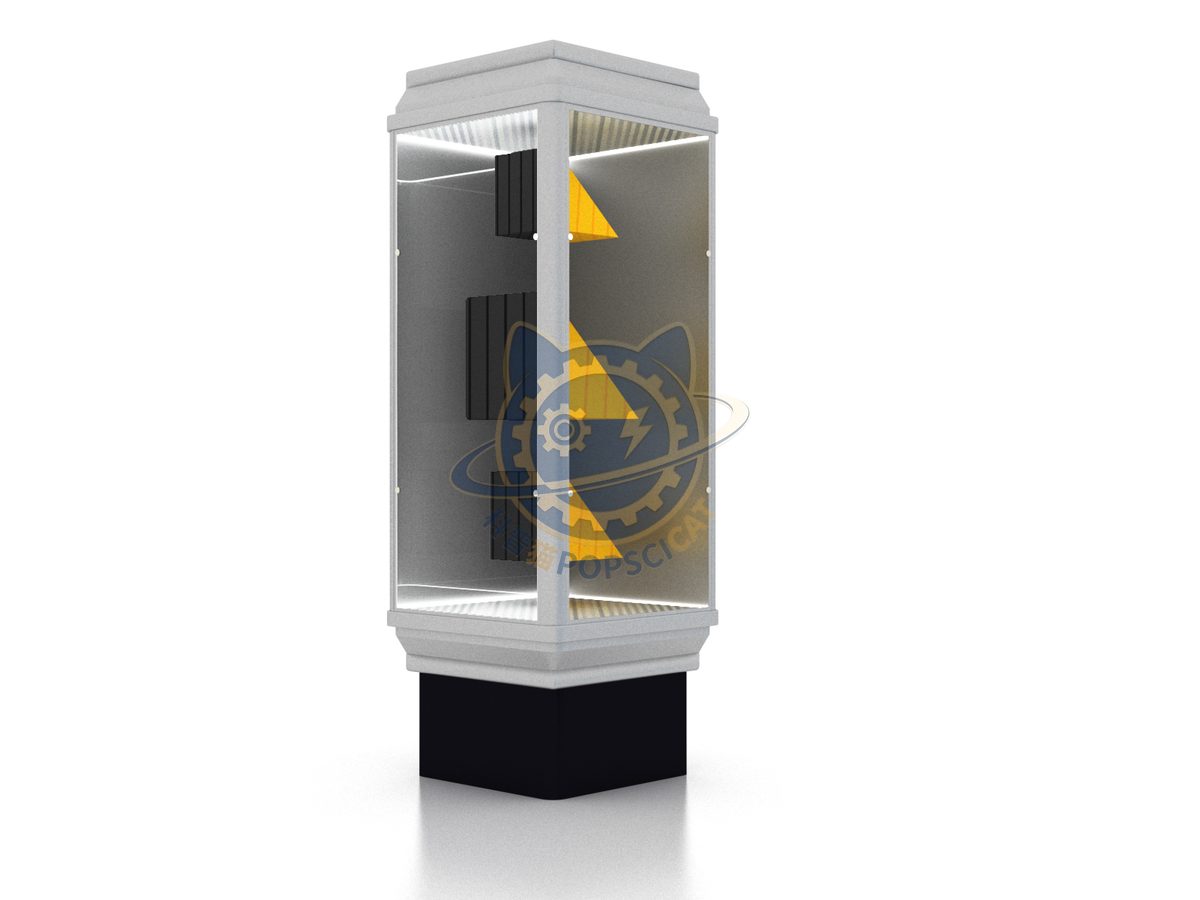
#2 Infinity mirror box
Basic science · Ages 3+ · Custom size
What it teaches
Repeated reflection, and the way a half-silvered mirror can make a shallow box look like a corridor. For older visitors it is the cleanest demonstration of an optical cavity we can build.
How it works
Two mirrors face each other, one fully reflective and one half-silvered. An LED ring sits between them, and each bounce produces another image, receding inwards. Because the half-mirror lets some light out at every bounce, the tunnel fades instead of becoming a solid wall of colour.
Age and setting
Children use it as a visual effect from the age of three, which is exactly why it earns its place: on a family floor you need units that hold a pre-reader for a minute while a parent reads the panel. The optical explanation belongs at twelve and above.
What wears out is the surface, not the electronics. Exposed glass in a public gallery gets scratched, so we specify coated acrylic and design the frame so the panel can be swapped without dismantling the box.
#3 Rolling ball maze
Children's discovery · Ages 4–10 · 4.3 × 0.66 × 3.5 m
What it teaches
Gravity, slope, momentum and the beginnings of path planning — plus the social skill of handing the ball to the next child instead of keeping it.
How it works
A wall-mounted track with gates, turntables and switches. Two visitors can change the route while a third sends a ball down it, so the result is never quite the same twice. The whole system is mechanical: no power, no sensors, nothing to update.
Age and setting
Four to ten is the sweet spot, but the height matters more than the age. A track that starts at 1.2 m is out of reach for a small child standing on the floor; the same track starting at 0.9 m gets used by everyone.
This is the highest-wear unit on the list and the one we are asked to rebuild most often after five or six years. Balls go missing, gates get bent, brackets work loose. It stays popular because the maintenance is obvious and cheap — any technician can see what is wrong without a manual.
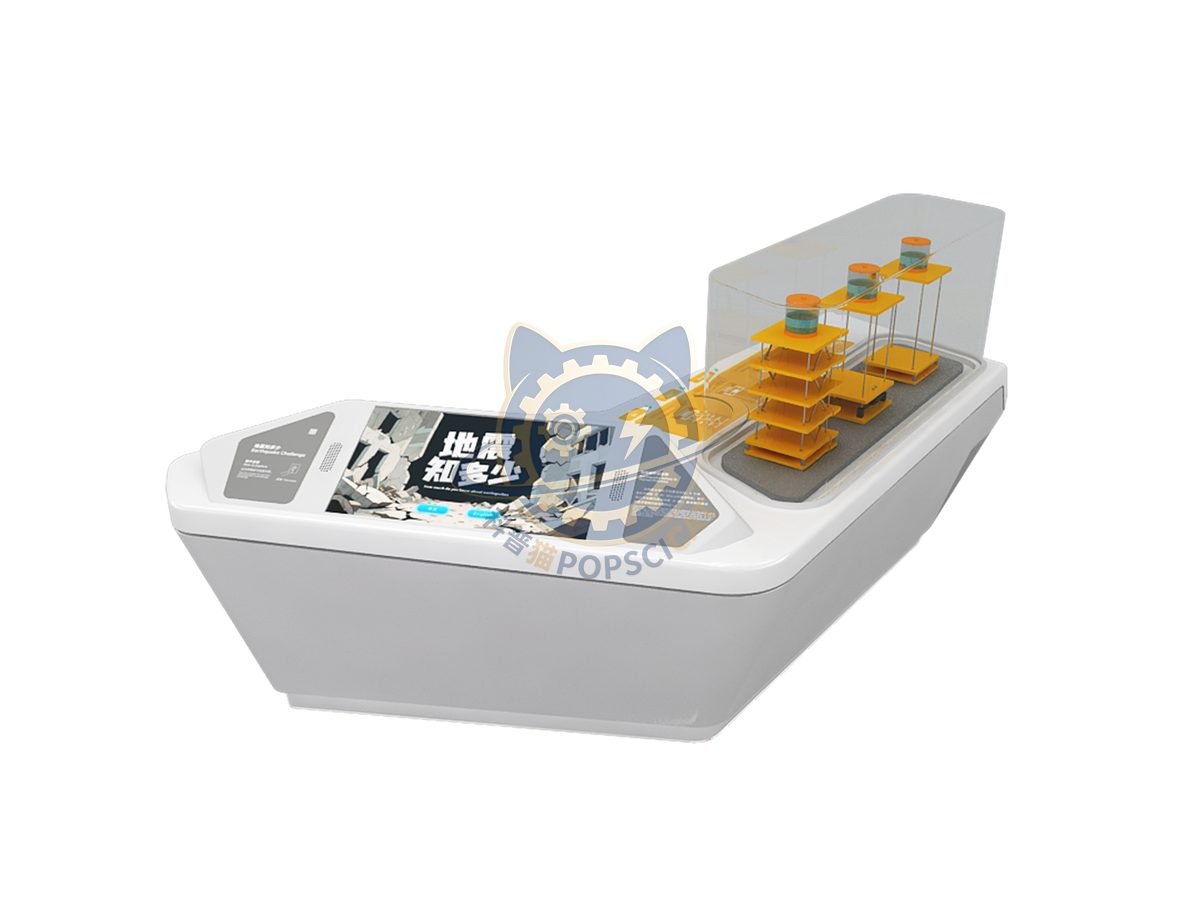
#4 Earthquake simulator
Earth science · Ages 8+ · Custom size
What it teaches
That an earthquake is a wave, that buildings respond differently to different frequencies, and that "earthquake-proof" is a set of engineering choices rather than a single product.
How it works
A platform moves on a controlled horizontal drive while the visitor builds a tower from blocks on top of it. Turn the frequency up and the tower starts to sway; change the bracing pattern and it survives a setting that destroyed the previous attempt.
Age and setting
Eight and up, and it is one of the few units that reliably holds a teenager. It also works as a facilitated activity, which is how most science centres actually run it — a staff member sets the challenge, a group builds, everyone compares results.
The engineering risk here is not the electronics but the fasteners. A platform that shakes thousands of times a week will loosen anything that is not positively locked, so the drive mounts are specified with thread-locking and a torque value in the manual, not "tighten as needed".
#5 Mechanical solar system
Aerospace and astronomy · Ages 6+ · 9.5 × 6 × 2.7 m
What it teaches
Relative orbital period, the difference between rotation and revolution, and — if the model is built to scale in time rather than distance — why the outer planets seem to crawl.
How it works
A single motor drives a gear train that turns eight planets at proportional rates. It is deliberately mechanical rather than projected: the visitor turns a handle or presses a button, and the movement is physical and slow enough to follow with a finger.
Age and setting
Six and up for the movement, ten and up for the numbers. It is the anchor piece of an astronomy gallery, which means it is usually specified early and then everything else is arranged around it — the opposite of how most exhibits get bought.
Gear trains wear. The design decision that matters is whether a worn gear can be reached and replaced in an hour, or whether the whole arm has to come off the ceiling. We build for the first case, and it is the reason this unit stays on the list while prettier ones drop off.
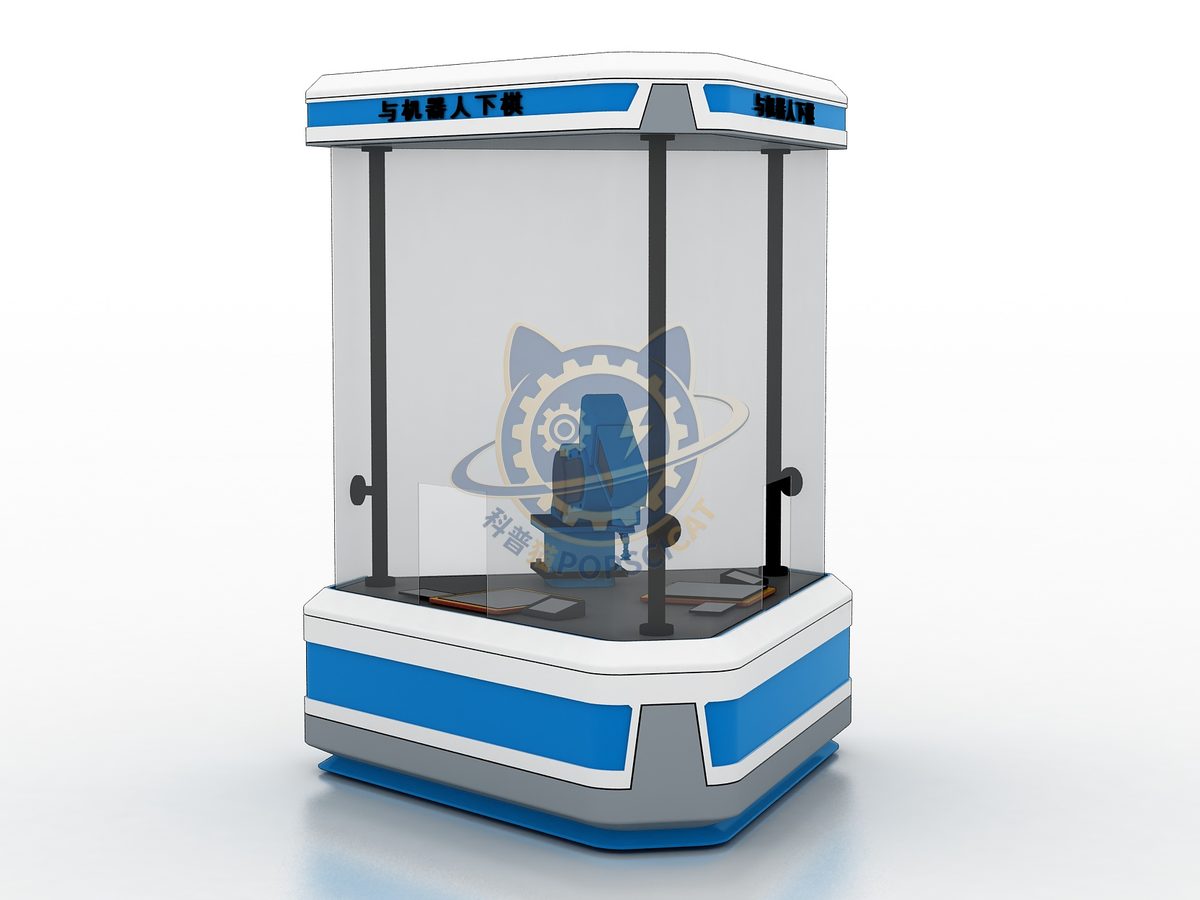
#6 Chess robot
Digital and AI · Ages 8+ · 2.4 × 2 × 2.2 m
What it teaches
That a machine can evaluate positions without understanding the game, and that the interesting question is not "can it win" but "how does it choose".
How it works
A camera reads the board, software picks a move, and an arm lifts the piece. The physical loop is what makes it work in a gallery: visitors watch something happen in the real world, not on a screen, and the queue forms around the arm rather than the monitor.
Age and setting
Eight and up; the strategy conversation belongs at twelve and above. It is also the most requested unit for lobbies and showrooms, where the audience is adults with five minutes to spare.
Be honest about the maintenance: this is the only unit on the list that needs software attention as well as mechanical attention. If a museum has no one who can restart a service or check a network connection, a different exhibit will serve them better. We say so before the order.
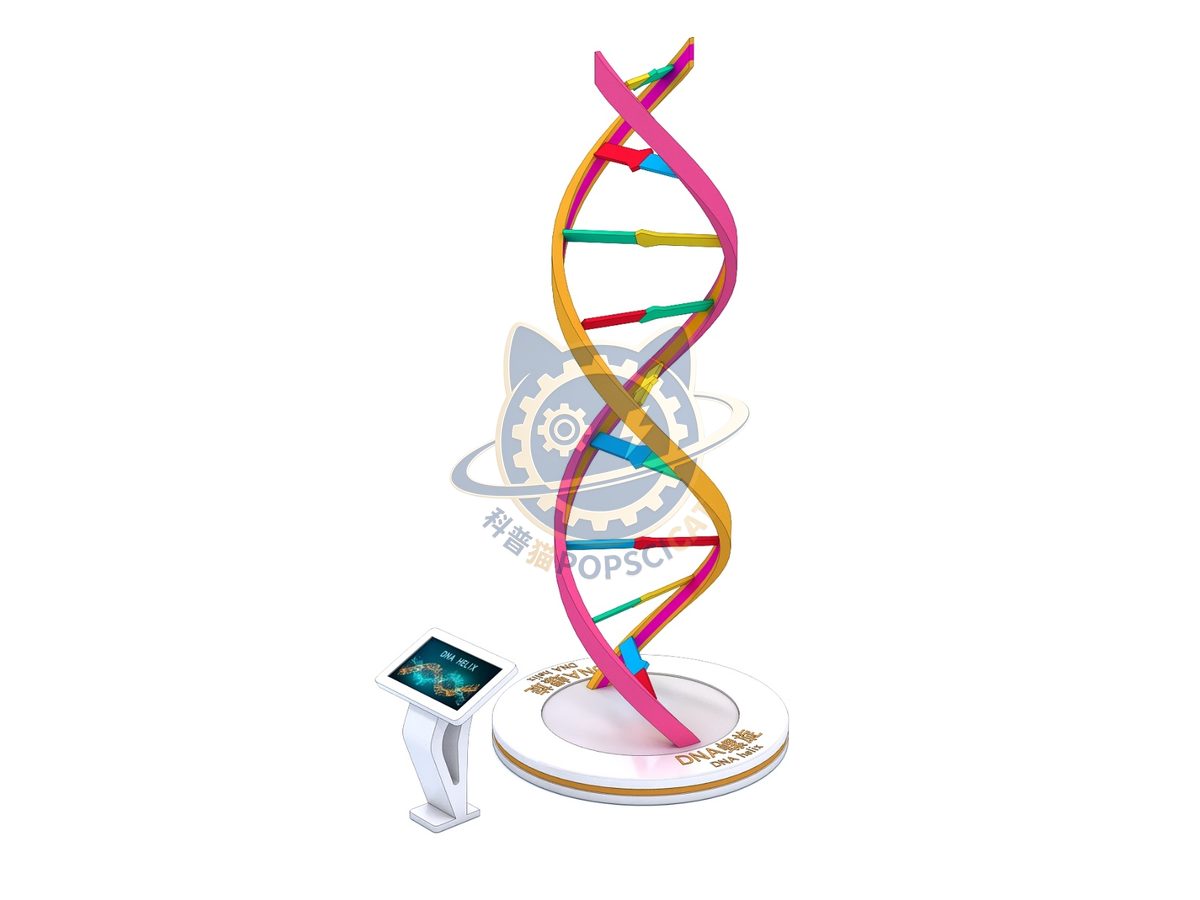
#7 DNA double helix
Life science · Ages 8+ · 2.3 × 1.6 × 3.7 m
What it teaches
That a molecule has a shape, and that the shape is the point. Base pairing, the two strands, the direction of the helix — all of it becomes physical when a visitor can walk around a model two metres tall.
How it works
A rotating double helix built from base-pair rungs, with lighting that runs along the strand and picks out a sequence. The rotation is slow and mechanical, which is what makes it readable: a fast animation on a screen is a pattern, a slowly turning model is a structure.
Age and setting
Eight and up for the shape, twelve and up for base pairing. It is the standard anchor for a life-science gallery, and at a smaller scale it works in a school biology room.
The wear question is the drive. A tall rotating model has a long shaft and a bearing at the top, and that bearing fails first. We specify it as a replaceable module with the access panel at the top of the frame rather than hidden behind the plinth.
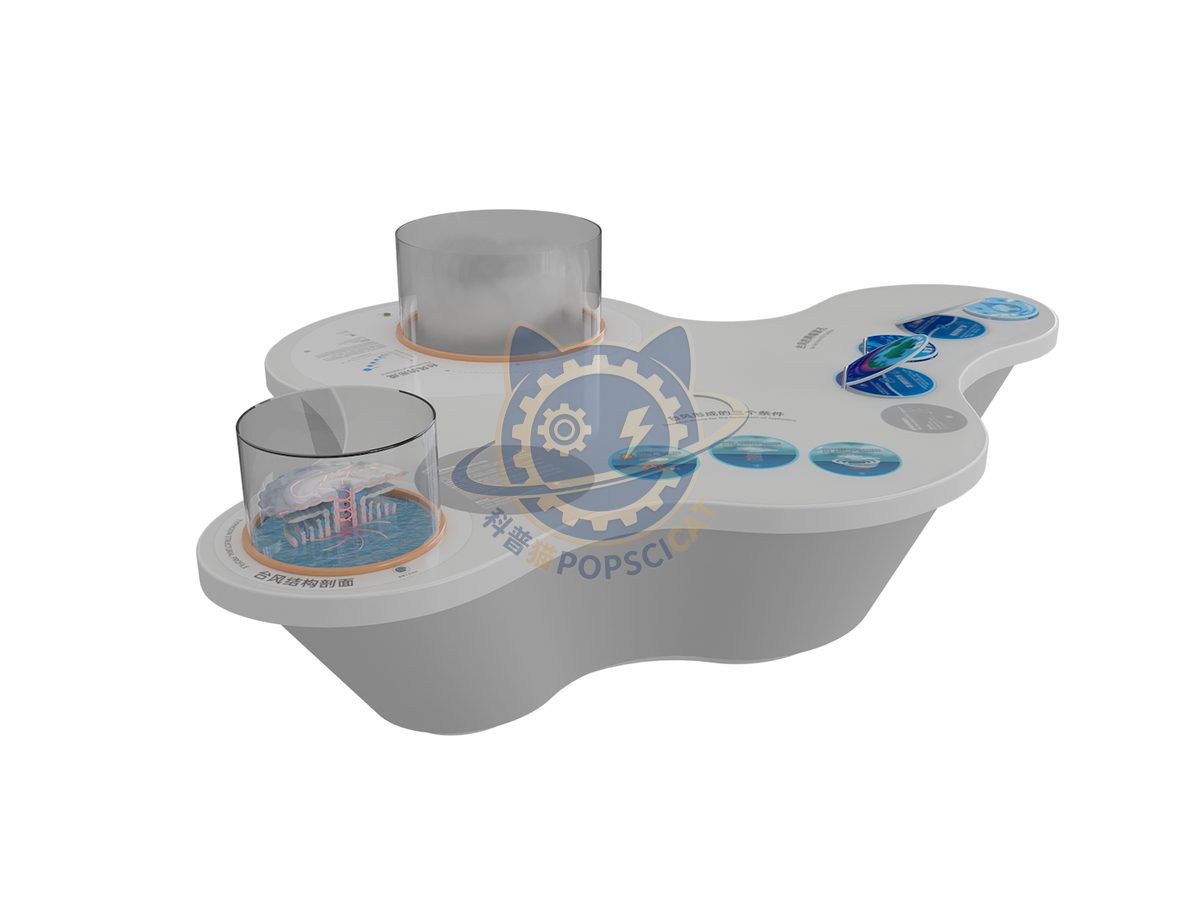
#8 Typhoon cross-section
Earth science · Ages 8+ · Custom size
What it teaches
The structure of a tropical cyclone: the eye, the eyewall, the spiral bands, and why the calm centre exists at all.
How it works
A cut-away model with airflow and mist to show the circulation, with the intensification stages selectable by the visitor. The physical section is what makes it teachable — a flat diagram of a typhoon is a weather map, a cut model is a machine.
Age and setting
Eight and up. It is the strongest single unit we make for regions where typhoons are part of life rather than a news item, which is why it appears so often in Southeast Asian projects.
Water mist means water treatment. Scale, filtration and drainage have to be designed at the same time as the model, or the unit becomes a cleaning problem within a year. This is the most common mistake we are asked to fix on other people's typhoon exhibits.
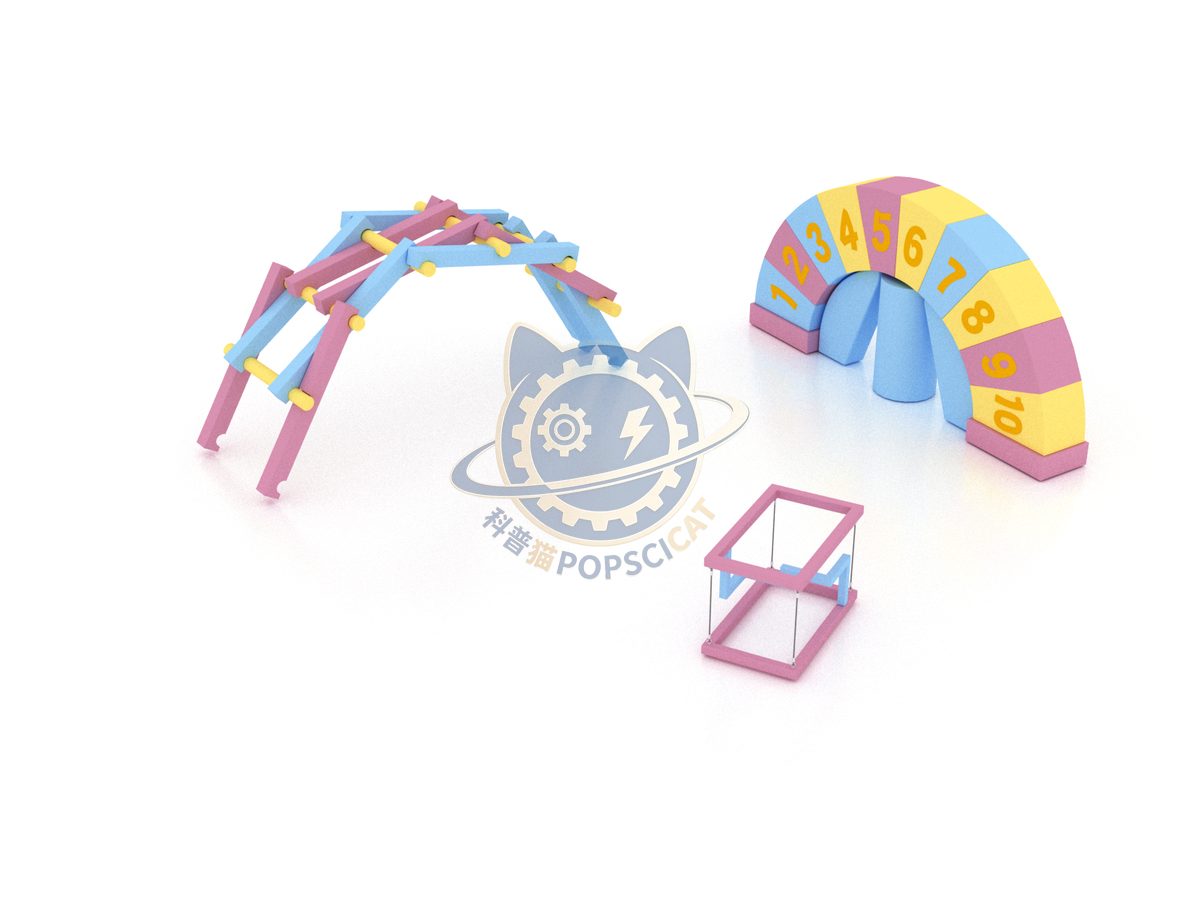
#9 Bridge building challenge
Engineering · Ages 10+ · Custom size
What it teaches
That engineering is a loop: build, test, fail, change one variable, test again. Also that a structure carries load through a path, and you can see the path if the model is honest about where it bends.
How it works
Visitors assemble a span from a fixed set of members, then load it until it deflects or fails. The load value is displayed, so the next group has a number to beat.
Age and setting
Ten and up, and it is the unit that most reliably turns a gallery visit into twenty minutes of activity. It works without a facilitator because the test rig is the judge — no staff member has to tell a child they failed.
The cost driver is not the rig, it is the parts. Members get lost, bent and taken home. A serious installation stocks spares as consumables and budgets for replacement from day one; a museum that does not will have a broken challenge within a season.
#10 Giant bubble ring
Children's discovery · Ages 3+ · 1.5 × 0.6 × 0.65 m
What it teaches
Surface tension, thin films and the reason a bubble is a sphere — though almost no child will describe it that way. What they learn first is that a material can behave in a way that looks like magic and still be predictable.
How it works
A large ring is lifted out of a soap reservoir on a slow mechanism, drawing a cylindrical film. Air from a fan inflates it into a bubble the size of a person.
Age and setting
Three and up. It is the single best unit we make for holding a very young child's attention, and the one that most often produces a photograph the museum can use.
Two practical notes. Soap is a consumable and the reservoir needs a fill routine the cleaning staff can follow without a technician. And the floor around it will be wet, so slip resistance is a specification item, not an afterthought.
What the ten have in common
None of them is the most sophisticated unit in our catalogue. What they share is that a visitor can start using one without instruction, and a technician can fix one without a specialist.
That combination is what repeat orders are made of. A museum that buys a spectacular custom centrepiece and eight units like these will usually end up with a floor that works; a museum that buys ten centrepieces often ends up with a floor that photographs well and needs a full-time engineer.
| Unit | Subject | Age | Main wear item |
|---|
| Bernoulli visualization | Physics | 5+ | Ball |
| Infinity mirror box | Light | 3+ | Front panel |
| Rolling ball maze | Mechanics | 4–10 | Balls, gates |
| Earthquake simulator | Earth science | 8+ | Drive fasteners |
| Mechanical solar system | Astronomy | 6+ | Gear train |
| Chess robot | Digital | 8+ | Arm, software |
| DNA double helix | Life science | 8+ | Top bearing |
| Typhoon cross-section | Earth science | 8+ | Mist system |
| Bridge building challenge | Engineering | 10+ | Member set |
| Giant bubble ring | Early years | 3+ | Soap |
Choosing for your own floor
If you are planning a STEM floor, the useful order of decisions is: age band first, weekly opening hours second, floor area third, and budget structure last. Buying the list above in order is not a plan; buying four of them that fit your age band is.
We keep specifications, sizes and spare-part lists for every unit in the catalogue, and we will mark up your layout with what we make and what we would change. If you send a floor plan, the reply includes a unit list and a budget range rather than a brochure.
About this article
Written by our engineering and sales team from live project work, not from a survey. Figures describe our own projects and are indicative; they are not a quotation. Sizes, ages and specifications refer to standard models and change with custom work.