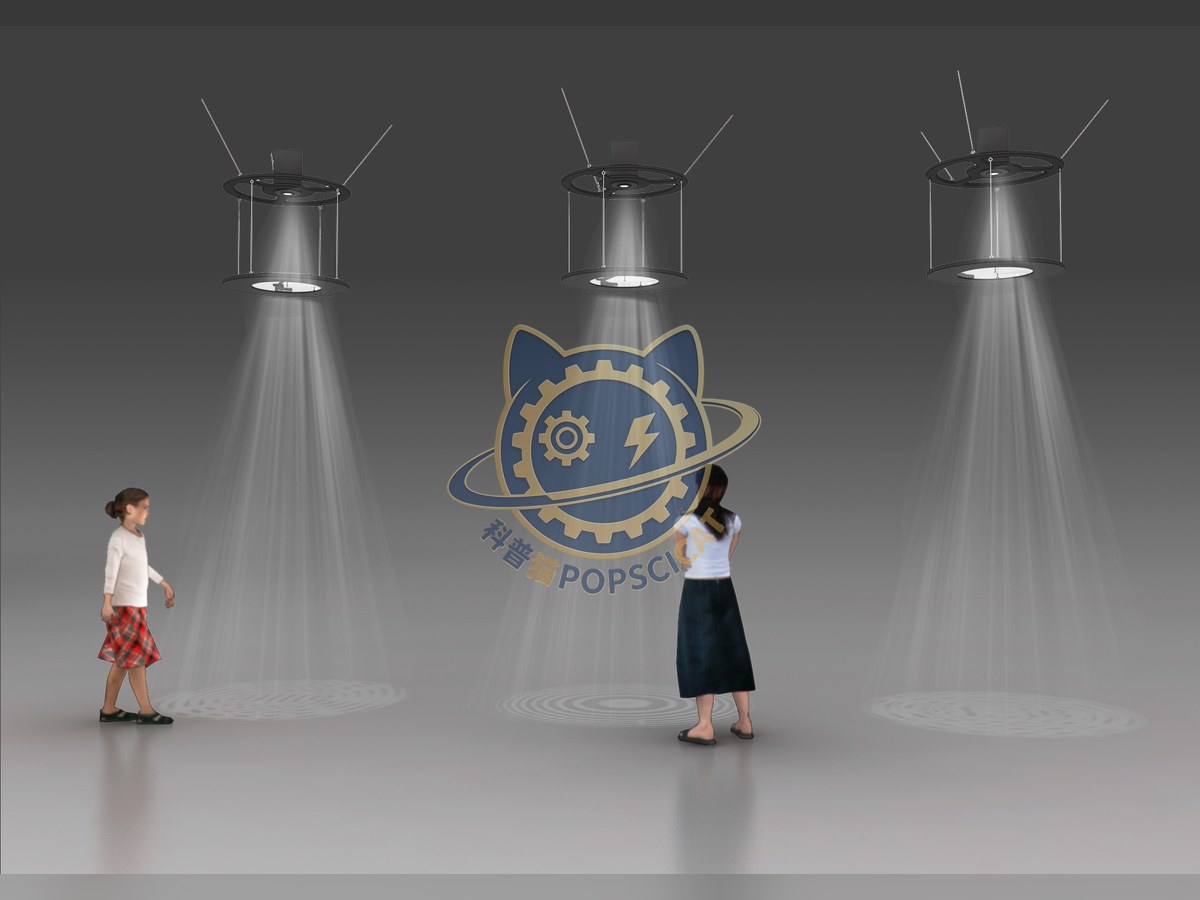
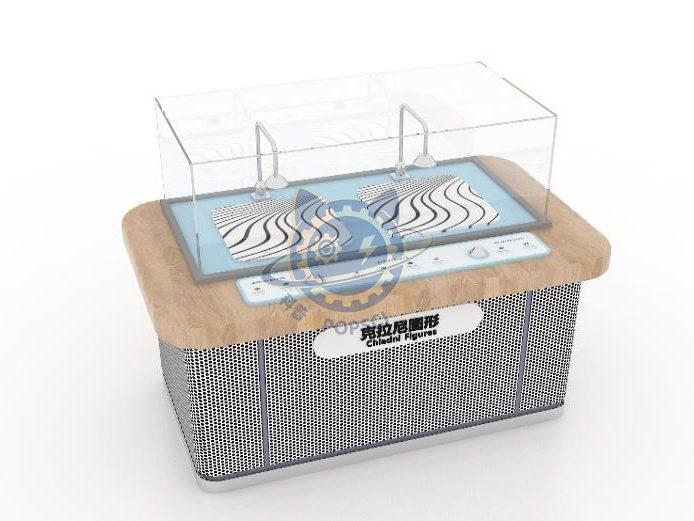
In this area, we are clearly standing on the ground. Why are there ripples? The secret lies right above our heads. The "Water Ripples" exhibit consists of a circular, transparent glass water basin suspended in the air and a mechanical device used to generate water ripples. The glass water tray is filled with silicone oil. The water dropper that generates the water waves is automatically controlled by the system. It continuously taps the silicone oil to create single-tap waves, double-tap interference waves, and diffraction waves, respectively. The ripples are projected onto the floor through the spotlight at the top. When we approach the sensor's detection range, the demonstration will start automatically. By observing the various wave patterns on the floor, we can learn about the phenomena of wave interference and diffraction. "Wave interference" refers to the superposition of two waves with the same frequency, which causes the vibration to intensify in some areas and weaken in others, with the areas of intensified vibration and weakened vibration being separated from each other. The pattern formed by wave interference is called an interference pattern. A necessary condition for interference to occur is that the frequencies and directions of vibration of the two waves (sources) must be the same and have a fixed phase difference. If the frequencies of the two waves are different or the two wave sources do not have a fixed phase difference, the amplitudes of the individual particles on the waves change over time when they are superimposed on each other. There are no regions where the vibrations are always reinforced or weakened, so no stable interference phenomenon can occur, and no interference pattern can be formed. "Diffraction of waves" refers to the phenomenon where, when waves encounter large obstacles or apertures within large obstacles during their propagation, they bend around the edges of the obstacles or apertures, exhibiting a curved path and diffracting behind the edges of the obstacles or apertures. This phenomenon is called diffraction of waves. However, the conditions for its occurrence are relatively stringent. Obvious diffraction phenomena can only be observed when the width of the slits or holes, or the size of the obstacles, is similar to or smaller than the wavelength. Relative to the wavelength, the larger the linear dimension of the obstacle, the less pronounced the diffraction phenomenon, and the smaller the linear dimension of the obstacle, the more pronounced the diffraction phenomenon. It is built for unsupervised public use: surfaces are robust and wipe-clean, there are no loose parts, and the interface works without instruction, so a child of about six can operate it on a busy floor.