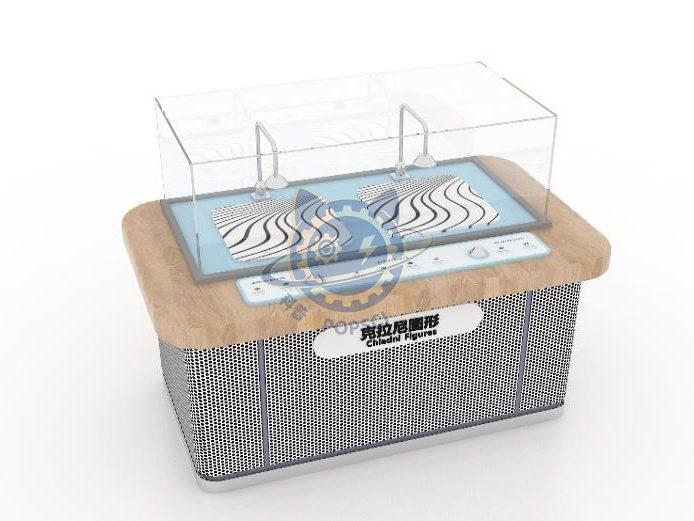
I. Purpose of the Exhibit This exhibit uses mechanical interaction to demonstrate the principles and knowledge related to chaotic phenomena, Gaussian distribution, and probability. II. Scientific Principles Chaos arises when objects continuously replicate the motion state of the previous phase according to a certain rule, resulting in unpredictable random effects. The saying "A miss by an inch is a miss by a mile" is the best description of this phenomenon. The original state of all things is a collection of seemingly unrelated fragments, but after this chaotic state ends, these inorganic fragments organically converge into a whole. Chaos theory holds that in a chaotic system, even the slightest change in initial conditions, when continuously amplified, can lead to an extremely significant difference in its future state. The chaotic pendulum uses rotational motion to measure the phase space trajectory of the physical pendulum in real time, recording the changes in angular displacement and angular velocity in the phase space during the process of chaos generation. It confirms the sensitivity of chaos to initial conditions and the existence of 3-periodic points in chaos. Chaos theory is a method that combines qualitative thinking with quantitative analysis to explore behaviors in dynamic systems (such as population movement, chemical reactions, weather changes, social behavior, etc.) that cannot be explained and predicted using a single data relationship, but must be explained and predicted using a holistic, continuous data relationship. The normal distribution, also known as the Gaussian distribution, was first derived by A. De Moivre in his derivation of the asymptotic formula for the binomial distribution. C. F. Gauss derived it from another perspective while studying measurement errors. P. S. Laplace and Gauss studied its properties. It is a probability distribution that is very important in fields such as mathematics, physics, and engineering, and has a significant impact on many aspects of statistics. The normal curve is bell-shaped, with low ends and a high middle, and is symmetrical on both sides. Because its curve is bell-shaped, it is often referred to as the bell curve. Probability distribution, or simply distribution, is a concept in probability theory. For ease of use, probability distributions take different forms depending on the type of random variable to which they belong. Sometimes, mainly for the convenience of theoretical research, a more general form is also needed to express the probability laws of the values taken by random variables and random vectors. The table lists the probability distributions commonly used in probability theory and mathematical statistics (including discrete distributions and continuous distributions that take integer values), their names and standard notations, the expressions of distribution columns or density functions, and graphs of some density functions, the corresponding mathematical expectations and variances (if they exist), and the corresponding characteristic functions. III. Function Description (Technical Proposal) The exhibit uses an interactive display method, allowing visitors to choose different exhibits to experience. It aims to introduce visitors to the principles and knowledge related to chaotic phenomena, Gaussian distribution, and probability. IV. Operating Instructions (1) Gently turn the handle and observe the trajectory of the pendulum arm. (2) Slowly rotate the turntable so that the small balls continuously fall within the triangular frame, and listen to the sound of the small balls colliding with the steel needles. (3) Rotate the turntable so that the balls fall from the tip of the triangle and observe the distribution characteristics of the balls at the bottom. V. Overall 3D Color Rendering of the Exhibit (The attached drawings are in CAD 2010 and 3D MAX 2012 formats). It is built for unsupervised public use: surfaces are robust and wipe-clean, there are no loose parts, and the interface works without instruction, so a child of about six can operate it on a busy floor.