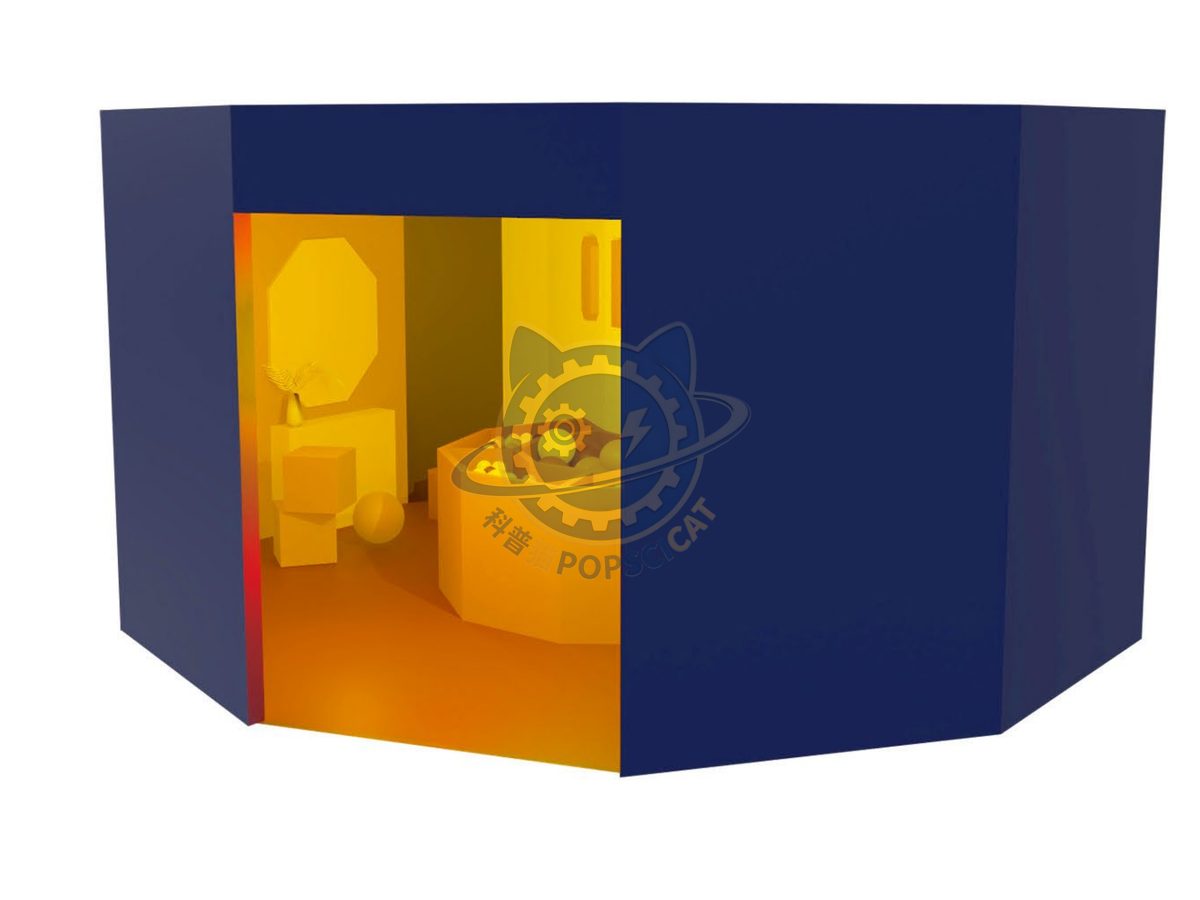
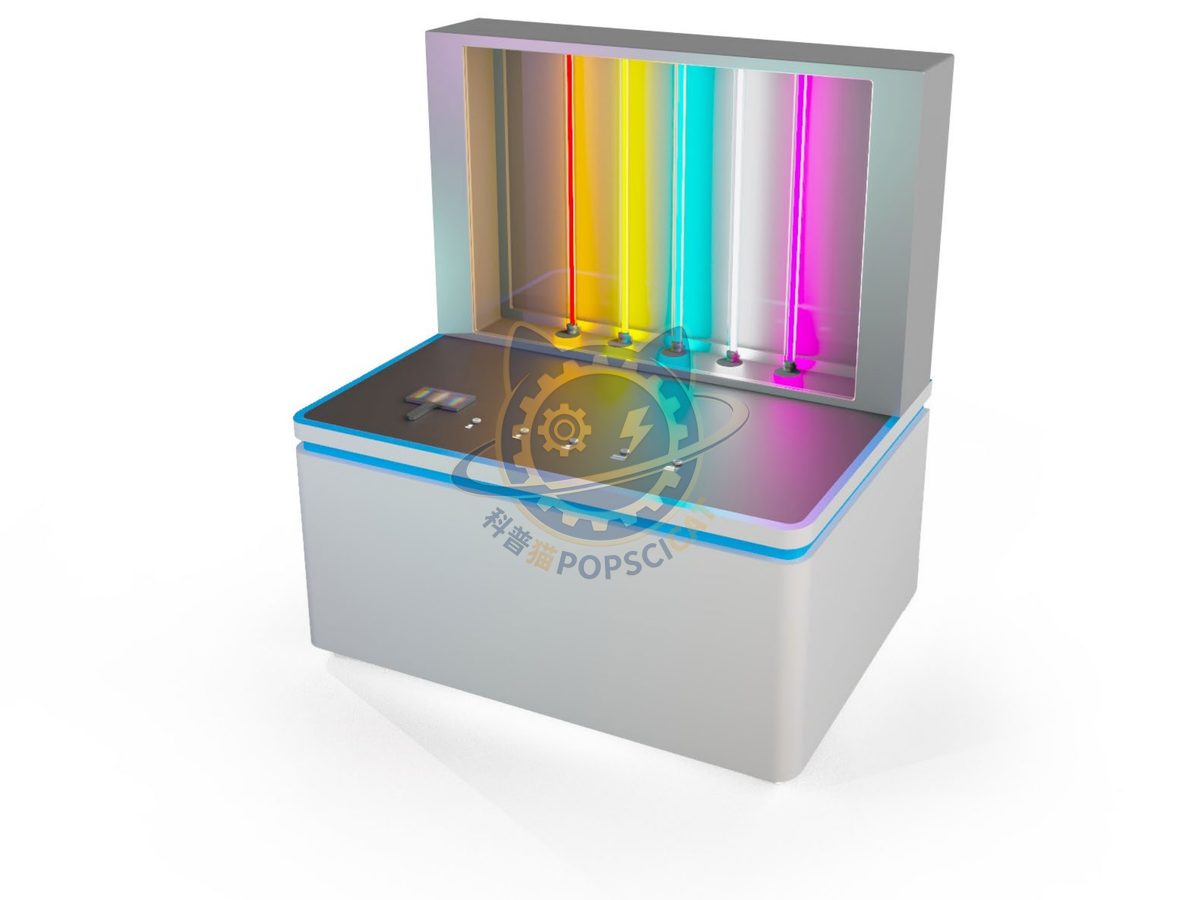
I. Purpose of the Exhibit This exhibit demonstrates the principles and applications of fiber-optic transmission through physical displays and electromechanical interactions. II. Scientific Principles Optical fiber is an abbreviation for optical waveguide fiber. It is a fiber made of glass or plastic that can be used as a light-conducting tool. Its transmission principle is total internal reflection of light. Former President of The Chinese University of Hong Kong, Charles K. Kao, and George A. Hockham were the first to propose the idea that optical fibers could be used for communication transmission, and Charles K. Kao was awarded the 2009 Nobel Prize in Physics for this. The fine optical fiber is encapsulated in a plastic sheath, allowing it to bend without breaking. Typically, the transmitting device at one end of the optical fiber uses a light-emitting diode or a laser beam to transmit light pulses into the optical fiber, while the receiving device at the other end of the optical fiber uses a photosensitive element to detect the pulses. In everyday life, optical fibers are used for long-distance information transmission because the loss of light transmission in optical fibers is much lower than the loss of electrical transmission in electrical wires. The terms "optical fiber" and "optical cable" are often confused. Most optical fibers must be covered with several layers of protective structures before use, and the covered cables are called optical fiber cables. The protective layer and insulating layer on the outer layer of the optical fiber can prevent damage to the optical fiber from the surrounding environment, such as water, fire, electric shock, etc. Optical fiber cables are composed of: cable sheath, aramid yarn, buffer layer, and optical fiber. Fiber optic cables are similar to coaxial cables, except that they do not have a braided shield. At the center is a glass core through which light propagates. Optical fibers are composed of two layers of glass with different refractive indices. The inner layer is the optical core, with a diameter ranging from a few micrometers to several tens of micrometers, while the outer layer has a diameter of 0.1 to 0.2 mm. Generally, the refractive index of the inner core glass is 1% higher than that of the outer glass. According to the principles of light refraction and total internal reflection, when the angle at which light strikes the interface between the inner core and the outer layer exceeds the critical angle for total internal reflection, the light cannot pass through the interface and is totally reflected. Advantages of fiber-optic transmission: 1. Wide bandwidth; 2. Low loss; 3. Lightweight – the optical fiber is very thin, made of glass fiber with a low specific gravity, giving it the characteristics of a small diameter and light weight, making installation very convenient; 4. Strong anti-interference capability; 5. High fidelity; 6. Reliable operating performance. III. Functional Description (Technical Solution) Fiber-optic communication uses light as the carrier and applies the principle of total internal reflection of light to transmit information over long distances with almost no loss. A single optical fiber transmits a single point of light. The signal in the optical fiber can be blocked. When you interrupt the signal with your hand, the image on the screen disappears. IV. Operating Instructions (1) Press the Start button to turn on the spotlight; (2) Wave your hand over the light-emitting surface and observe the changes on the upper part of the light-emitting surface; (3) Observe the fiber-optic transmission process through the unobstructed area. 5. Overall 3D color renderings of the exhibits (the attached drawings are in CAD 2010 format and 3D MAX 2012 format). It is built for unsupervised public use: surfaces are robust and wipe-clean, there are no loose parts, and the interface works without instruction, so a child of about six can operate it on a busy floor.