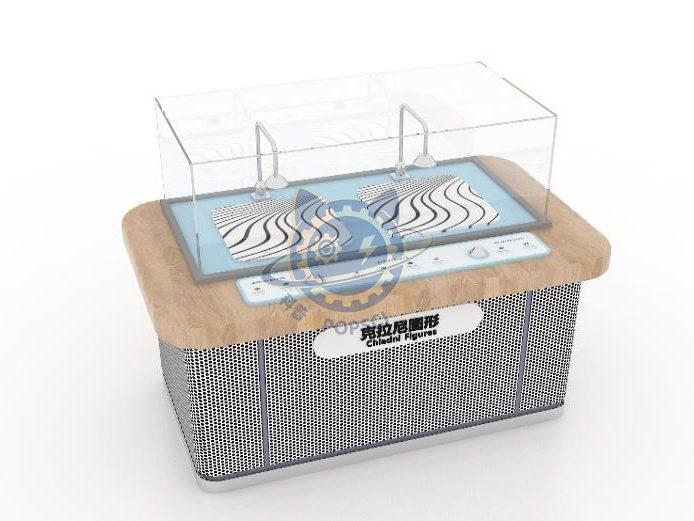
I. Purpose of the Demonstration To demonstrate the interesting phenomenon of iron particles "dancing to the music" and to show the magnetic field of a magnet and the shape of its magnetic field lines. II. Scientific Principle Magnetic field lines, also known as magnetic induction lines, are curves drawn in a magnetic field (represented by dashed or solid lines) such that the direction of the tangent at any point on the curve is the same as the direction of the magnetic field at that point (and the magnetic field lines do not intersect each other). These curves are called magnetic field lines. Magnetic field lines are closed curves. The direction in which the north pole of a small magnetic needle points is defined as the direction of the magnetic field lines. The magnetic field lines around a magnet all emerge from the north pole and enter the south pole. Inside the magnet, the magnetic field lines run from the south pole to the north pole. Physical characteristics of magnetic field lines: 1. Magnetic field lines are closed curves. The magnetic field lines outside the magnet emerge from the north pole and return to the south pole of the magnet, while inside, they run from the south pole to the north pole. The magnetic field lines outside the magnet are curved, whereas those inside are straight. 2. Each magnetic field line is a closed curve, and any two magnetic field lines do not intersect. 3. The direction of the tangent at each point on the magnetic field line indicates the direction of the magnetic field at that point. 4. The density of magnetic field lines indicates the magnitude of the magnetic flux density. 5. The direction of the Earth's magnetic field lines is the same as the direction of the magnetic field lines of a bar magnet. Special Note: 1. Magnetic field lines do not objectively exist in a magnetic field; they are hypothetical constructs created by humans to facilitate the study of magnetic phenomena. 2. The difference between electric field lines and magnetic field lines: Electric field lines are open, while magnetic field lines are closed curves. III. Functional Description (Technical Solution) The exhibit features a rectangular array composed of multiple "iron pellet spheres." Each "iron bead" demonstrates the magical art of electromagnets by combining permanent magnets with electromagnets to attract, repel, and change the magnetic force acting on the "iron bead," causing the iron bead to "dance to the music." IV. Operating Instructions Select different music buttons to watch the iron particles "dance.". It is built for unsupervised public use: surfaces are robust and wipe-clean, there are no loose parts, and the interface works without instruction, so a child of about six can operate it on a busy floor.