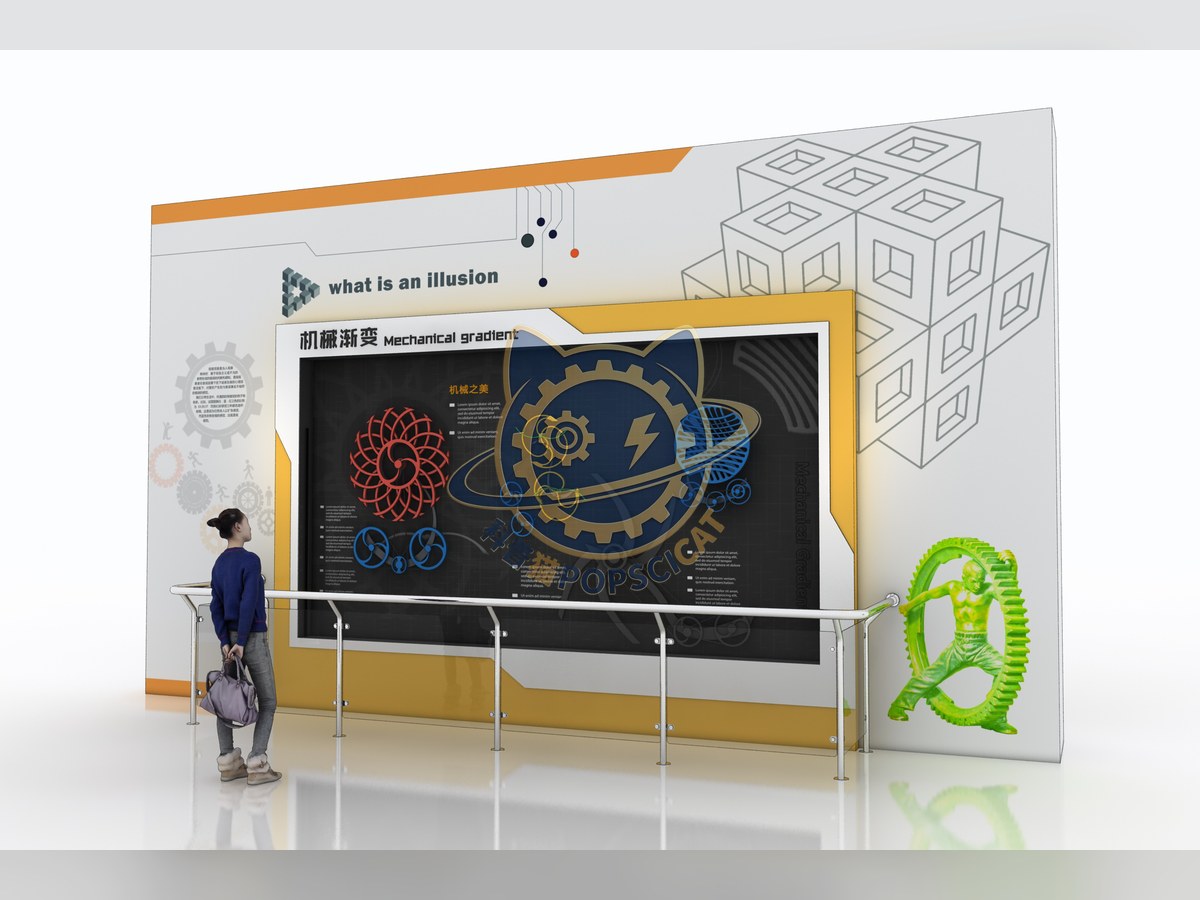
I. Purpose of the Exhibit The exhibit uses a motor to drive the rotation of a rotating mechanism, allowing visitors to observe the beautiful, visually gradient patterns formed by the rotating mechanism. II. Scientific Principle Gears are mechanical components with teeth on their edges that can continuously mesh with each other, allowing them to change the magnitude and direction of force. The shape of the gear teeth can minimize wear, vibration, and noise while achieving the highest transmission efficiency. Planetary gear trains, spatial linkage mechanisms, intermittent Geneva mechanisms, universal joint mechanisms, iris mechanisms, robotic arms, non-circular gear mechanisms, and crank-weighted mechanisms, among others, are organically combined to transmit and convert motion. The form of gradation can be seen everywhere in daily life and is a very common visual image. Due to the principle of perspective in painting, objects appear larger when they are closer and smaller when they are farther away. Examples include telephone poles along roadsides, trees, balconies of buildings, and railway sleepers extending into the distance, among many others. Numerous natural phenomena are characterized by gradual changes in form. The meaning of gradation is very broad. In addition to the gradation of forms, there can also be gradation in the order of arrangement. In terms of form, gradation can be seen in shape, size, color, and texture. In terms of arrangement, gradation can be seen in position, direction, skeletal units, and so on. The gradation of shapes can start from one shape and gradually transform into another shape, or from one image to another completely different image. The pace of the gradation can be fast or slow, or it can alternate between fast and slow. Basic gradations can be applied to visual elements such as shape, size, position, direction, and color. In a functional framework, basic shapes are treated tangentially to achieve gradation of the basic shapes. The gradation of the framework is generally a change resulting from altering the position of horizontal or vertical lines, such as the gradation effects of factors like direction, size, position, and width. In the form of a loose gradation, there can be a gradation of the framework as well as a gradation of the basic form. The gradation of the framework is sometimes more important than the gradation of the basic form, and the gradation effect is more pronounced. It is an important element in the composition of gradation. III. Functional Description (Technical Solution) The exhibit consists of three independent rotating mechanisms and electric motors. When participating, visitors can directly approach the exhibit to observe the alternating beautiful visual gradient patterns presented by each independent rotating mechanism during its rotation. From a distance, the colors of the combined squares alternate and change, also creating a sense of lines in both horizontal and vertical directions. When we look at a moving pattern, our brain makes a basic judgment about the information it receives, and this judgment is based on the moving pattern we are looking at. For example, when we look at a wall and the palm of our hand, there is a discrepancy between the actual motion of the objects we are looking at and our brain's perception of them, which gives us the illusion that the wall is rotating and the palm of our hand is twisting. However, our brains are quick to correct themselves, make new judgments, and adapt to the real world. IV. Operating Instructions Watch the rotation process of each independent mechanical mechanism and enjoy the beautiful visual gradient patterns. V. Overall 3D color rendering of the exhibit (the attached drawings are in CAD 2010 and 3D MAX 2012 formats). It is built for unsupervised public use: surfaces are robust and wipe-clean, there are no loose parts, and the interface works without instruction, so a child of about six can operate it on a busy floor.