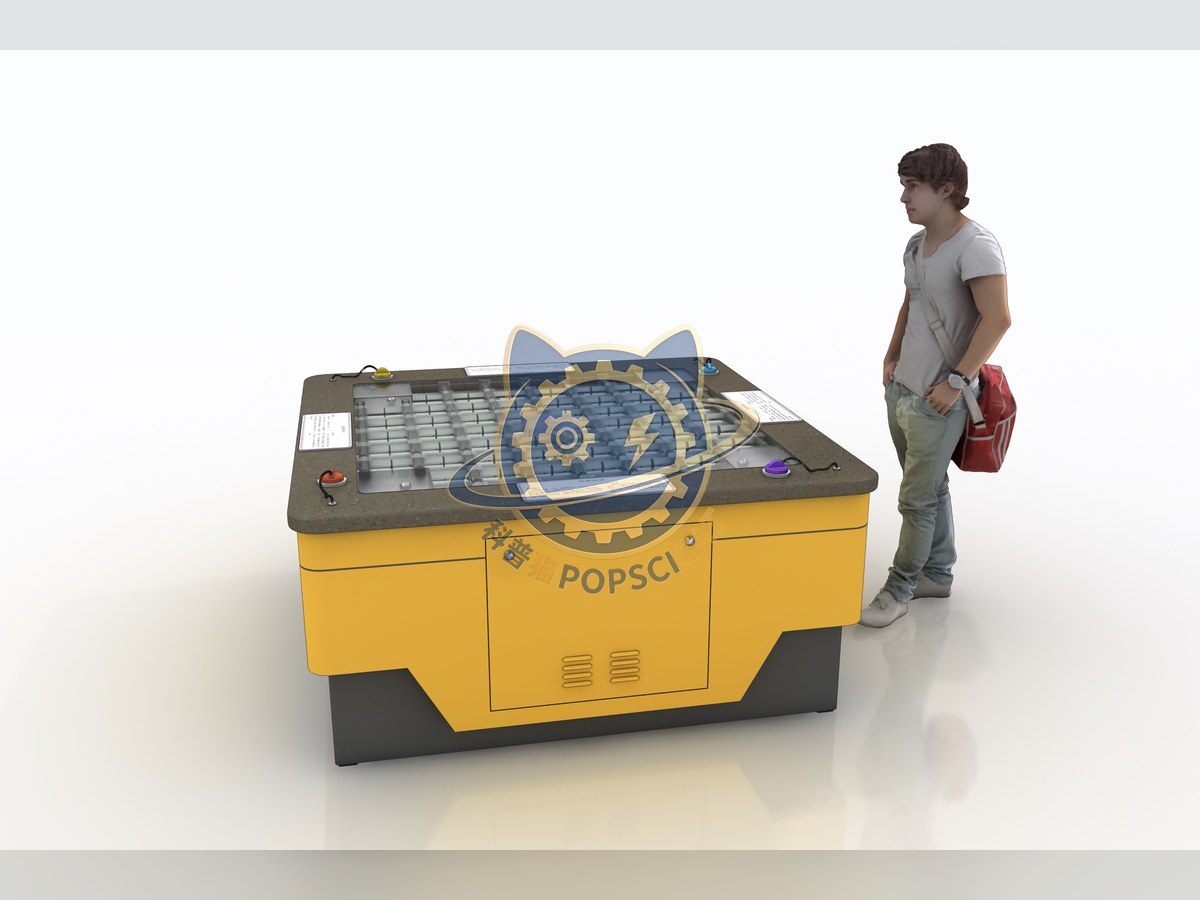
I. Purpose of the Exhibit This exhibit uses interactive games to demonstrate the polarization properties of light and the operating principles of polarizing filters to the audience. II. Scientific Principle The asymmetry of the direction of vibration with respect to the direction of propagation is called polarization, and it is one of the most obvious distinguishing features of transverse waves from other longitudinal waves. The phenomenon in which the spatial distribution of the electric vector vibration of a light wave loses symmetry with respect to the direction of light propagation is called light polarization. Only transverse waves can produce polarization, so the polarization of light is another example of the wave nature of light. In a plane perpendicular to the direction of propagation, there are transverse vibrations in all possible directions, and on average, they have the same amplitude in any direction. Light with such transverse vibrations that are symmetrical to the direction of propagation is called natural light (unpolarized light). Any light whose vibration loses this symmetry is generally referred to as polarized light. Polarizers have the function of blocking and transmitting incident light, allowing either longitudinal or transverse light to pass through while blocking the other. It is a composite material made by laminating a polarizing film, an inner protective film, a pressure-sensitive adhesive layer, and an outer protective film. Two polarizing filters, perpendicular to each other, are placed on the false wall in the exhibit. After passing through a polarizing filter, natural light is transformed into light with a specific direction of vibration. This is because there is a characteristic direction in the polarizing filter, called the polarization direction. The polarizing filter only allows vibrations parallel to the polarization direction to pass through, while filtering out light with vibrations perpendicular to that direction. When light shines on two polarizing filters that are perpendicular to each other, a dark area is formed because the light cannot pass through that area, and it looks like a virtual wall has been formed. That's why we have this polarizing maze in front of us, which combines real and virtual walls. The application of polarizing filters is now becoming increasingly widespread. For example, the brownish-gray glass on the windshield of a car is also a polarizing filter, which prevents direct sunlight from shining into the driver's eyes. Secondly, we can also use polarizers to make 3D glasses, which make the images we see more three-dimensional. A polarizer is also attached to the lens of a camera to reduce reflections. III. Function Description (Technical Solution) Through an interactive game, the exhibit challenges participants to identify the "fake walls" in the maze and use a magnet to guide an iron ball to the center of the maze first. This engaging and entertaining approach demonstrates the working principle of polarizing filters to the audience. 4. Operating Instructions: Use the magnet to attract the ball, allowing it to move along with the magnet within the passage. Guide the ball along the path you have chosen. Compete to see who can move the ball to the center the fastest. It is built for unsupervised public use: surfaces are robust and wipe-clean, there are no loose parts, and the interface works without instruction, so a child of about six can operate it on a busy floor.