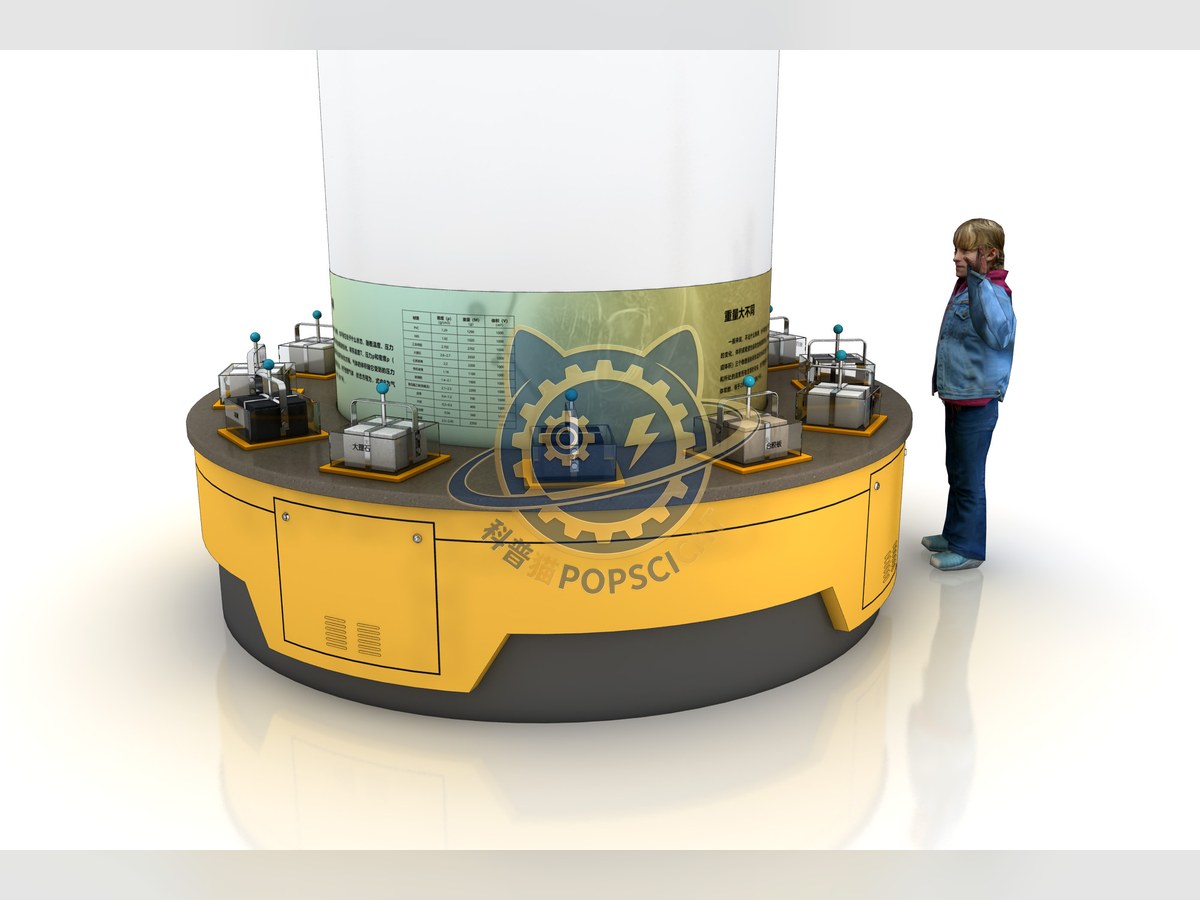
The exhibit in front of us is called "Weight Makes a Big Difference." One day, the ancient Greek philosopher Archimedes was taking a bath at home. When he sat down in the bathtub, he saw the water overflowing and suddenly realized that he could determine the volume of an object by measuring the amount of water displaced by a solid in water. After further experimentation, he realized that he could solve the mystery of the king's crown, so he went to the palace. He placed the crown and an equal weight of pure gold in two basins filled with water. He then compared the amount of water that overflowed from the two basins and found that the basin containing the crown overflowed with more water than the other one. This showed that the volume of the crown was greater than that of pure gold of the same weight, and that the densities were different, thus proving that other metals had been mixed into the crown. The significance of this experiment lies in Archimedes' discovery of the law of buoyancy (Archimedes' principle): The buoyant force exerted on an object immersed in a liquid is equal to the weight of the liquid displaced by the object. This is the well-known method of displacement. We know that the weight of an object = the volume of the object × the density of the object. Density is the ratio of the mass of a substance to its volume, and the density of the same substance is the same under the same conditions. From the formula ρ=m/V, we can derive the formulas m=ρV and V=m/ρ. (ρ is density, m is mass, and V is volume) In this exhibit, we lift different weights to see whether objects of the same volume have the same weight. We also refer to the density table on the wall to understand the factors that affect density. From ρ = m/V, it can be deduced that when different substances have the same volume, the density of the substance is directly proportional to its mass. Also, since G = mg, the weight of an object is directly proportional to its mass. Therefore, when different substances have the same volume, we can directly perceive the difference in their densities by feeling the weight of the objects. (G refers to the weight of the object in question, m refers to the mass of the object. g is the constant for the weight of an object, 9.8 N/kg.). It is built for unsupervised public use: surfaces are robust and wipe-clean, there are no loose parts, and the interface works without instruction, so a child of about six can operate it on a busy floor.